Booking the CMFAS M8 exam: portal, fees and dates
CMFAS M8 booking runs through the SCI portal in about ten minutes. This page covers the day and evening fees, and why booking M8 alone beats CM-CIS.
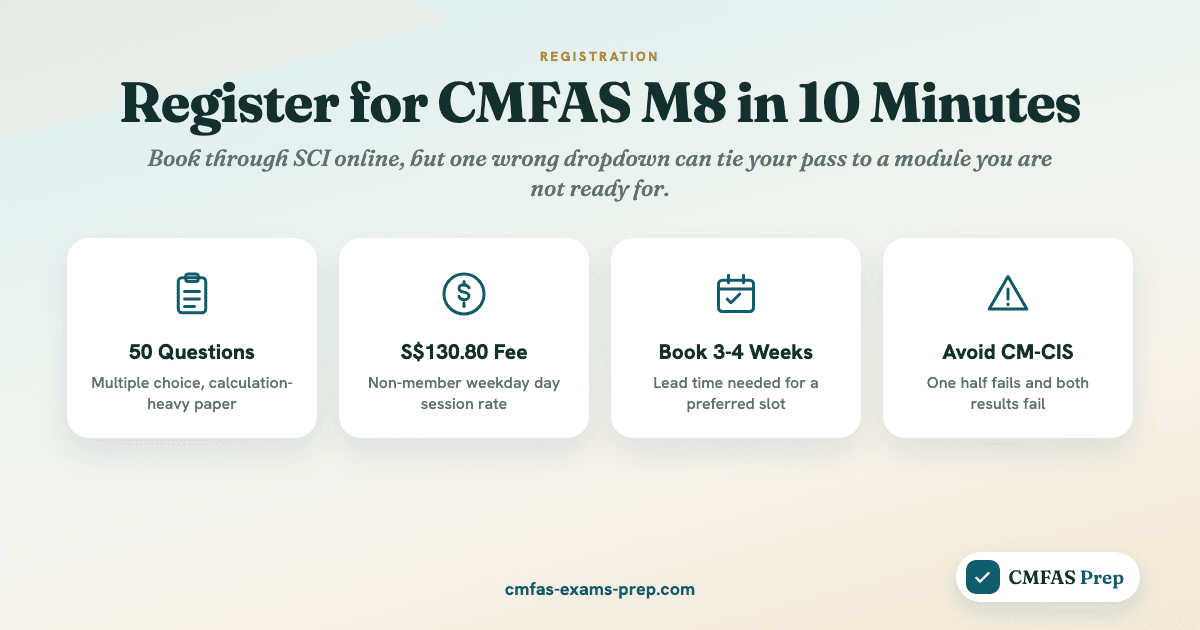
To register for the M8 exam you book a slot through the Singapore College of Insurance (SCI), pay by credit card, and pick the standalone Module 8 code rather than the combined paper. The whole process takes about ten minutes online, but one wrong dropdown choice can tie your pass to a second module you may not be ready for. Here is exactly how to do it in 2026, plus the booking traps that cost candidates time and money.
What you're actually registering for
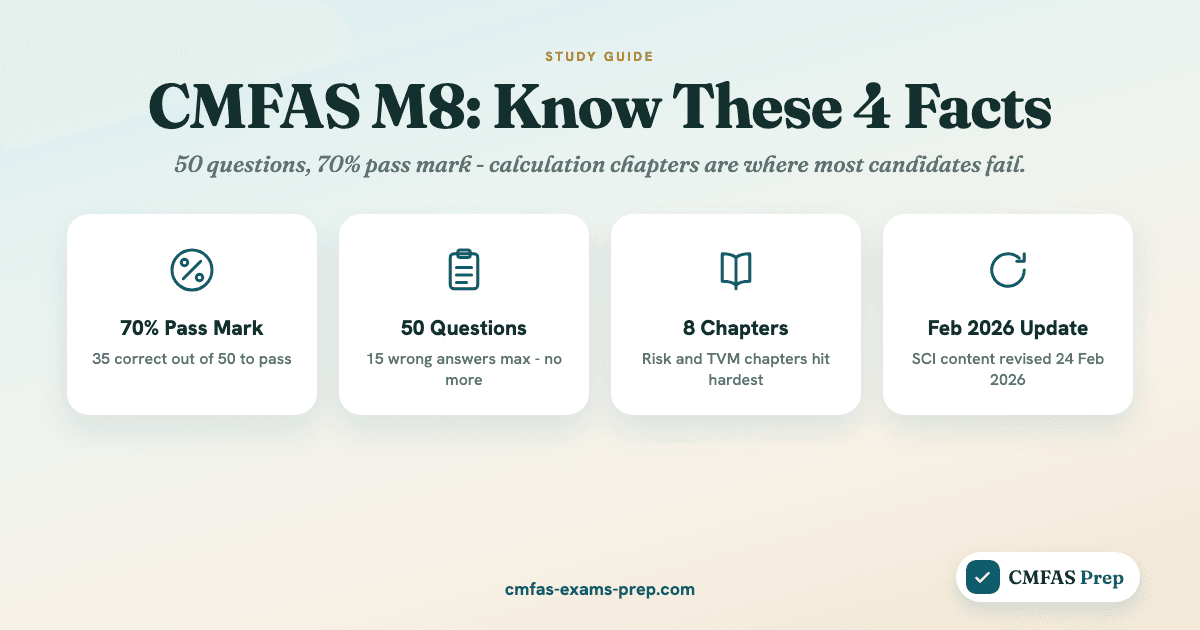
M8 is Module 8: Collective Investment Schemes under the CMFAS framework, run by SCI. It is the paper you need to advise on unit trusts and similar investment products. The exam is 50 multiple-choice questions and leans heavily on the calculation chapters, so the booking is the easy part and the studying is where people come unstuck. Full format details sit in the M8 passing score and exam format guide.
Quick facts before you start:
| Item | Detail |
|---|---|
| Exam body | Singapore College of Insurance (SCI) |
| Module | M8: Collective Investment Schemes |
| Questions | 50 multiple choice |
| Fee (non-member, day) | S$130.80 |
| Fee (non-member, evening/weekend) | S$149.33 |
| Payment | Credit card (VISA or MasterCard) |
| Study text | eBook only, emailed after payment |
| Book ahead | 3 to 4 weeks for a preferred slot |
Decide first: M8 alone or the combined CM-CIS
This decision matters more than anything else in the booking flow, so settle it before you log in.
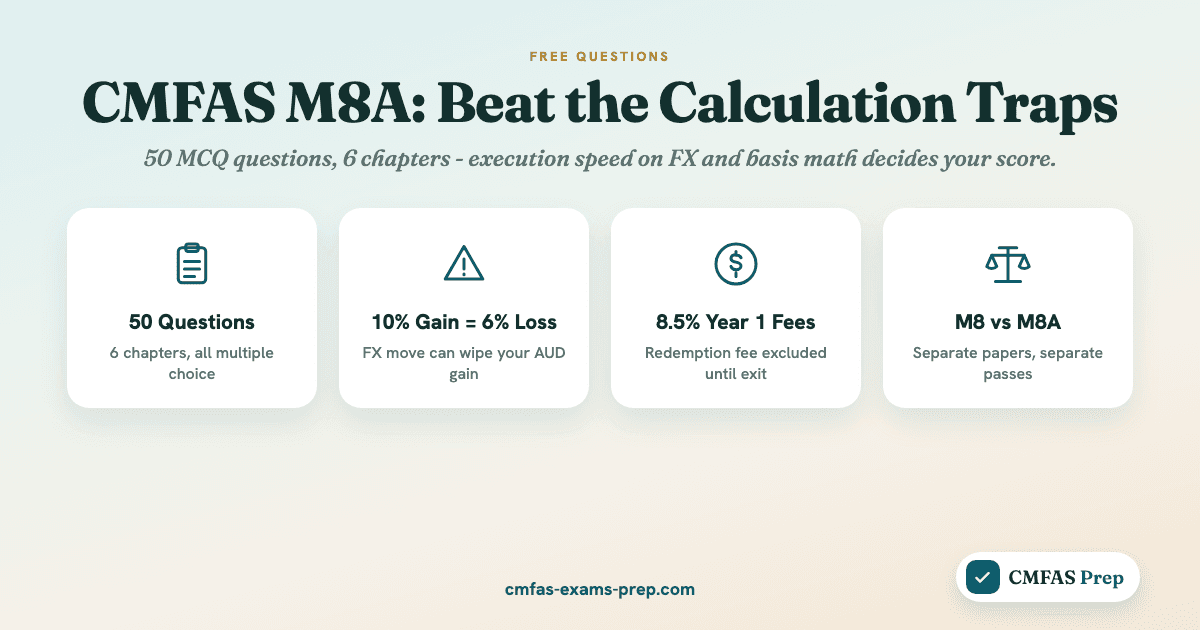
SCI lets you sit M8 on its own, or take CM-CIS, which combines M8 with M8A (Derivatives) in one sitting. The combined paper looks efficient, but it carries a real risk: if you pass the unit trust questions and fail the derivatives questions, the whole CM-CIS result fails and you repeat both halves.
Booking M8 separately locks in your Collective Investment Schemes pass the moment you clear it. If derivatives is your weaker area, sit M8 first and book M8A later once you have studied for it. If you genuinely know both syllabuses cold and want to save a trip to the exam centre, CM-CIS is defensible. For most candidates, two clean passes beat one risky one. The trade-offs between the two papers are laid out in our M8 vs M8A comparison.
Step by step on the SCI portal
Create or log into your candidate account
Go to the SCI website and find the candidate login. If this is your first CMFAS exam, register a new account.
Use a personal email address, not a work one. Agents change agencies, and you want your exam history, certificates, and future re-registrations tied to an inbox you keep. Your SCI record follows you across firms; your company email does not.
Open exam registration and pick the right module
Once you are logged in, go to exam registration and choose CMFAS as the category. In the module dropdown, select Module 8 (M8): Collective Investment Schemes.
Read the dropdown line carefully. CM-CIS sits near M8 in the list, and the names are similar enough that a quick scroll lands you on the wrong one. If you only want the unit trust paper, the line you want says M8, not CM-CIS. Picking CM-CIS by accident means paying for and preparing two modules instead of one.
Choose your session and price
SCI charges by time of day, so the slot you pick changes what you pay:
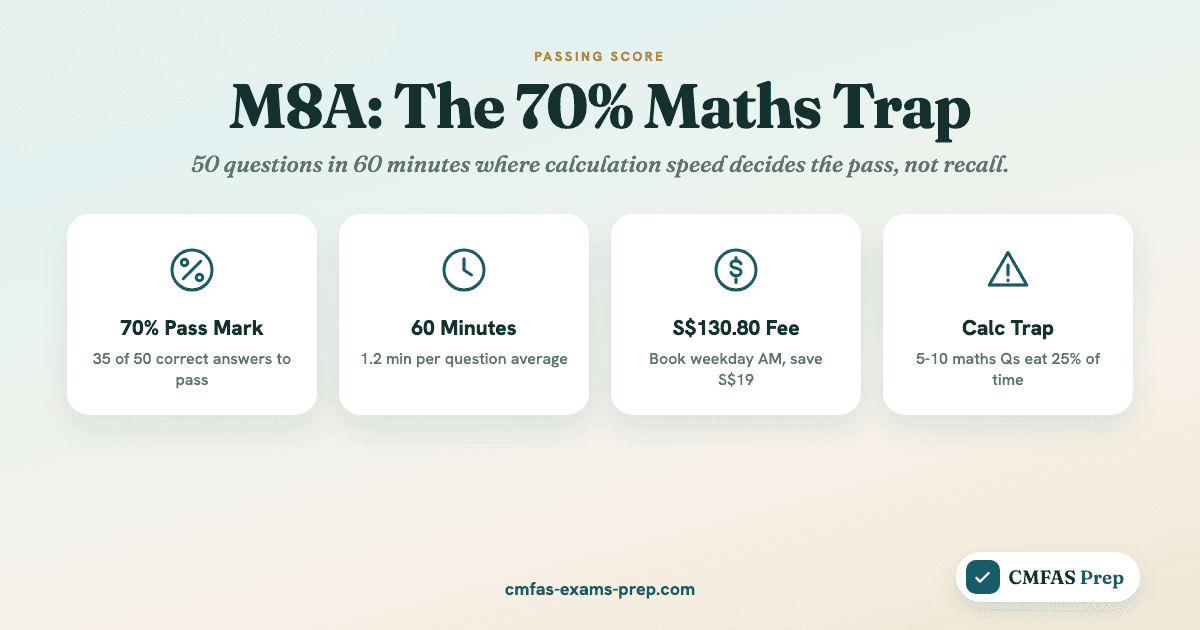
- Weekday day session (Monday to Friday, roughly 9am to 5pm): S$130.80 for non-members
- Evening (after 5pm) or weekend: S$149.33 for non-members
A weekday morning slot is the cheaper option, and it tends to suit the M8 syllabus. The paper has a block of time value of money and risk-and-return questions that need clear arithmetic, and most people handle that better earlier in the day than after a full shift at work. If your schedule allows it, book the morning and keep the extra S$18.53.
Pay and grab your eBook
SCI takes credit card only for online registration, VISA or MasterCard. There is no invoice-and-pay-later option for self-registration, so have the card ready.
Hard copy study texts are no longer issued. After your payment clears, SCI emails an eBook access link, usually within minutes. Check your junk and promotions folders if it has not arrived, because the automated email often gets filtered. This official eBook is your primary source for the syllabus; if you are weighing whether to also buy third-party notes, our M8 mock exams and study guide comparison covers what is worth paying for and what is not.
After you've booked
You now have a fixed date and a syllabus that rewards spaced practice, not cramming. The calculation chapters in particular reward repetition, because the question formats repeat even when the numbers change.
Two areas account for a large share of fails:
- Risk and return, including how returns and volatility are measured and compared
- Time value of money, including present and future value calculations
These are the chapters that separate a pass from a re-sit. We pulled apart five of the trickier styles in free M8 mock exam questions so you can see the traps before exam day. A retake costs roughly S$130 and pushes your licensing back by weeks, so the practice you do now is cheaper than a second booking.
Exam day logistics
Sort these out before the morning of the exam so nothing derails your sitting:
- Calculator: SCI does not provide one. Bring your own non-programmable model, and check it against the approved list on the SCI exam page for M8 before you go. A disallowed calculator means sitting the paper without one.
- Identification: bring your physical NRIC or Employment Pass. A photo on your phone is not accepted.
- Arrival: get there 30 minutes early. Latecomers are turned away and forfeit the fee.
Get ready to pass, not just to sit
Booking M8 is a ten-minute job. Clearing it is the part worth your attention, and the calculation chapters are where the marks are won or lost.
Start drilling the risk and time-value questions now, while your exam date still gives you room to repeat them. You can practise full M8 question sets on CMFAS Prep and track which chapters still need work, and the M8 exam page lists everything the syllabus covers. Book your slot, then put in the reps.
Practise M8 now
800+ exam-style M8 questions with instant explanations.
Frequently asked questions
For non-members, the M8 exam fee is S$130.80 for day sessions and S$149.33 for evening or weekend sessions (inclusive of GST).
M8 is a single module covering Collective Investment Schemes (Unit Trusts). CM-CIS is a combined exam that includes both M8 and M8A (CIS II). We generally recommend taking them separately to avoid the risk of failing both if you struggle with the derivatives section in M8A.
Yes. If you request it **7 or more working days** before the exam, the first change is free. If you request it between **2-7 working days** before, there is an administrative fee of S$32.70. No changes are allowed within 2 working days.
The M8 exam consists of 50 multiple-choice questions over 1 hour.
You need to score at least 70% (35/50 questions) to pass the M8 exam.