A study plan for CMFAS M9 that clears 100 questions in 120 minutes
A study plan for CMFAS M9: split calculation and law chapters, sit it alone (not CM-LIP), and follow a four week plan to clear 70 of 100 questions.
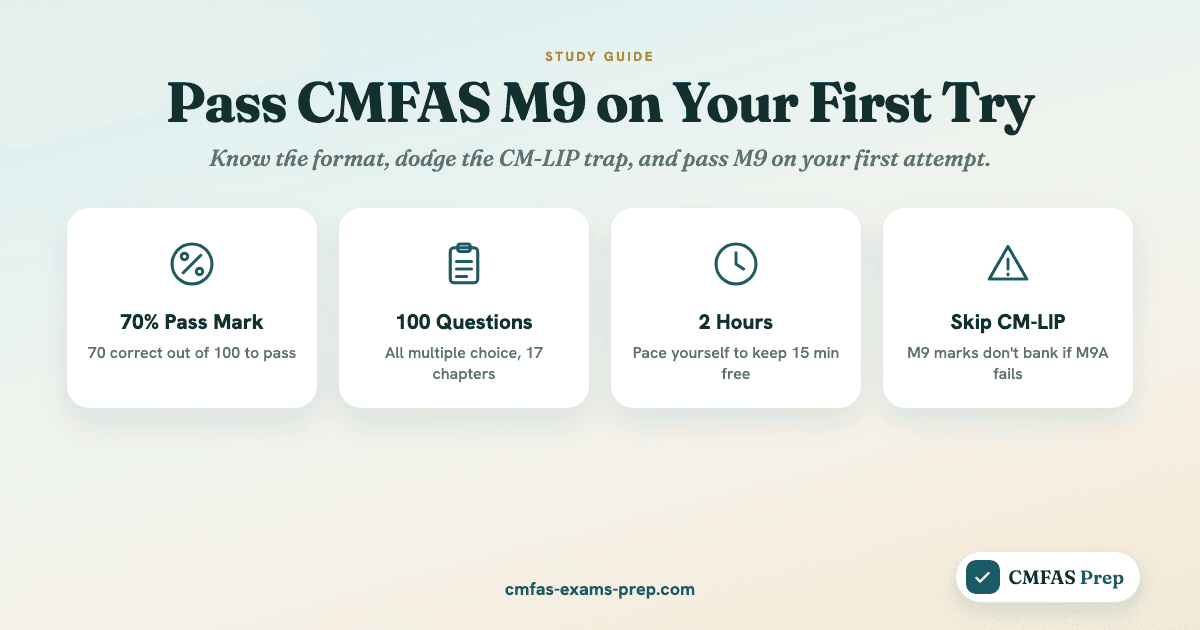
The CMFAS M9 exam is a 100-question, two-hour paper, and you pass at 70%, meaning 70 correct answers. The fastest way through it is to stop treating all 17 chapters equally: drill the calculation chapters and the law chapters hard, and take M9 on its own instead of bundling it into the combined CM-LIP sitting.
M9 covers Life Insurance and Investment-Linked Policies, and it is the first of two papers that together make up the CM-LIP qualification. The second paper is M9A. What trips people up is the mix of skills the paper demands. Some chapters reward plain product knowledge. A handful demand arithmetic under time pressure and a working grasp of contract and agency law. You can read the full breakdown on the M9 exam page.
What you actually face on exam day
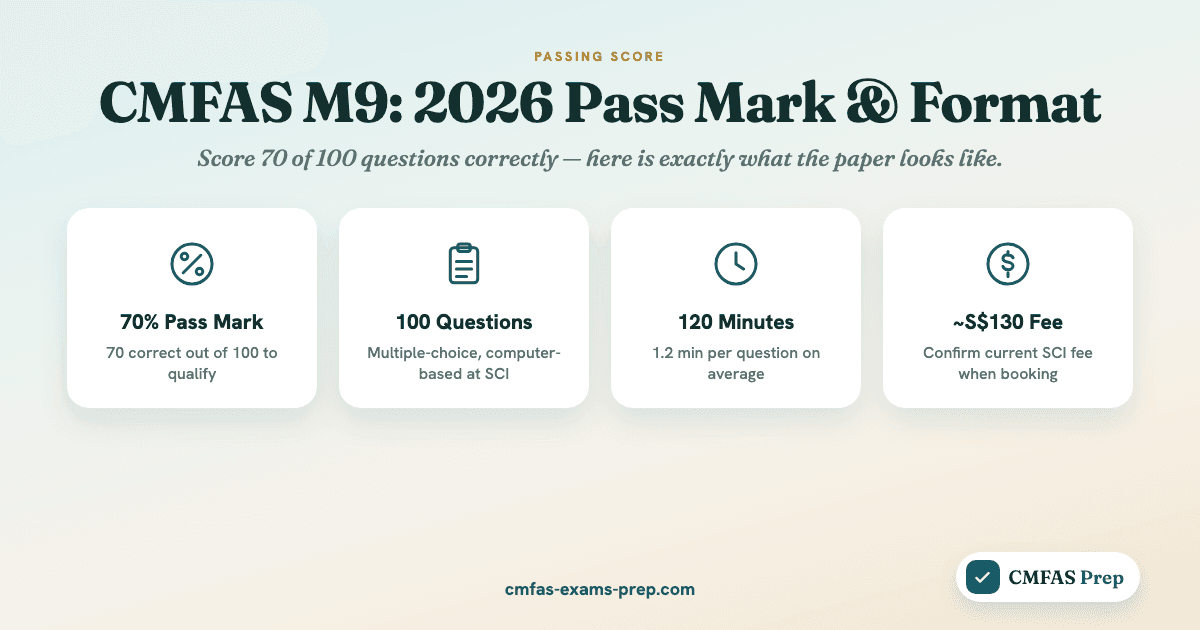
Here is the format, with nothing rounded off:
| Item | Detail |
|---|---|
| Questions | 100 multiple choice |
| Duration | 2 hours |
| Pass mark | 70% (70 correct) |
| Calculator | Allowed and needed; bring your own approved model |
| Syllabus | 17 chapters |
The Singapore College of Insurance does not hand out calculators at the test centre. You bring an approved model, or you sit there doing premium math by hand. Check the current approved list on the SCI M9 exam page before the day.
The 70% mark sounds gentle until you sit a real paper. Plenty of candidates land at 64 or 66 because two or three calculation questions eat ten minutes each, or because they freeze on a nomination-law scenario they half-remember. The pass mark is not the problem. Pacing and topic coverage are.
Sit M9 alone, not as part of CM-LIP
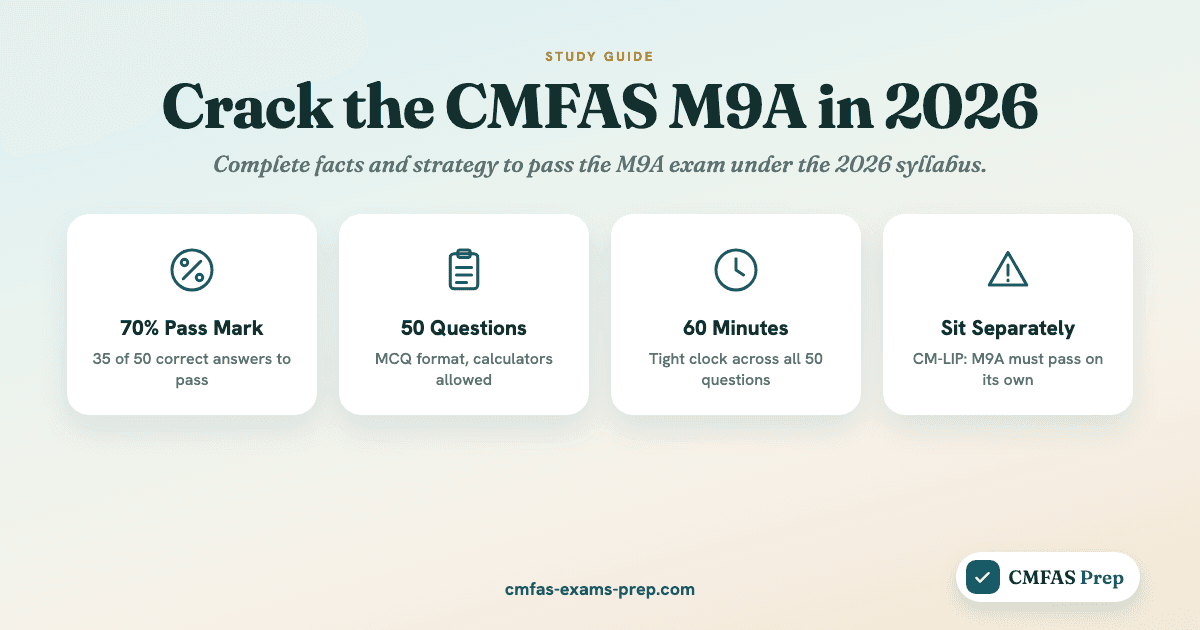
Most agencies register new reps for CM-LIP, which fuses M9 and M9A into a single three-hour paper. Sitting them separately costs roughly $100 more in total. Pay it.
The reason is how the combined paper is graded. In CM-LIP you have to clear Part I (M9) and Part II (M9A) in the same sitting. Score 88% on the M9 half and fall short on the M9A half, and the whole result is a fail. The M9 marks do not bank. You book again and re-sit both halves, including the part you already aced.
M9A is where people slip, because the derivative and instrument questions are denser than anything in M9. Taking M9 first and on its own means that once you pass, it is done. You walk into M9A later carrying no risk to the credit you already hold. If you want the side-by-side, the M9 vs M9A comparison lays out what each paper tests.
The chapters that decide your result
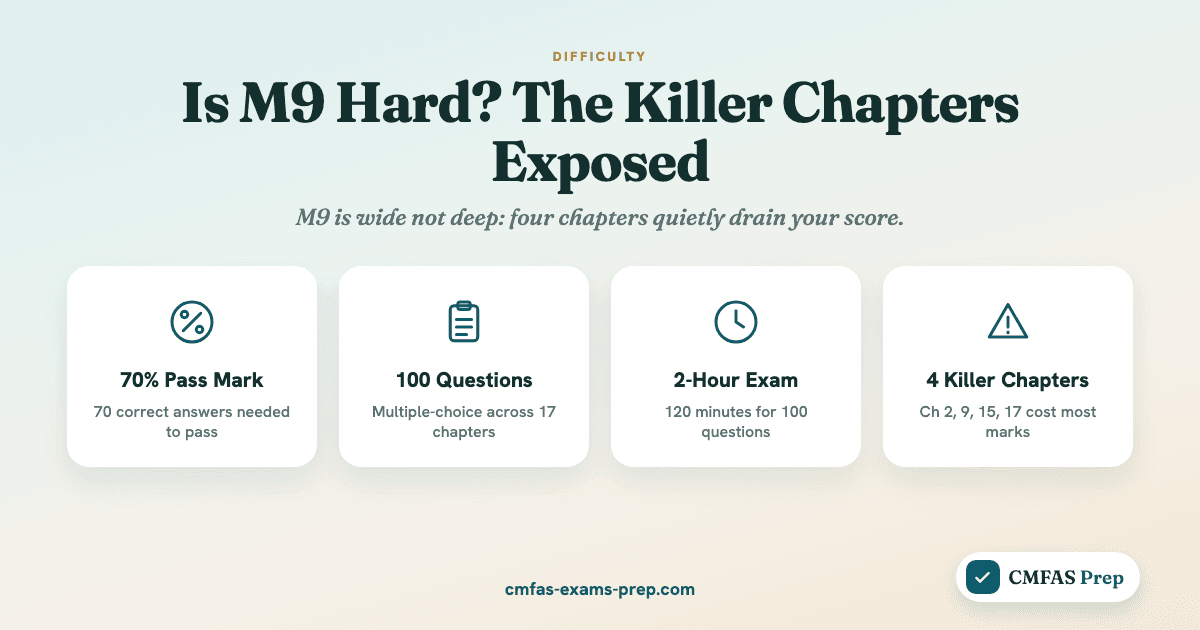
Difficulty is lumpy across the syllabus. Two clusters account for most failed papers.
Calculation chapters
The premium and fund-pricing questions cannot be reasoned out from common sense. You either know the formula or you guess.
Chapter 2 deals with how premiums are built: net premium versus gross premium, mortality tables, and the loading added for expenses and contingencies. Expect questions that hand you a few inputs and ask for the figure.
Chapter 9, on ILP computations, is the one most candidates rate hardest. You need net asset value, the bid-offer spread, and the difference between forward and backward pricing. A typical question reads: offer price is $1.50, bid-offer spread is 5%, find the bid price. If you cannot do that on paper in under a minute, this is where your study hours go.
Law chapters
These read like a contract-law module, and the wording is precise on purpose.
Chapter 15 covers the law of agency. You have to keep actual authority, apparent authority, and ratification straight, because the questions describe a situation and ask which one applies. Mix them up and you lose easy marks.
Chapter 17 covers wills, trusts, and nominations. The split between a revocable nomination and a trust nomination under the Insurance Act matters, and scenario questions will hand you a client's circumstances and ask which type of nomination governs the payout. Know which provision does what before you sit.
A four-week plan built around math and law
The aim is to spend reading time on the fact chapters and active practice time on the chapters that punish you.
Week one is product knowledge: the basic policy types (term, whole life, endowment), riders, and annuities, plus the introductory chapters. This is recall work. Read the notes once, then test yourself with quick quizzes so the definitions stick.
Week two is the law block. Underwriting, claims, utmost good faith, insurable interest, and the nomination rules. These chapters are dense, so do not just reread them. Use the practice-by-chapter mode on CMFAS Prep to grind agency and nomination questions until the terms stop blurring together.
Week three is the math intensive: chapters 2, 7, 8, and 9. Close the textbook. Work problems on paper. Start with these five free M9 calculation examples, and when you get one wrong, read the worked solution to find the exact step where your math went off, not just the right answer.
Week four is full simulation. Sit at least three complete 100-question papers under timed conditions. Aim to finish the questions in about an hour and forty-five minutes so you keep fifteen minutes to revisit anything you flagged. If you want to compare practice papers before you commit, the best M9 mock exams comparison walks through the options.
The thing that separates passes from re-sits
M9 is not a memory test on product brochures. It checks whether you can price a policy and read the contract behind it. Candidates who study from old notes that show the formula but never the steps tend to stall in the exam hall, because the paper asks them to produce a number, not recognise one.
If your weak spot is the math, treat it as a drilling problem, not a reading problem. The more bid-offer and premium questions you work through, the less the calculations cost you in time and nerves on the day.
When you are ready, run timed sets and chapter drills on CMFAS Prep, or start straight from the M9 practice page. Work the calculation and law questions until your scores settle above 70%, then book the exam.
Practise M9 now
800+ exam-style M9 questions with instant explanations.
Frequently asked questions
M9 is considered moderately difficult due to the mix of calculation questions (Premiums/ILPs) and complex legal concepts (Law of Agency/Trusts). The sheer volume of 17 chapters also makes retention a challenge.
The passing score is 70%. You must answer at least 70 out of 100 multiple-choice questions correctly. There is no negative marking.
Yes. You will encounter calculation questions regarding premiums, cash values, and ILP unit pricing. You must bring an SCI-approved calculator (e.g., Casio FC 100V) as one is not provided.
Yes, usually. For a full Life Insurance license (CM-LIP), you typically need to pass both M9 (Life Insurance And Investment-Linked Policies I) and M9A (Life Insurance And Investment-Linked Policies II). M9 covers the core laws and calculations, while M9A focuses on complex structured products and derivatives.
While SCI does not publish a fixed ratio, candidates typically encounter 15-20 calculation questions out of 100. These mostly cover Premium Calculation (Gross vs Net), Cash Values, and ILP Unit Pricing. You cannot afford to skip these if you want a safe passing margin.