M9 sample questions: premium calculations and law scenarios to try
Five M9 practice questions on premium math and insurance law, the two areas that trip up most CM-LIP candidates. Work them, then check your answers.
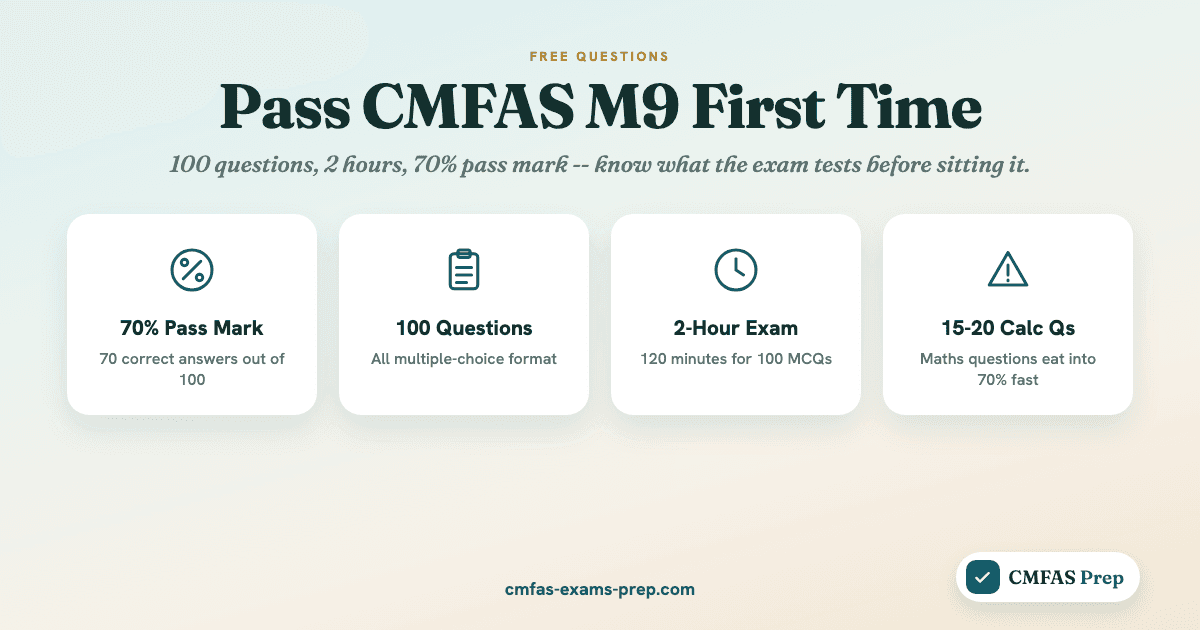
Facts confirmed (M9 = CM-LIP Part 1, 100 MCQs / 2 hours, 70% pass mark, SCI registration). You can practise free M9 (CM-LIP) questions below covering the two areas that sink most candidates: premium math and insurance law. The M9 paper has 100 multiple-choice questions over two hours, and you need 70 correct to pass, so the five questions here mirror the calculation and legal-reasoning style you will face on exam day.
Before you start, one thing trips people up at registration.
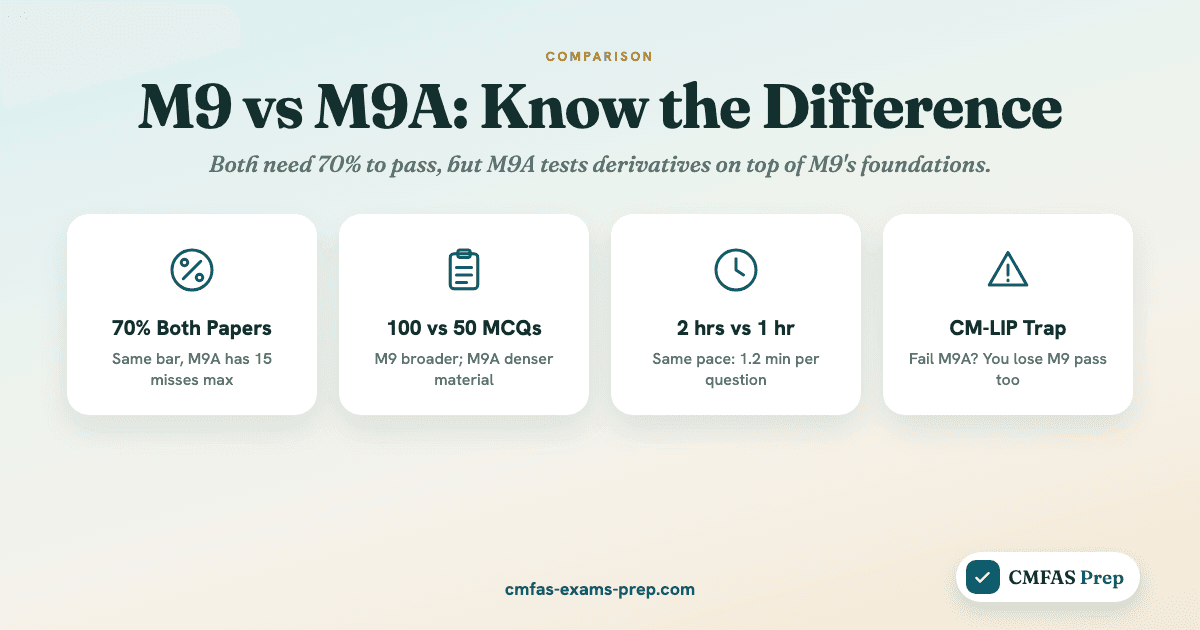
M9 and M9A are not the same paper
The M9 (CM-LIP Part 1) exam covers life insurance principles: how premiums are built, how policy values work, and the law sitting behind a life policy. M9A is a separate paper that deals with investment-linked products and the riskier instruments inside them. Studying the wrong one wastes weeks, because the question style and the syllabus barely overlap.
Here is the split at a glance.
| M9 (CM-LIP Part 1) | M9A | |
|---|---|---|
| Focus | Life insurance fundamentals | Investment-linked and structured product knowledge |
| Typical topics | Premium calculation, agency law, nomination, non-forfeiture | ILP sub-funds, fund risk, product disclosure |
| Who sits it | Anyone advising on life policies | Advisers dealing with ILPs and related products |
If your study materials are about ILP sub-funds and fund risk rather than gross premium and agency law, you are revising for M9A. For the full syllabus and a study order, read how to pass the CMFAS M9 exam.
What the mini-mock covers
The five questions below hit the chapters that produce the most wrong answers: premium math, ILP pricing mechanics, the law of agency, nomination of beneficiaries, and the non-forfeiture provisions. Roughly 15 to 20 of the 100 exam questions involve a calculation, so getting the math reflex right is worth real marks. Work each one before reading the answer.
Question 1: building a gross premium
An insurer prices a policy from these figures:
- Mortality cost: $800
- Interest earnings: $80
- Expenses: $150
- Contingency loading: $30
What is the gross premium?
- A) $900
- B) $980
- C) $1,060
- D) $870
Answer: A, $900.
The reason candidates miss this is the direction of the interest figure. Interest the insurer expects to earn reduces what it needs to charge, so it comes off, not on. First find the net premium: mortality cost minus interest earnings, $800 − $80 = $720. Then add the loadings the insurer needs to recover, expenses and contingencies: $720 + $150 + $30 = $900. The gross premium is the net premium plus those loadings.
If you added the $80 instead of subtracting it, you landed on C. That single sign error is the most common way to lose this mark.
Question 2: nomination of beneficiaries
Under the Nomination of Beneficiaries (NOB) framework, which statement is true?
- A) Every policy owner must make a nomination when taking up a policy.
- B) The current framework is created by section 73 of the Conveyancing and Law of Property Act 1886.
- C) A policy owner may make a nomination that he can later revoke or change.
- D) The regime exists to shield policy owners from their insurers.
Answer: C.
A policy owner can make a revocable nomination and change or cancel it later while alive, which is the flexible option most people choose over a trust nomination. Nomination is voluntary, so A is wrong. Section 73 of the old Conveyancing and Law of Property Act governed the earlier trust arrangement, not the current NOB regime, so B is wrong. The framework exists to direct policy money to the right people on death, not to shield owners from their insurer, so D is wrong.
This topic alone tends to generate several questions on the paper, and the wording of the options is designed to look almost identical.
If you keep mixing up revocable and trust nominations, drill that single chapter on the M9 exam page rather than re-reading the whole textbook.
Question 3: forward pricing on an ILP
An investment-linked policy uses forward pricing. A client submits a redemption request at 10:30 am on Thursday, and the fund's daily cut-off is 1:00 pm. Which price applies?
- A) Wednesday's price
- B) Thursday's valuation price
- C) Friday's closing price
- D) The unit price at 10:30 am exactly
Answer: B.
Forward pricing means the price is not known at the moment you transact. Because the request came in before the 1:00 pm cut-off, it is processed at Thursday's valuation price. That price is usually struck and published the next working day, but it still represents Thursday's value. The trap is reading "forward" as "next day's price." It is not. Had the request arrived after the cut-off, it would roll to the next dealing day instead.
Question 4: how authority is created in agency
A representative whose appointment has been terminated still collects a renewal premium from a client. The insurer banks the money without realising, and when it discovers the termination it elects to treat the policy as in force anyway. Authority here arises by:
- A) Necessity
- B) Agreement
- C) Estoppel
- D) Ratification
Answer: D.
Ratification is when a principal approves an act after the fact that was done without proper authority at the time. The insurer is the principal, the representative acted without a valid appointment, and by keeping the premium and honouring the policy the insurer adopts that act retrospectively. Estoppel would apply if the insurer's conduct had led the client to rely on the agent's authority beforehand, which is not what happened here. All four options are genuine agency concepts, which is exactly why this style of question is hard under time pressure.
Question 5: keeping a lapsed policy alive
The owner of a whole life policy with accumulated cash value misses a premium. Without being asked, the insurer advances the amount due against the policy's own cash value, and full cover keeps running. Which provision is at work?
- A) Surrender for cash
- B) Automatic premium loan (APL)
- C) Conversion to a paid-up policy
- D) Extended term assurance
Answer: B.
An automatic premium loan treats the missed premium as a loan against the policy's cash value, charged with interest. Coverage stays exactly the same. Compare that with a paid-up policy, where the sum assured drops to a lower amount that the existing cash value can fully fund. The two get confused because both keep the policy alive without further payment, but only APL leaves the original coverage intact.
The math is where marks quietly disappear
If you got Question 1 wrong, you are not alone, and it points to the real risk on this paper. You can memorise every definition and still fail if the formulas for net premium, gross premium, or the bid-offer spread are not automatic. With 15 to 20 calculation questions in the mix, guessing your way through them eats into a 70% threshold fast.
The fix is repetition with feedback. Seeing the worked formula for every calculation, not just the final letter, is what turns a shaky topic into a quick one. For a deeper look at which chapters are genuinely hard, see whether the M9 exam is difficult, and for picking practice material, compare the best M9 mock exams.
Practise the real thing
CMFAS Prep has more than 550 M9 questions with step-by-step workings, a practice-by-chapter mode for drilling weak topics like nomination and agency law, and full mock papers set to the current SCI syllabus. Start a free session on the M9 simulator and work the calculations until the formulas come without thinking.
Practise M9 now
800+ exam-style M9 questions with instant explanations.
Frequently asked questions
M9 and M9A are completely different CMFAS certifications. M9 (also called CM-LIP Part 1) covers life insurance fundamentals — including premium calculations (Gross/Net Premium), insurance law (Agency, Nominations), and policy provisions. M9A focuses specifically on derivatives and structured products within Investment-Linked Policies. The question formats and required knowledge are fundamentally different.
You can find 2026-updated M9 mock questions on CMFAS Prep. We offer a bank of over 1,000 questions covering calculations, law, and product knowledge for the latest syllabus.
The hardest topics are typically **Chapter 9 (ILP Computations)** due to the math, and **Chapter 17 (Wills & Trusts)** due to the complex content.
No. You are not allowed to bring any notes or formula sheets. You must memorize the formulas for Gross/Net Premium and ILP pricing before entering the exam hall.
In the real exam, you have about 1.2 minutes per question. However, calculation questions (like Premiums) often take 2-3 minutes. You need to save time on the theory questions (aim for 30 seconds each) to "bank" time for the math section.