RES 5 replaced M5: what changed in the syllabus and scoring
Is CMFAS RES 5 harder than M5? Yes. See the full 2026 RES 5 vs M5 syllabus breakdown, including the new two-part scoring and why your old M5 notes are now dangerously outdated.
RES 5 is not M5 with a new name
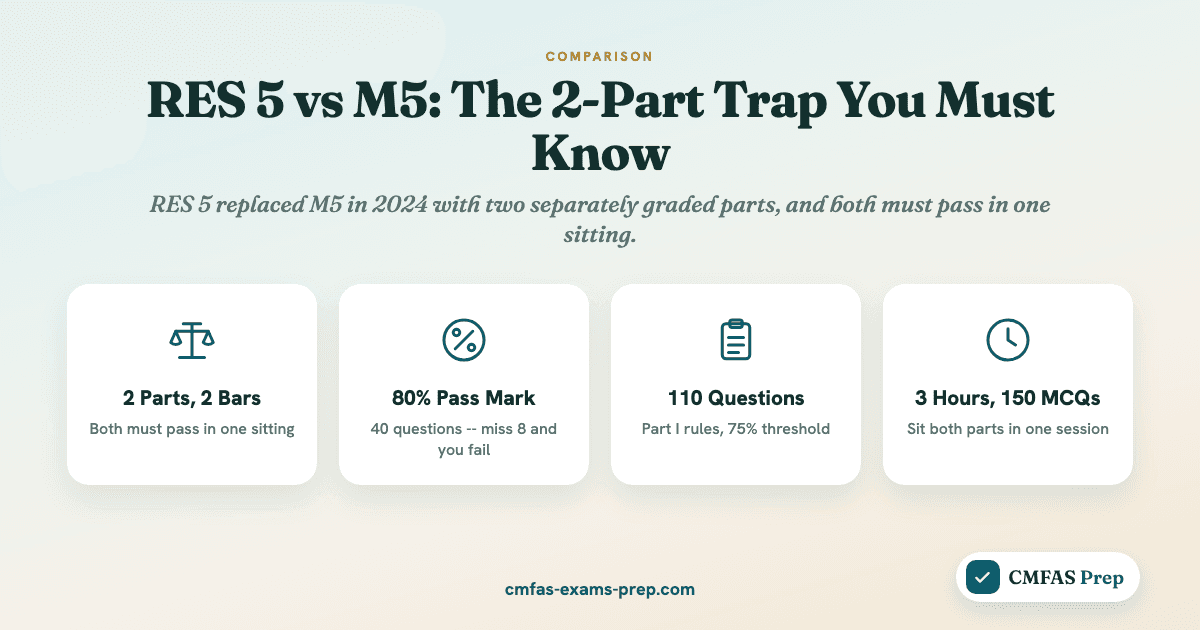
RES 5 replaced the old CMFAS M5 paper in 2024, and it changed the scoring, the question style, and the weight given to ethics. The short version: you now sit one exam split into two separately graded parts, and you have to clear both in the same sitting to pass. If you are retaking after a lapse or studying from a senior's M5 binder, that single structural change is the thing most likely to catch you out.
Here is what actually moved between the two papers, and what it means for how you prepare in 2026.
What changed at a glance
| Old M5 | RES 5 (2026) | |
|---|---|---|
| Scoring | One combined score | Two parts, graded separately, both must pass |
| Part I, rules and regulations | Counted into the single score | 110 questions, 75% to pass |
| Part II, ethics and skills | Lighter weighting | 40 questions, 80% to pass |
| Total | — | 150 MCQs in 3 hours |
| Question style | Mostly recall | Situational, applied judgment |
| Old M5 notes still safe? | — | Part I roughly, Part II no |
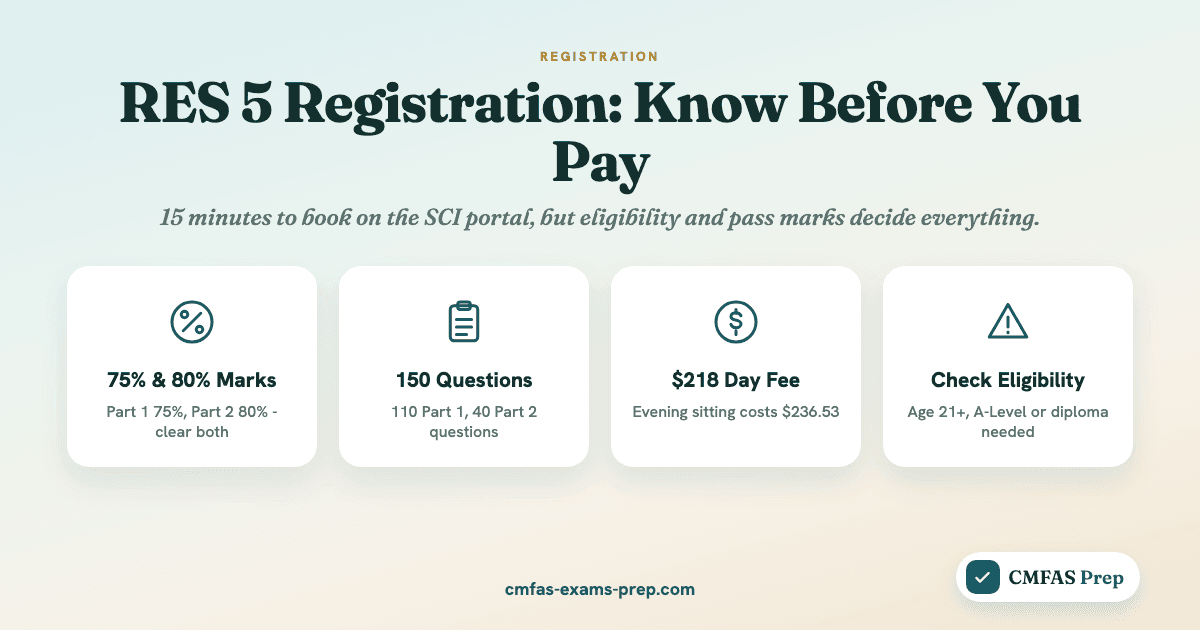
The exam is still registered and sat through the Singapore College of Insurance, and the fee sits in the usual S$150-250 range including GST. What you are tested on, and how, is the part that shifted.
The two-part scoring trap
Under M5 your marks were pooled into one figure. A strong run through the regulations questions could carry a shaky ethics section, and you passed on the total.
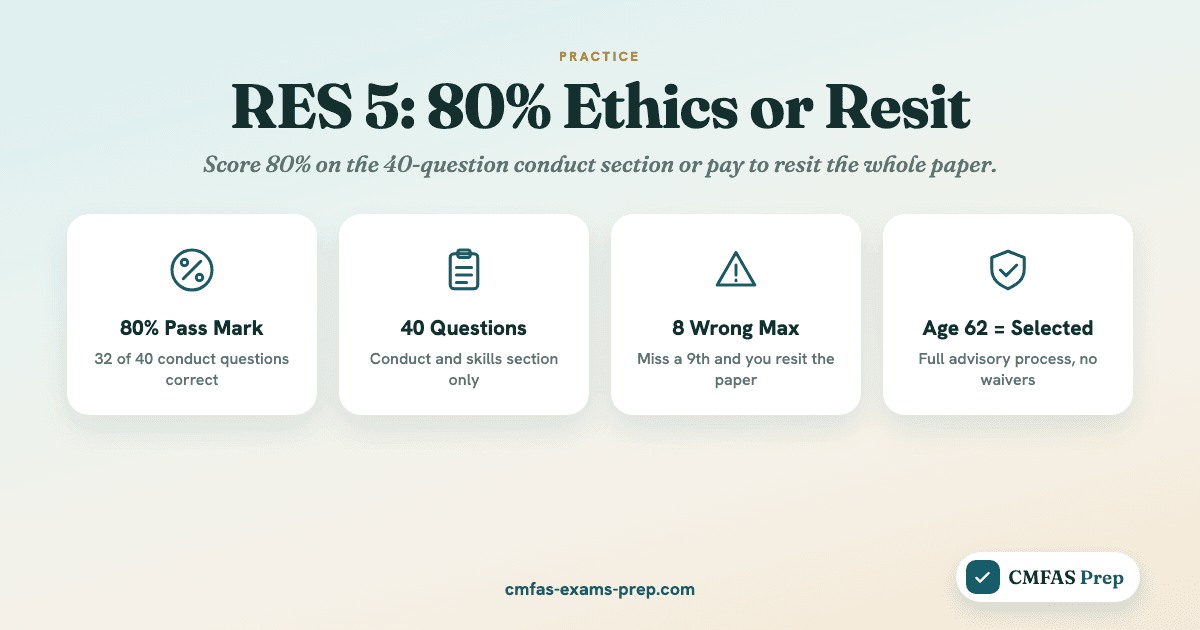
RES 5 closes that door. The paper is split into Part I, rules and regulations, and Part II, ethics and skills. Part I has 110 questions and needs 75% to pass. Part II has 40 questions and needs 80%. You sit both in one three-hour session, and the two scores never mix. Score 90% on Part I and 77% on Part II and you have failed the whole paper, even though your blended mark would have sailed past any single threshold.
That 80% bar on Part II is the tightest number in the exam. On 40 questions, 80% means you can miss eight and no more. There is very little room to guess your way through a section you only half-studied. Most candidates who fail RES 5 fail on this part, not on the rules.
If you want the full numbers and worked examples, the RES 5 passing score breakdown goes through both parts in detail.
Is RES 5 harder than M5 was?
Yes. The 80% requirement on Part II is the clearest reason, but the question style matters just as much.
M5 rewarded memory. You learned the definitions, the timelines, the disclosure rules, and you recognised them on the page. RES 5 still tests that knowledge in Part I, but Part II asks you to do something with it. A typical Part II question drops you into a client scenario and asks what you should do, where two or three answers all look defensible and only one fits the conduct rules and the client's interest. You cannot recognise your way to the right answer. You have to reason through it.
There is more on why candidates underestimate this paper in is the RES 5 exam difficult.
Are my old M5 notes useless?
Partly useful, partly dangerous, and you need to know which is which.
For Part I, the regulations content overlaps a lot with M5. The Financial Advisers Act, conduct rules, disclosure and suitability obligations, conflict handling, the underlying law has not been rewritten. Old M5 material gives you a workable base for this half of the paper, as long as it reflects current rules and not a 2019 snapshot.
For Part II, old M5 notes leave you exposed. The ethics-and-skills section is where the syllabus was rebuilt, and the situational format is the part your old binder almost certainly does not cover. You can read every page of M5 ethics notes and still walk into Part II having never practised the kind of judgment call the exam puts in front of you. The situational question format is worth seeing before exam day, not during it.
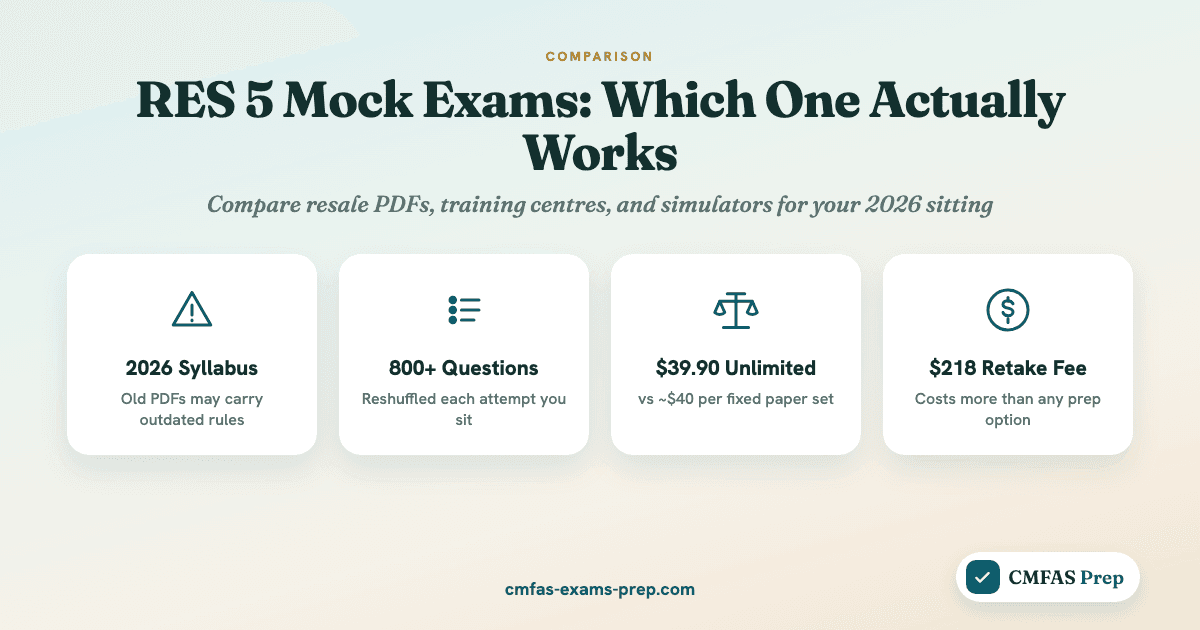
This is also why secondhand mock papers are a poor bet. The PDFs that change hands on resale sites and in study groups are often built for the old M5 format and report a single combined score, which trains you for an exam that no longer exists. They give you a false read on your readiness, and the gap shows up in Part II when it is too late to fix. The mock exam comparison guide walks through which materials still match the 2026 paper.
How to study for the paper as it is now
Reading the textbook end to end and hoping it sticks worked better for M5 than it does for RES 5. The textbook runs to around a thousand pages, and undirected reading sends you over chapters you already know while your real gaps sit untouched. Build the plan around three things instead.
Track Part I and Part II as separate scores from day one. If you only watch a combined figure, you will not see the Part II problem until the real exam surfaces it. Practise the two parts to their own thresholds: 75% on rules, 80% on ethics.
Drill the situational ethics questions specifically. These are the questions M5 notes do not prepare you for, and the ones carrying the harder pass mark. Volume helps here, because the judgment you need comes from seeing many scenarios, not from rereading the rule that governs them.
Use material built for the 2026 syllabus. Anything that reports one score or leans on recall-style questions is preparing you for the wrong exam.
That is the thinking behind CMFAS Prep. The mock exams are scored as two parts, so you see your Part I and Part II standing the way the real paper grades them. The question bank weights the Part II situational ethics work that old notes skip, and you get an explanation on every question so you understand why an answer is right rather than memorising that it is. Practice by Chapter mode lets you spend time on the chapters costing you marks instead of the ones you have already cleared, and the analytics track whether you are improving over time.
Your 2026 plan
Treat RES 5 as the harder, two-part exam it is, not as M5 under a new label. Get your Part I rules solid, then put the bulk of your effort into Part II ethics, because that is where the 80% bar and the situational format will decide your result. Study from current material, watch both scores separately, and walk in having practised the judgment the paper actually tests.
Once the differences are clear, the next step is a full study schedule. The complete RES 5 study guide lays out a four-week plan you can follow.
When you are ready to practise, start free RES 5 mock questions on CMFAS Prep and see your two-part score the way the real exam will report it.
Practise RES 5 now
800+ exam-style RES 5 questions with instant explanations.
Frequently asked questions
No. The CMFAS RES 5 is a major structural update. The biggest change is the new two-part scoring (75% for Part I, 80% for Part II) and a much heavier focus on Part II (Ethics).
It's highly risky. While Part I (Regulations) is similar, Part II (Ethics) is substantially different and has a higher 80% pass mark. Using outdated M5 materials is a common reason for failing.
The main difference is the emphasis. The RES 5 exam is designed to test the application of ethics in real scenarios, not just memorization of rules, which was more common in the M5.
The new two-part scoring system is a major change from the M5 exam. The RES 5 exam is now split into two parts, and you must pass both parts in one sitting. The Part I score is 75% and the Part II score is 80%.
If you fail either Part I or Part II, you fail the entire RES 5 exam, regardless of how well you did on the other part. You must retake the entire exam and pass both parts in the same sitting. This is why understanding the two-part scoring is crucial.