RES 5 pass marks: 75% and 80%, one sitting, two hurdles
Understand the 2026 CMFAS RES 5 passing score requirements. Learn how the two-part scoring works, why many candidates fail, and how to build a study plan that keeps you above both cut-offs.
The short answer on the RES 5 passing score
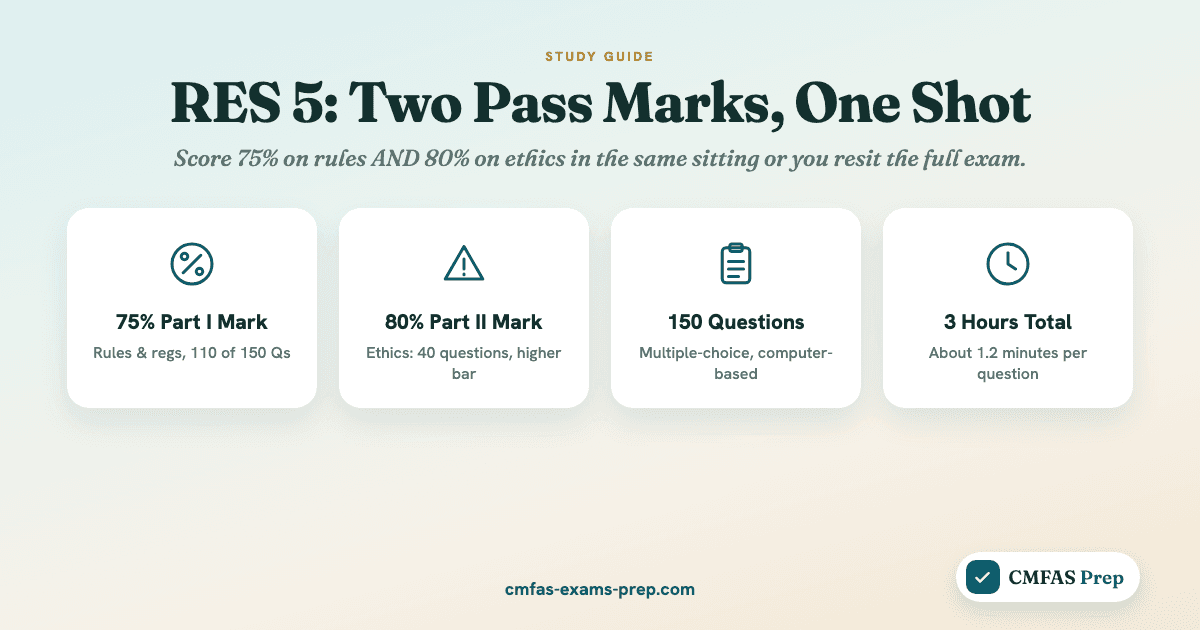
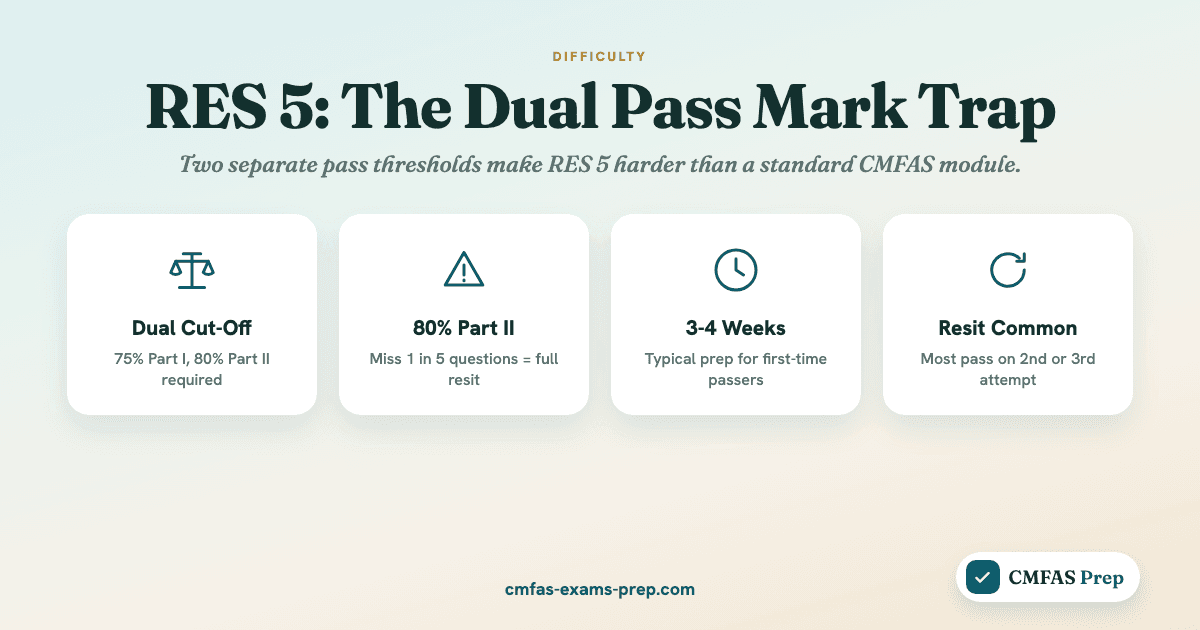
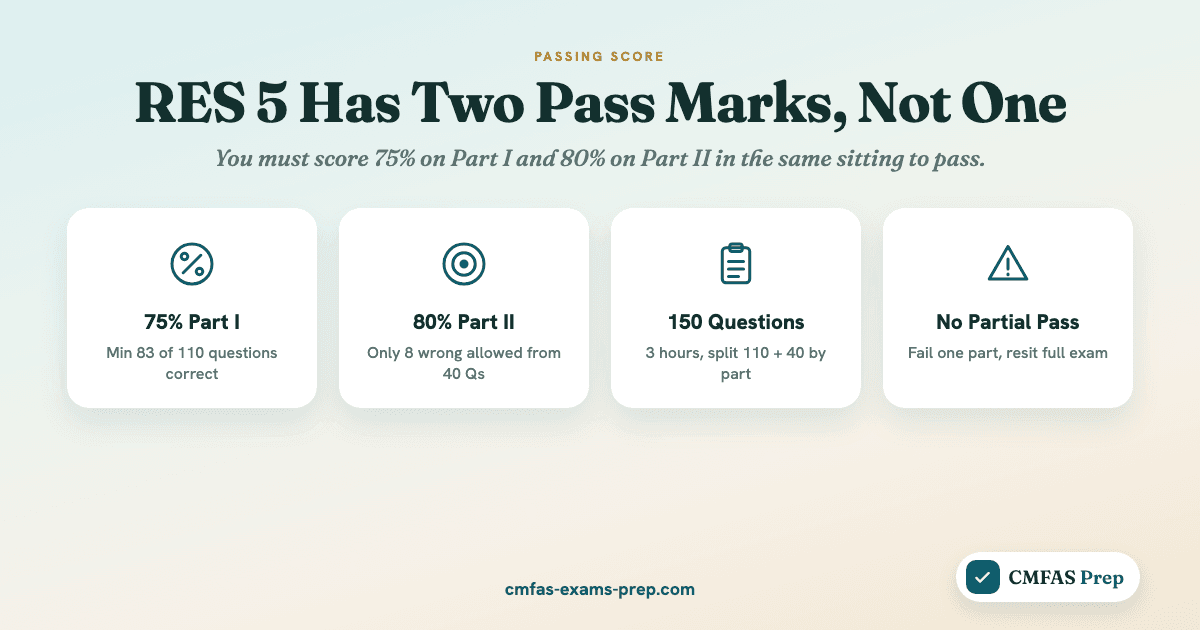
To pass the CMFAS RES 5 exam you need 75% on Part I and 80% on Part II, and you have to hit both in the same sitting. There is no combined total and no averaging across the two parts. Clear one and miss the other by a single question, and the whole paper is a fail.
That second sentence is where most candidates get caught. They walk in expecting a single 75% line to cross, score well overall, and still leave without a pass because the two parts are graded as two separate hurdles.
Here is what the exam actually looks like and how to study for the structure rather than against it.
What you are scored on
The RES 5 paper runs for three hours and has 150 multiple-choice questions, split into two parts that are marked independently.
| Part | Topic | Questions | Pass mark |
|---|---|---|---|
| I | Rules and regulations | 110 | 75% |
| II | Ethics and skills | 40 | 80% |
Part I is about three-quarters of the paper. It covers the regulatory material: the Financial Advisers Act, MAS notices and guidelines, licensing, disclosure obligations, and the conduct rules that govern how advice is given and products are sold. To pass it you need to answer at least 83 of the 110 questions correctly.
Part II is shorter but graded harder. The 80% line on 40 questions means you can afford to drop only 8. These questions put you inside a scenario and ask what the right course of action is, not what a rule says on paper. The full breakdown of topics sits on the RES 5 exam page if you want the chapter list.
Why a high score can still be a fail
The two-hurdle design is the reason strong candidates fail, so it is worth seeing it in numbers.
Picture two people sitting the same paper.
The first scores 96% on Part I, which is close to perfect on the regulations, then lands 78% on Part II. That is two questions short of the ethics threshold. Result: fail. The entire paper has to be retaken, Part I included, even though the regulatory knowledge was nearly flawless.
The second scores exactly 75% on Part I and exactly 80% on Part II. Both are bare passes. Result: pass.
The first candidate knew more overall and still walked away with nothing. The grading does not care about your total or your average. It checks each hurdle on its own, and the higher one sits on the smaller, harder section.
This is also why a generic "I scored 85% on the practice paper" tells you almost nothing. An 85% overall can hide a 70% on Part II, which is a fail waiting to happen on exam day.
Where the two-part system came from
RES 5 replaced the old CMFAS Module 5 (M5). When MAS reworked the syllabus, it put more weight on professional conduct and applied ethics rather than treating ethics as a few questions tacked onto a knowledge test.
The reasoning is straightforward. A licensed representative can recite every disclosure rule and still mishandle a real client sitting across the table. So Part I checks whether you know the rules, and Part II checks whether you can apply them when a scenario is messy and the "technically allowed" answer is not the right one. The 80% bar on Part II reflects how little room there is to get conduct wrong once you are advising real money.
How to study for two scores, not one
The grading dictates the study method. You cannot aim for a single good average, because an average can pass while Part II quietly fails. You have to track Part I and Part II separately from the start, and you need a way to see those two numbers at any point in your prep.
A textbook will not give you that. A photocopied question pack off a marketplace will not either, since it grades you on one combined figure. This is the gap CMFAS Prep is built to close: every mock exam returns a Part I result and a Part II result split out, the same way the real paper does.
Take mocks that mirror the real split
Sit full-length simulations under the three-hour, 150-question format, and read the report as two scores rather than one. The first time you see 88% on Part I and 72% on Part II side by side, the whole plan changes. You stop celebrating the average and start working on the part that is failing.
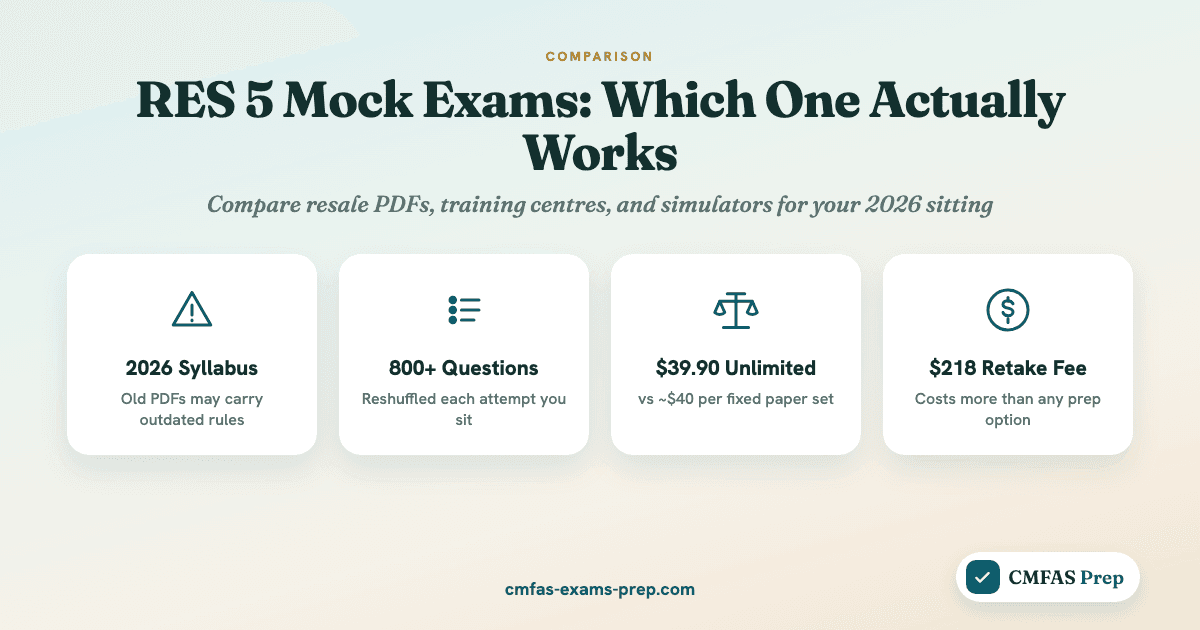
For how different practice tools handle this, the RES 5 mock exam comparison goes through what to look for.
Pour your time into the weaker part
Once you have two scores, the decision is easy. If Part I is sitting at 90% and Part II is at 70%, stop drilling regulations. Every extra hour on the part you have already cleared is wasted while the part that fails you goes untouched.
Practice by chapter so you can drill only the ethics and conduct topics that are dragging Part II down, instead of re-reading material you already know.
Treat ethics questions as judgment, not recall
Part II questions rarely have a clean lookup answer. They describe a client situation and ask what you should do, often with two options that both look defensible until you read the conduct rules closely. Working through the situational sample questions shows the kind of traps these set.
Read the explanation for every question you get wrong, and for the ones you got right by guessing. The point is to understand why an answer is correct so the reasoning transfers to a scenario you have not seen before, which is exactly what exam day throws at you.
A target to study toward
So the real number to aim for is not one figure but two: 75% on Part I and 80% on Part II, held at the same time. Build your prep around watching both climb, and book your slot once both are clearing the line with room to spare. The fee is around $218, so a confident first attempt is worth more than a cheap rushed one. The registration guide covers booking and what to bring.
Common questions
Can I retake just the part I failed? No. A fail on either part means you re-sit the full RES 5 paper, both Part I and Part II, at the next sitting.
Is the 75% an average across both parts? No. Part I needs 75% and Part II needs 80%, judged separately. There is no combined or averaged score.
How many questions can I get wrong? On Part I you can miss up to 27 of 110. On Part II you can miss up to 8 of 40. Cross either limit and you fail the paper.
How long is the exam? Three hours for all 150 questions across both parts.
Practise on CMFAS Prep
If you want to know where your Part I and Part II scores actually stand before you book, run a full mock on CMFAS Prep. You will get the two numbers split out, see which chapters are pulling Part II down, and study the part that decides whether you pass.
Practise RES 5 now
800+ exam-style RES 5 questions with instant explanations.
Frequently asked questions
You must achieve at least 75% on Part I (110 questions) and 80% on Part II (40 questions) in the same 3-hour sitting to pass RES 5 in 2026. Falling short in either part, even by one question, results in a fail.
No. The RES 5 exam reports two independent scores. You only pass when both Part I and Part II meet or exceed their respective cut-offs, regardless of your total percentage.
Use a mock exam platform like CMFAS Prep that mirrors the real exam format. Every simulation provides individual Part I and Part II scores so you know exactly which section needs more work.
Shift your study time toward ethics scenarios and real-world case studies. Drill the weak chapters with targeted quizzes and review detailed explanations until you can explain the reasoning behind each answer.