A study plan for RES 5: ethics, rules and the double pass mark
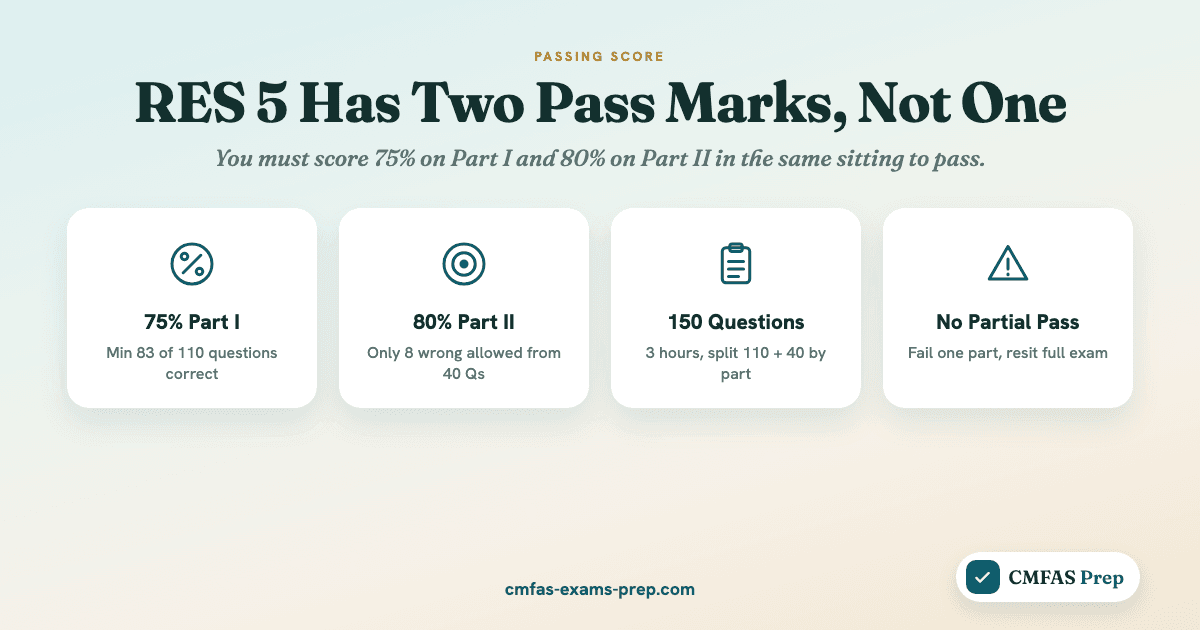
RES 5 has two pass marks in one paper: 75% on rules and 80% on ethics. Here is a four-week study plan built around that split.
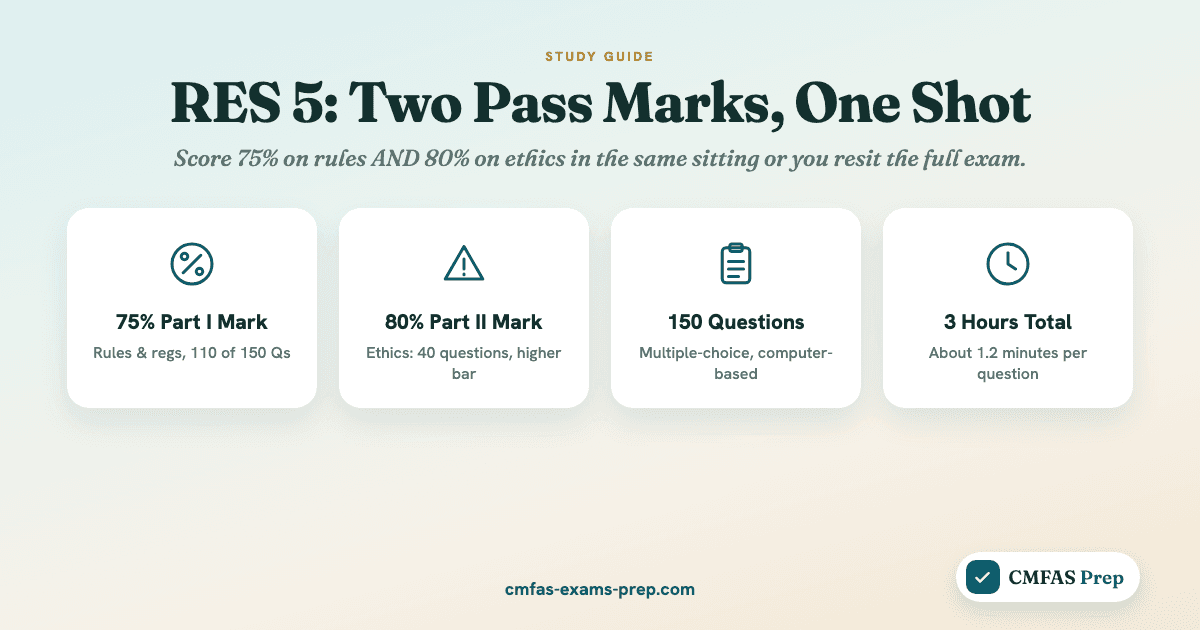
You pass the RES 5 exam by treating it as two separate tests that happen to share one paper. You need 75% on the rules section and 80% on the ethics section in the same sitting, and a healthy total score counts for nothing if either half falls below its line. The people who clear RES 5 on the first attempt are the ones who train for that split from week one instead of finding out about it on results day.
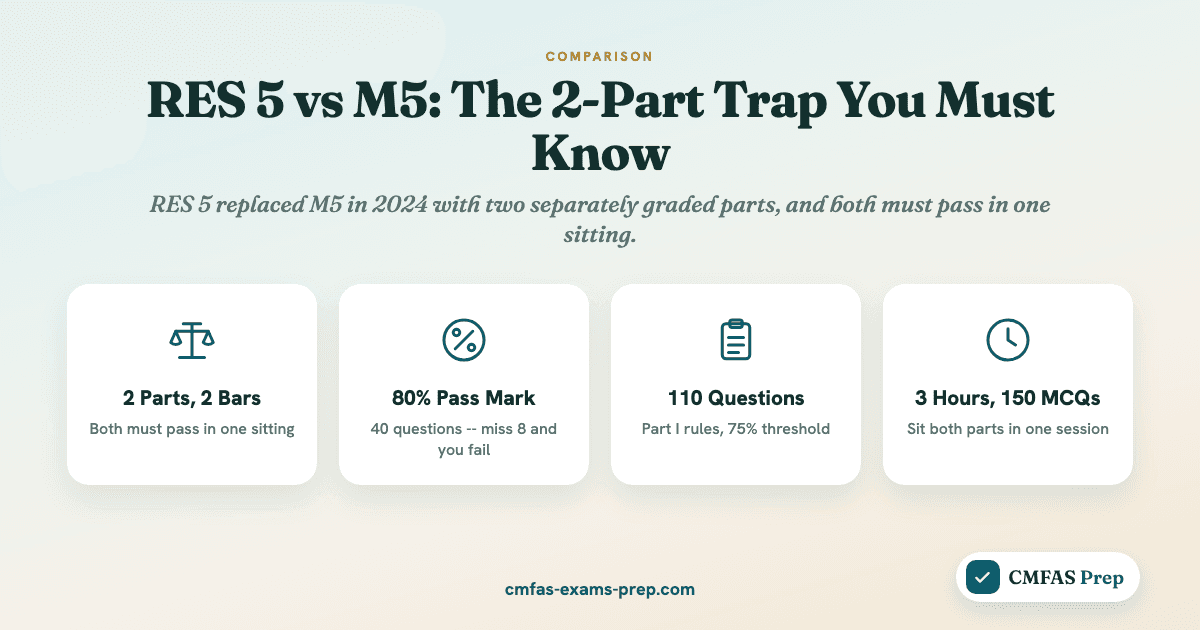
RES 5 is the CMFAS module you sit before you can advise clients on life insurance and investment-linked products in Singapore. It replaced the older M5 module, so any borrowed notes or question sets built for M5 are out of date and will teach you the wrong things. The Singapore College of Insurance (SCI) administers the exam, and the syllabus carries a revision that takes effect on 24 Feb 2026. If you are working from older material, check every topic against the current SCI study guide before you trust a single answer.
What the paper actually looks like
The exam is 150 multiple-choice questions in 3 hours, sat on a computer at an SCI test centre. That sounds generous until you do the arithmetic: roughly 1.2 minutes per question, including the longer situational items that hide the answer inside two paragraphs of client background.
The scoring is what catches people out. The 150 questions are split into two sections, and each section is marked on its own.
| Section | Topic area | Questions (approx.) | Score you need |
|---|---|---|---|
| Part I | Rules and regulations | 110 | 75% |
| Part II | Ethics and skills | 40 | 80% |
You have to clear both minimums in one sitting. Get 95% on Part I and 79% on Part II and you fail, even though your combined mark looks safe. Part II is the smaller section carrying the higher pass bar, which is exactly why it sinks candidates who only watch their overall percentage during practice.
What each section tests
Part I is the bulk of the paper and it is mostly regulation. Expect questions on the Financial Advisers Act and its regulations, the relevant MAS notices and guidelines, anti-money-laundering and counter-financing-of-terrorism obligations (AML/CFT), and CPF and investment scheme rules. These chapters reward precision. A question will turn on whether a duty sits with the representative or the licensed entity, or on a specific disclosure threshold, so vague familiarity loses marks.
Part II covers ethics and the advisory process: how you handle conflicts of interest, conduct a needs analysis, and apply the principles behind the rules to a client scenario. The questions read like short cases rather than definitions. You are judged on applying a principle to a situation, not reciting it, which is why the pass bar sits at 80% and why rote memorisation alone tends to stall here.
Why well-prepared people still fail
Three habits account for most of the resits, and each one has a clear fix.
The first is studying to an average. Reading the guide front to back feels productive, but it spreads your hours evenly across chapters you already know and chapters you keep getting wrong. By exam day you have a comfortable overall practice score and a quiet Part II problem you never measured.
The second is second-hand material. PDFs passed down from a colleague who sat M5, or mock papers bought off a marketplace listing, are usually out of syllabus and sometimes plainly wrong. You spend real hours memorising rules that no longer apply. Our breakdown of where to get reliable mock papers goes into why the cheap second-hand route costs you more than it saves.
The third is never sitting a full timed paper before exam day. Stamina and pacing are skills of their own. If the first time you face 150 questions in one unbroken three-hour block is the real exam, the back third of the paper is where your accuracy quietly drops.
A four-week plan built around the split
This plan keeps Part I and Part II on separate tracks so the higher-bar section never gets neglected.
Week 1 — get Part I solid
Spend the first week on the rules and regulations, because it is the larger section and the foundation for everything in Part II. Work through the Financial Advisers Act, the MAS notices, AML/CFT, and the CPF and investment scheme rules in order. Aim to understand why each rule exists, not just what it says. Rules you understand are far easier to recall under time pressure than rules you have only memorised, and the situational questions in Part II assume you grasp the reasoning.
Week 2 — work Part II to its higher bar
Now move to ethics and skills, and give it more attention than its question count suggests, because 80% leaves almost no room for slips. This is the section where practising beats re-reading. Working questions and reading the explanation for each one is how the application clicks. The practice mode in CMFAS Prep marks each answer straight away and explains why the right option is right and the others are wrong, so you build the judgment Part II is testing rather than guessing at the difference between two plausible answers.
Week 3 — sit a full timed paper
This is the week that tells you whether you are ready. Sit one complete, timed paper under exam conditions: 150 questions, 3 hours, no pausing, no checking notes. The point is to see your separate Part I and Part II scores, not a blended average, so you find out which half is at risk while you still have time to fix it. CMFAS Prep reports the two scores separately and runs in a layout close to the real computer-based test, so the pacing you practise is the pacing you will face. Timing yourself with a printed paper can work, but it will not flag a failing Part II for you the way a scored simulation does.
Week 4 — drill your weak chapters
Your last week is for surgery, not revision. Do not re-read the whole syllabus. Take the chapter breakdown from your mock results, pick your three or four weakest topics, and drill only those with focused question sets until the scores come up. CMFAS Prep tracks your accuracy by chapter and builds practice sets from your weak spots automatically, so the final days go to the topics that are actually costing you marks instead of the ones you already have. Watching those chapter scores climb is also the clearest sign that you are ready to book the exam.
If you have not registered yet, our step-by-step guide to booking RES 5 with SCI walks through the dates, the fee, and the documents you need.
On exam day
Sleep properly the night before. A rested brain reading carefully beats a tired one that crammed until 2am, especially on the situational questions where one missed word changes the answer.
Watch the clock against that 1.2-minutes-per-question budget. If a question stalls you, flag it, lock in your best guess, and move on. Unanswered easy questions later in the paper cost more than one hard question you left behind.
Read the qualifiers. Words like "except", "not", "always", and "only" flip the meaning of a question, and the situational items are written to reward the candidate who notices them. Slow down on those few words; they decide more marks than their length suggests.
Start practising
The plan only works if you are answering real RES 5 questions and watching your two section scores, not just reading. Open CMFAS Prep, sit a timed paper, and let your Part I and Part II results tell you where the next week of study should go.
Practise RES 5 now
800+ exam-style RES 5 questions with instant explanations.
Frequently asked questions
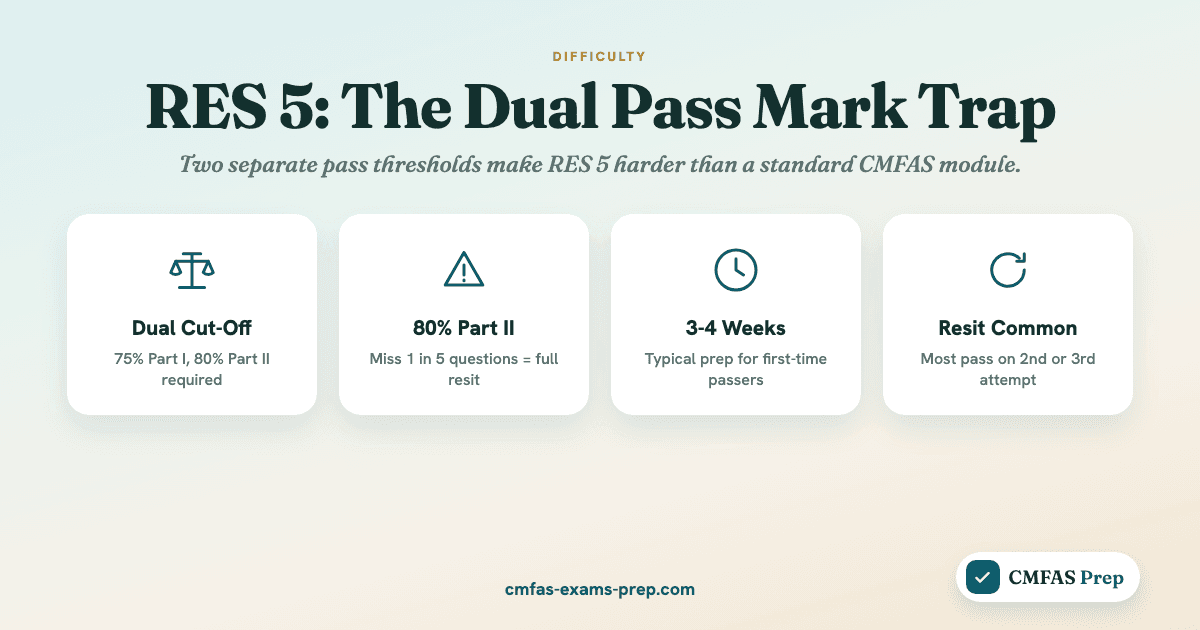
The RES 5 exam is challenging, with a unique two-part scoring system that requires candidates to pass both Part I (75% minimum) and Part II (80% minimum) separately. Many candidates fail not because they lack knowledge, but because they don't understand this scoring format or focus too much on one part over the other.
With a structured 4-week study plan, most candidates can adequately prepare for the RES 5 exam. However, the exact time depends on your background knowledge and how consistently you study. Following our proven strategy helps you maximize your preparation efficiency.
RES 5 replaced the CMFAS M5 exam with an updated syllabus that reflects current regulations and best practices in Singapore's financial advisory industry. The two-part scoring system is a key differentiator that makes RES 5 more challenging than its predecessor.
Yes, absolutely! Many candidates pass RES 5 on their first try by following a strategic study plan, understanding the two-part scoring system, taking realistic mock exams, and focusing on their weak areas. The key is preparation, not memorization.
If you fail either Part I or Part II, you fail the entire RES 5 exam, regardless of how well you did on the other part. You must retake the entire exam and pass both parts in the same sitting. This is why understanding the two-part scoring is crucial.