RES 5 sample questions: the situational style, with worked answers
Failing your mocks? See 5 tricky CMFAS RES 5 exam questions (2026 Syllabus) that trip up most agents. Get the full Q&A breakdown & spot the "Situational Traps."
Here are five RES 5 practice questions written for the 2026 syllabus, each with the answer and the rule behind it. They copy the shape of the real paper: a short situation, four options that all sound reasonable, and one correct choice that turns on what the Financial Advisers Act actually says rather than what happens in a normal sales meeting.
That gap is where most candidates lose marks. You can know the textbook cold and still fail the ethics questions, because the 2026 paper rarely asks you to recite a penalty or a definition. It hands you a scenario and asks what you should do. The options are built to reward the answer that sounds practical and helpful, which is usually the answer that breaches a rule.
How the marks work in the ethics section
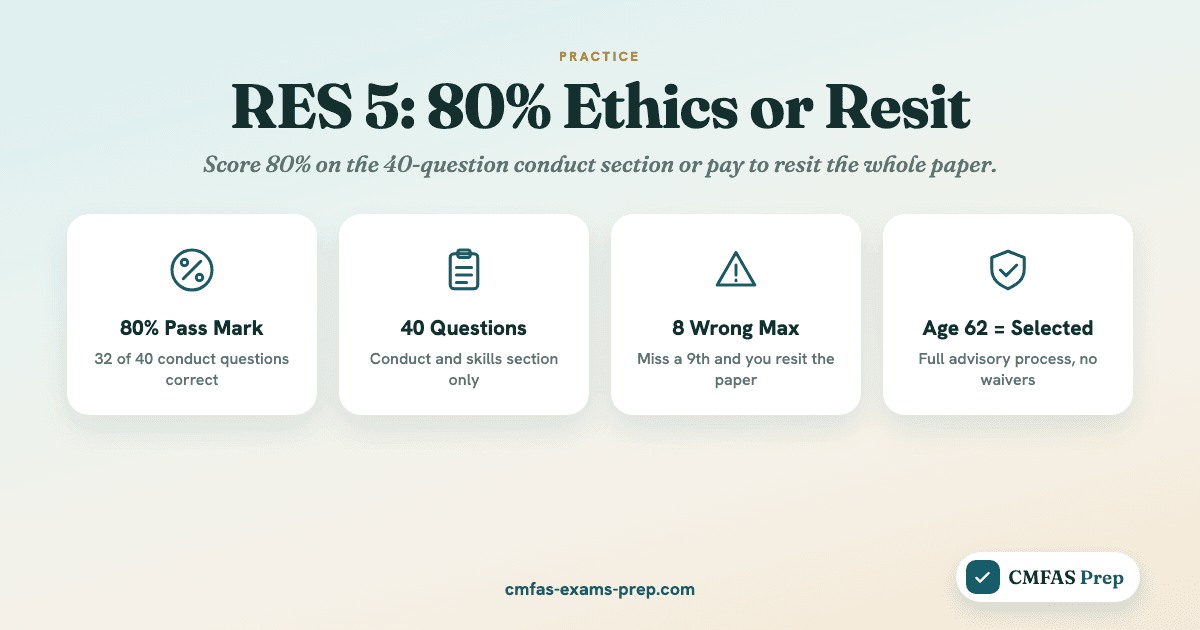
The part of RES 5 that tests rules of conduct and skills has 40 questions, and you need 80% to clear it. That is 32 correct out of 40. You can afford eight wrong answers and no more. Miss a ninth and you resit the whole paper, pay the fee again, and wait for the next slot.
Eight is a thin margin once you realise how many questions are designed to look like two right answers. The fix is not more reading. It is doing enough worked scenarios that the trap becomes obvious before you reach the options.
Work through the five below honestly. Pick your answer before you read the explanation.
Question 1: the client who wants to skip her own checks
Mdm Goh is 68, of sound mind, and dead set on a single-premium investment-linked policy because her neighbour did well out of one. Her adviser, Raymond, walks her through the risks. She waves them off and asks to buy it on the spot. To save her a second appointment, Raymond offers to have her sign a waiver of the financial needs analysis so the sale can go through that day.
Is Raymond allowed to do this?
A) Yes, since Mdm Goh is mentally competent and chose the product herself. B) No, a representative cannot put a selected client onto a waiver of the financial needs analysis. C) Yes, as long as he records the sale as execution-only at her request. D) Yes, provided a relative signs as a witness.
The answer is B. Mdm Goh is a selected client, the category that covers anyone aged 62 or older or with low educational qualifications. For these clients you cannot transact on a waiver of the needs analysis, full stop, no matter how firmly they ask. The full advisory process exists precisely to protect this group, so her consent does not remove the duty. A and C feel right because waivers are common in the field, and that familiarity is the trap.
Question 2: thanking the friend who sent a lead
Wei Lin holds a representative's licence. Her cousin Daniel, a property agent with no financial advisory licence, sends a client her way. The client buys a whole-life policy. Wei Lin wants to pass Daniel 15% of her commission as a thank-you.
Can she?
A) Yes, if she tells the client about the arrangement. B) Yes, because Daniel only passed a name and gave no advice. C) No, a representative cannot share commission with anyone who is not a licensed or exempt financial adviser. D) Yes, as long as the money comes from her own earnings and not the client's premium.
The answer is C. Commission sharing is closed to unlicensed people, and disclosure does not open it. The rule exists because paying outsiders for introductions quietly turns them into unlicensed solicitors. Option A is the one that catches people, because in plenty of other industries telling the client makes a payment fine. Here it does not.
If a question hands you "just disclose it" as an escape hatch, treat that as a warning sign rather than an answer.
Try more RES 5 scenario questions free
Question 3: the roadshow gift
An agency runs a mall roadshow. To pull a crowd, the banner reads: sign up for a 10-year endowment today and walk away with a free tablet worth $1,200. The cost of the tablet is fully borne by the agency, not the client.
Does the promotion sit within market conduct rules?
A) Yes, because the client pays nothing for the gift. B) No, a gift this large can push someone into a policy they do not need. C) Yes, gifts are fine as long as they are not cash. D) No, insurers can never give gifts of any kind.
The answer is B. Gifts are not banned outright, so D is wrong. The line MAS draws is about influence: a gift cannot be so substantial that it improperly sways the buying decision away from whether the product actually suits the client. A $1,200 tablet attached to a 10-year commitment crosses that line. A and C are tempting because everyone has seen free luggage and gadgets handed out at roadshows, but "the client didn't pay for it" is not the test.
Question 4: the applicant with a credit card balance
Marcus is applying to become a representative. He carries a $9,000 credit card balance that he pays down on time every month. He has never been made bankrupt.
Does this hurt his financial soundness under the fit and proper criteria?
A) Yes, any unsecured debt above $5,000 rules him out. B) No, he is not an undischarged bankrupt and is servicing the debt on schedule. C) Yes, he has to clear every debt before he can be licensed. D) No, unless the debt is more than three months of his pay.
The answer is B. Owing money is not the same as being unfit. The fit and proper assessment of financial soundness looks at whether you are solvent and manage your obligations sensibly, not at whether your balance is zero. Marcus pays on time and is not bankrupt, so he meets it. The trap is panic: candidates see the word "debt" and reach for A or C, inventing a hard cutoff that the guidelines do not set.
Question 5: the client who won't share his details
A client wants to buy a particular unit trust but refuses to tell his adviser his income, his job, or his financial goals.
What should the adviser do?
A) Refuse to sell anything until the client cooperates. B) Transact on an execution-only basis and tell the client no advice can be given and the product may not suit him. C) Sell it and mark the risk profile as aggressive by default. D) File a report with the Suspicious Transaction Reporting Office.
The answer is B. A client is allowed to hold back information, and you can still carry out the trade for him. What you cannot do is pretend you advised him. You process it as execution-only and make clear, on record, that no advice was given and suitability cannot be confirmed. People reach for A because refusing feels like the strict, safe choice, or for D because withholding information sounds suspicious, but a quiet client is not a money-laundering report.
What these five have in common
Every one of them rewards the candidate who has read the rule and punishes the candidate who answers from experience. That is the core skill the 2026 paper is testing. A quick way to check your reasoning under exam pressure:
- Ask who the rule protects, not what is convenient for the sale.
- Treat "the client agreed" and "I disclosed it" as red flags, since neither overrides a conduct rule.
- Watch for selected clients, because the rules tighten the moment age 62 or low education appears.
- When information is missing, think execution-only with a warning before you think refuse or report.
If those instincts are not automatic yet, that is the part to drill. Reading a list of rules once does not build them; answering scenario after scenario until the pattern is reflex does.
How to practise the rest
Five questions show you the style. Clearing 32 out of 40 on exam day takes far more repetition than any free sample can give you. A few hundred worked scenarios, sorted by topic, with the reasoning spelled out, is what moves the needle.
CMFAS Prep holds over 1,000 RES 5 questions written to the 2026 syllabus, with a heavy share of the conduct and skills scenarios that decide pass or fail. Each answer cites the rule it rests on, so you learn why B is right rather than just memorising that it is. The app also tracks which chapters you keep missing and feeds those back to you, so your weakest topic gets the most reps instead of the least.
If you are still choosing where to drill, the mock exam comparison guide lays out the options. And if you have not booked your sitting yet, the registration walkthrough covers the steps and the fee before you commit.
Start with the question bank, set the mode to the conduct and skills chapters, and keep going until 80% feels routine rather than lucky. Practise the RES 5 questions on CMFAS Prep when you are ready.
Practise RES 5 now
800+ exam-style RES 5 questions with instant explanations.
Frequently asked questions
You can find updated RES 5 exam questions on CMFAS Prep, which offers a bank of over 1,000 questions specifically designed for the 2026 syllabus, including the new situational format.
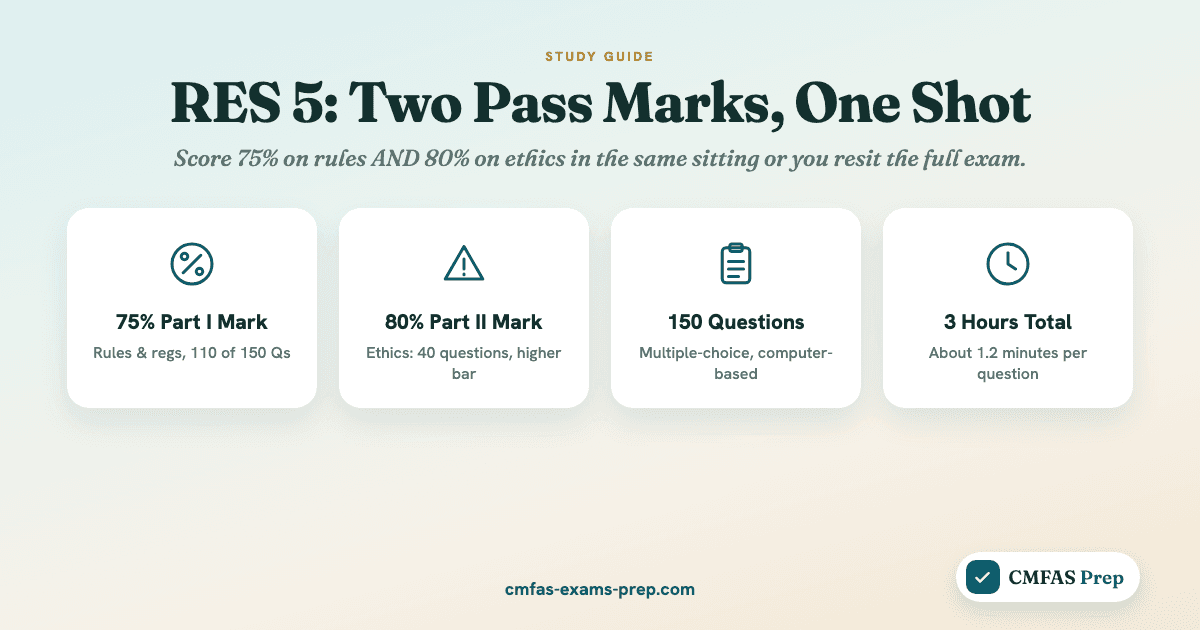
Yes, the RES 5 exam consists of 150 Multiple Choice Questions. However, they are split into "Knowledge" (Recall) and "Competency" (Application/Situational) styles.
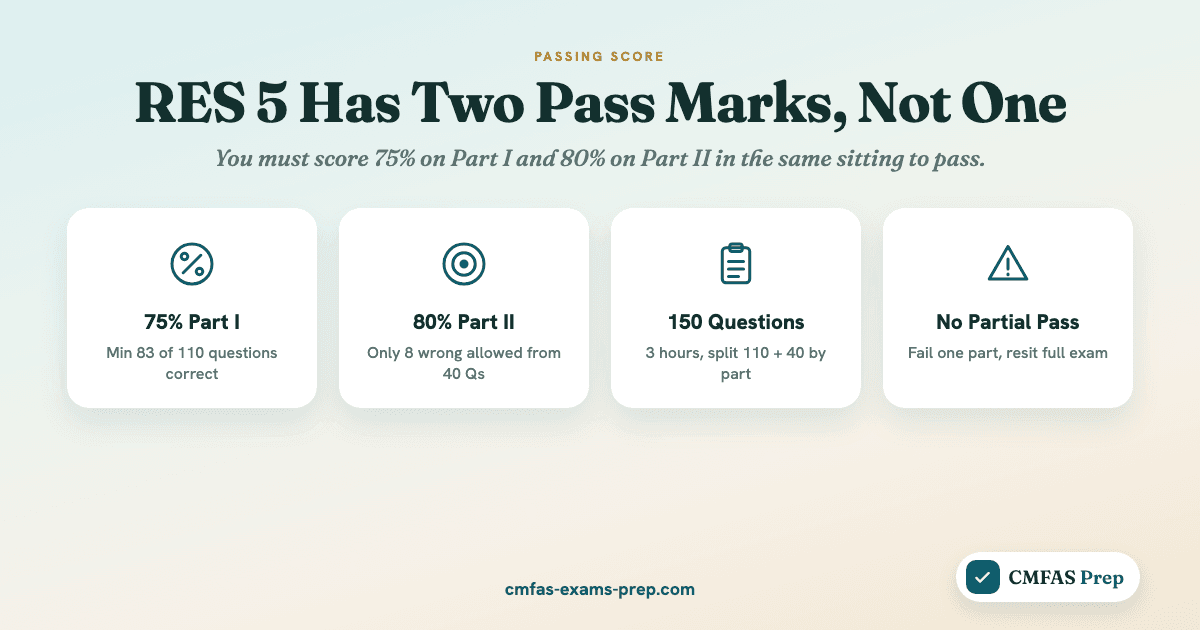
You need to answer approximately 83 out of 110 questions correctly for Part I (75%) and 32 out of 40 questions correctly for Part II (80%).
No, there is no negative marking for incorrect answers in the RES 5 exam. You are encouraged to attempt every question, even if you have to make an educated guess.
Situational questions are most common in the "Market Conduct" and "Ethics" chapters. Specifically, look out for scenarios involving the "Reasonable Basis for Recommendation" and "Fair Dealing Guidelines," as these require judgment rather than just memorization.