Booking the RES 5 exam: portal, fees and dates
How to register for the CMFAS RES 5 exam. 2026 guide to SCI fees ($218+), booking day vs evening slots, calculator policy, and license prerequisites.
Registering for the CMFAS RES 5 exam takes about 15 minutes once you have an account on the Singapore College of Insurance (SCI) portal, and the booking itself is the simplest part of the whole process. The harder questions are which session to book, what you actually need before MAS will appoint you, and how to use the weeks between booking and exam day.
This guide walks through the registration end to end and flags the things first-time candidates trip over.
Before you book: confirm you can be licensed
Anyone can pay to sit RES 5 (Rules and Regulations for Financial Advisory Services). The SCI exam portal will not ask for your age or qualifications, and that catches people out. Passing the paper is not the same as being allowed to advise clients.
To be appointed as a financial adviser representative, the Monetary Authority of Singapore (MAS) requires the appointing firm to confirm you meet the minimum entry standards. In practice that means you are at least 21 and hold one of the following:
- A full GCE 'A' Level certificate with at least two passes, or
- A diploma from a local polytechnic, or
- A degree, professional qualification, or other equivalent recognised by MAS.
If you do not yet meet these, the exam fee is money you cannot get back. You will sit the paper, possibly pass it, and still have no route to appointment until the qualification is in place. Sort the eligibility question first, then book.
It also helps to know whether your firm is paying. Many candidates are sponsored, and a sponsored booking sometimes runs through the firm's training coordinator rather than your own account. Ask before you pay out of pocket.
What RES 5 actually is
RES 5 is the module that replaced the old M5 paper. If you find study notes or forum threads labelled "M5", treat them with care, because the syllabus has moved on and the question style with it. When you reach the module dropdown in the portal, pick RES 5, not M5.
The exam runs as a Computer Screen Examination (CSE) at SCI's premises. It comes in two parts that are marked separately:
| Part | Topic area | Questions | Pass mark |
|---|---|---|---|
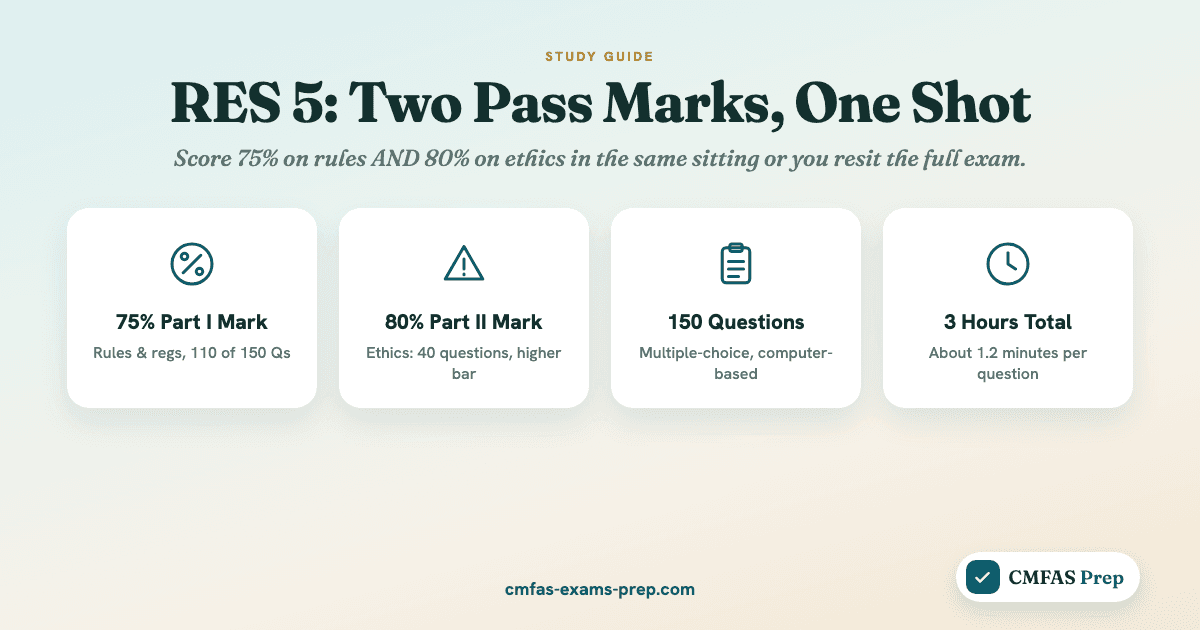
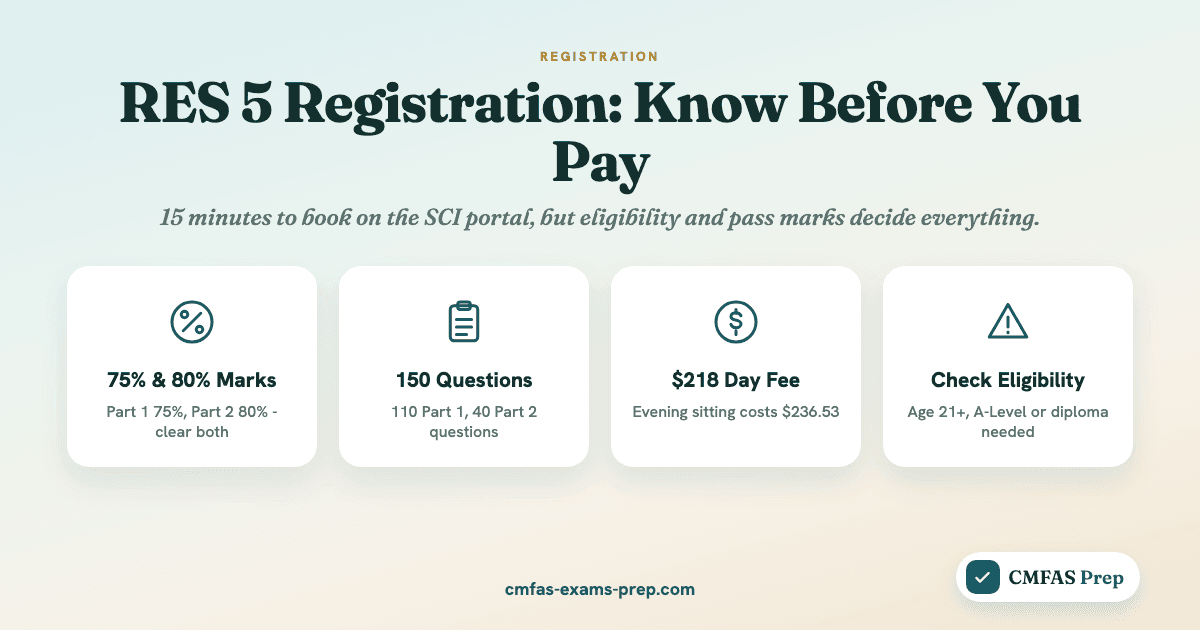
| Part 1 | Rules and regulations | 110 | 75% |
| Part 2 | Ethics and skills | 40 | 80% |
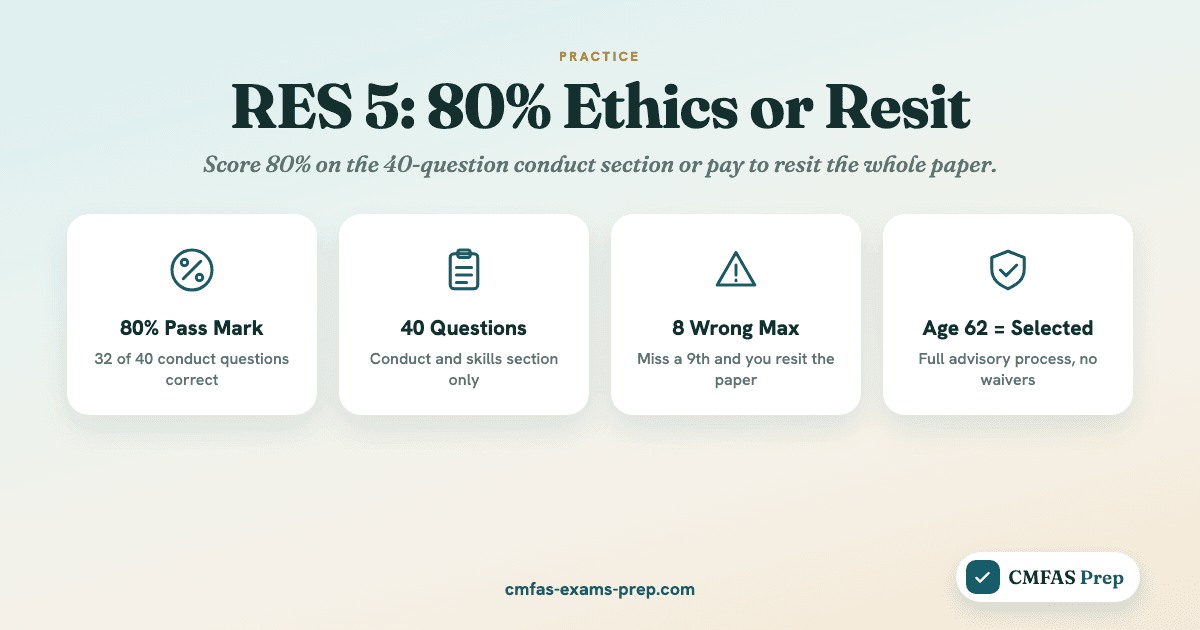
You have to clear both parts in the same sitting. Scoring 90% on Part 1 does nothing for you if Part 2 lands below 80, and you would re-sit the whole exam, not just the half you failed. That two-part structure is the single biggest reason people underestimate RES 5, so plan your revision around clearing the higher Part 2 bar rather than just the larger Part 1. There is more on the scoring rules and why both halves matter in our breakdown.
Step-by-step registration
Create your candidate account
Go to the SCI website and look for the candidate registration option. Set the account up under a personal email address rather than a work one. Your exam results and eBook access stay tied to this login, and if you change employers later you will want to keep it.
Pick the RES 5 module
Once you are logged in, open the exam registration section and choose CMFAS as the exam family. From the module list, select RES 5. Double-check the module title on the confirmation screen before paying, since the dropdown sits next to similarly named papers like M8, M9 and HI.
Choose a session
There are day and evening sittings, and they are not the same price. For a non-member candidate:
- Day session: $218.00
- Evening session: $236.53
The day slot is the cheaper one by roughly $18, and it also tends to be the better choice for focus, since you are sitting the paper fresh rather than after a full day at work. Book early either way. Popular dates, especially month-end and the run-up to firm intake deadlines, fill weeks ahead, so aim to secure a slot three to four weeks out.
Pay and get your study text
SCI stopped issuing printed study guides. After payment you receive an email with a link to the RES 5 eBook, and that digital copy is the official, current version of the syllabus. Any updates SCI makes are folded into the eBook automatically, which is one reason it has replaced hard copies.
If the email does not land within a few minutes, check your spam or junk folder before contacting SCI. The access link is sometimes filtered out.
What the syllabus covers
Part 1 is the regulatory bulk of the exam. Expect the Financial Advisers Act and its regulations, the relevant MAS notices and guidelines including anti-money-laundering and countering-the-financing-of-terrorism requirements, rules on investment-linked policies and life insurance, market conduct, and CPF-related schemes that affect advice. It is wide, and a lot of it is rote.
Part 2 shifts from rules to judgement. It covers ethical conduct and conflicts of interest, the fact-find and financial needs analysis process, building suitable recommendations, and reviewing a client's situation over time. The questions here are often situational: you are given a client scenario and asked which action is appropriate. Two answers can both look defensible, which is exactly why the 80% pass mark stings. We pulled apart five of these in a walkthrough of RES 5 situational questions if you want to see how the framing works.
The authoritative chapter list lives on the SCI exam details page for RES 5. Use it to check nothing in the eBook is missing before you start revising.
After you've booked
A booked exam comes with a date, and the most common mistake is treating that date as far away. With the fee above $200 and a re-sit costing the same again, a fail is an expensive way to learn that you started a week too late. RES 5 has a reputation for being hard for a reason, and most of that difficulty is volume plus the twin pass marks. Our note on how tough RES 5 really is sets out what the failure rate actually reflects.
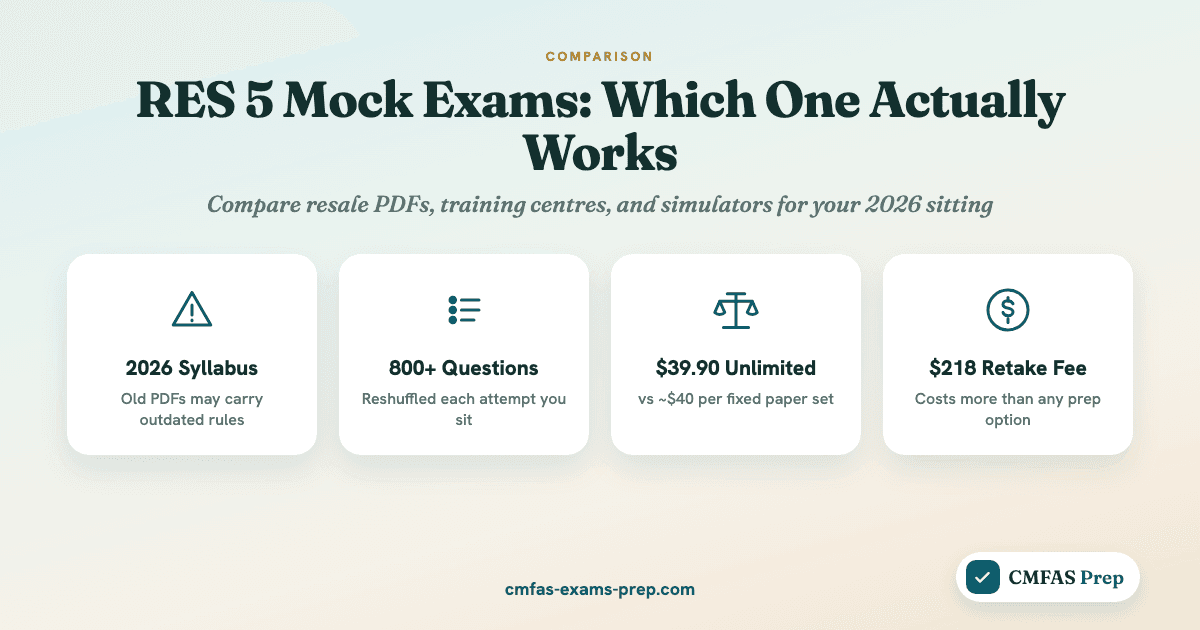
Spend your first revision session finding your weak chapters rather than reading cover to cover. Before you buy any third-party notes, check they match the 2026 syllabus, because outdated material is common; our comparison of RES 5 mock exam options covers what to look for.
Exam-day logistics
A few practical things decide whether the morning goes smoothly:
- Bring your physical NRIC or Employment Pass. No ID, no entry.
- Bring your own calculator. SCI does not supply one. Approved models include the Casio FC-100, FC-100V, FC-200 and FC-200V, the HP 10b and 10b II, the Texas Instruments BA II Plus, and the Sharp EL-735 and EL-738. RES 5 is mostly theory, but a calculator is worth having for any planning-related question in Part 2.
- Use the on-screen flag tool. Mark anything you are unsure of, move on, and return to flagged questions once you have banked the easy marks. Both parts reward finishing rather than stalling on one hard item.
Practise before you sit
Booking RES 5 is administrative. Clearing 75% on Part 1 and 80% on Part 2 in one go is the real task, and the surest way there is repeated timed practice against questions written to the current syllabus.
You can work through full RES 5 question sets on CMFAS Prep, see which chapters you are weakest on, and re-test until both parts sit comfortably above the pass marks. When you are ready to start, the RES 5 module page has the practice plan and pricing.
Practise RES 5 now
800+ exam-style RES 5 questions with instant explanations.
Frequently asked questions
For non-members (most individuals), the fee is $218.00 for day sessions and $236.53 for evening sessions (inclusive of GST). Retakers pay the same full fee.
SCI states that no calculators are provided. You should bring an approved financial calculator (e.g., Casio FC 100V or TI BA2+) just in case, although RES 5 focuses more on rules and ethics than complex math.
Yes, if you request it more than 7 days in advance, the first change is free. If you request it between 2-7 days before, there is an admin fee of $32.70. No changes are allowed within 2 days of the exam.
No. SCI has a strict policy that all results are final. They do not entertain any appeals or requests to re-check the exam paper, regardless of how close you were to the passing mark.
There is no limit. You can retake the exam as many times as necessary until you pass. However, there is no discount for retakes; you must pay the full registration fee for every single attempt.