M9A sample questions: ILP charges and policy values to try
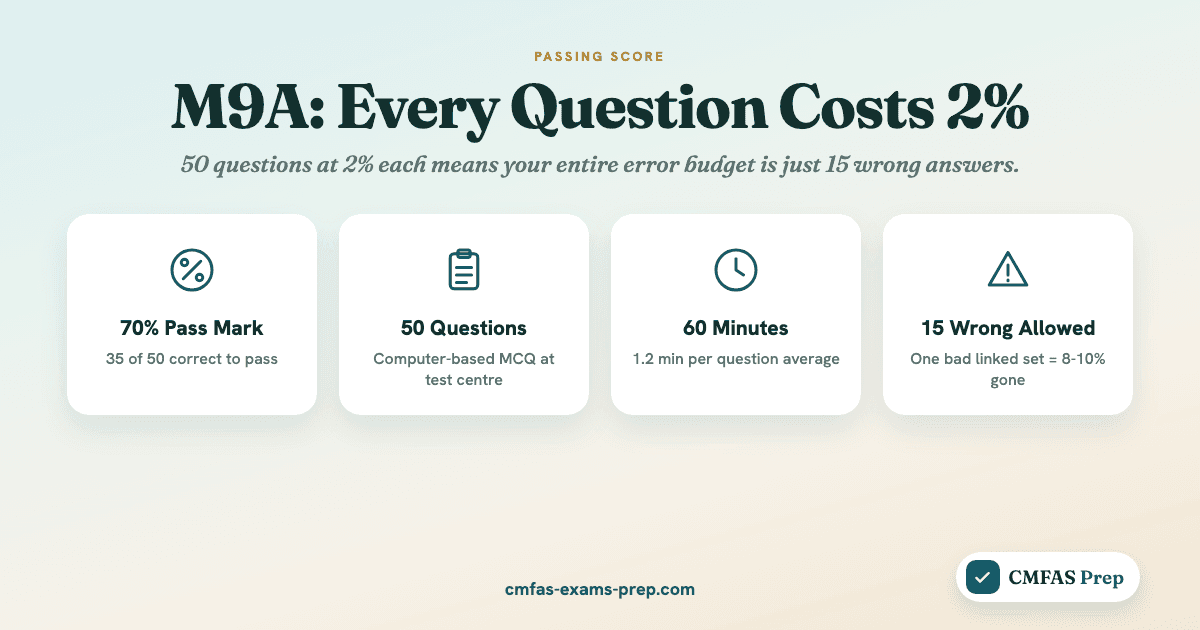
M9A gives you 50 questions in 60 minutes and 70% to pass. Try three worked examples on ILP charges and policy values before you sit it.
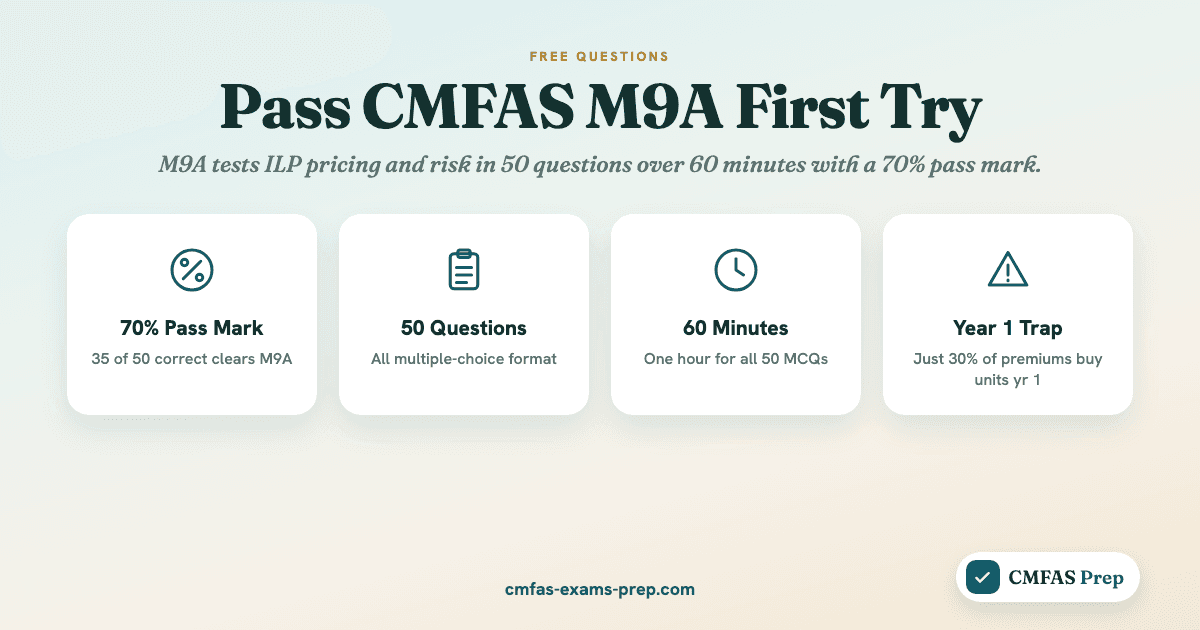
M9A gives you 50 multiple-choice questions in 60 minutes, and you need 70% to pass. The questions that fail people are rarely the definitions. They hand you a client, a premium, and a set of charges, then ask what the policy is actually worth. Below are three worked examples on the parts of the M9A syllabus that cost the most marks: how units are priced, where the early-year money goes, and who carries the investment risk.
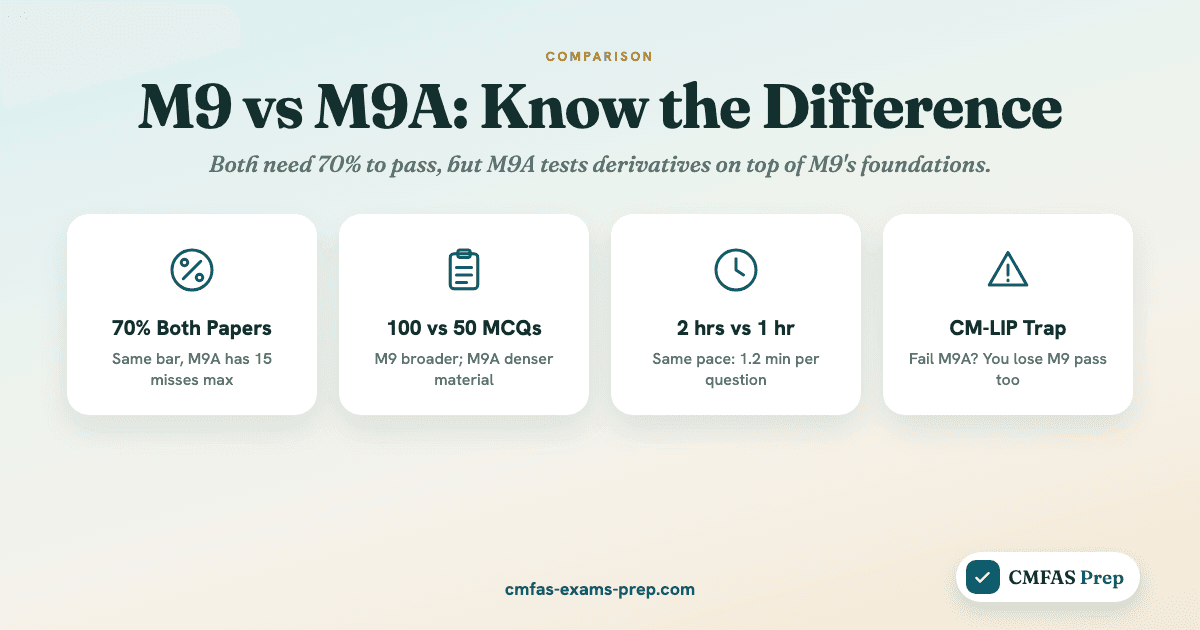
M9A is CM-LIP Part 2, the investment-linked policy paper. If you have not sat M9 yet, or you are unsure which one you need, read M9 vs M9A first.
What actually gets tested
The exam is principle-heavy, but the marks hide in the arithmetic of an ILP: the bid-offer spread, the allocation rate, fund switching limits, and matching a fund to a client's risk profile. You can recite the definition of an investment-linked policy (ILP) word for word and still lose a run of questions because you cannot tell where the premium goes in year one.
Question 1: how units are priced
A client pays a single premium of S$10,000 into an ILP. The allocation rate is 100%. Units are bought at the offer price of $1.00 and valued for surrender at the bid price of $0.95.
What is the policy worth the moment the units are bought?
A) S$10,000 B) S$9,500 C) S$10,500 D) S$500
Answer: B.
The premium buys 10,000 units at the offer price of $1.00. Those same units are valued at the bid price of $0.95 if the client cashes out, so the surrender value is S$9,500. The 5% gap between offer and bid is the bid-offer spread, and it comes off the top straight away. The trap is reading "100% allocation" as "no cost." Full allocation still leaves the spread sitting against you.
This is the kind of question CMFAS Prep's Practice by Chapter mode lets you isolate, so you can sit on fund pricing until the numbers come without thinking.
Question 2: where the first year's premium goes
A regular-premium ILP has an allocation rate of 30% in the first policy year. The annual premium is S$3,600.
How much of that first premium is used to buy units?
A) S$3,600 B) S$2,520 C) S$1,080 D) Nothing, the first year is free
Answer: C.
Only 30% of S$3,600 buys units, which is S$1,080. The other S$2,520 covers initial and distribution charges in the early years. Allocation rates on regular-premium ILPs are usually low at the start and climb toward 100% in later years, which is why surrendering an ILP in the first two or three years often returns far less than the premiums paid in. The trap is assuming the allocation rate applies to the fund value rather than to the premium going in.
Question 3: who carries the risk
Which statement correctly describes an ILP?
A) The insurer guarantees the maturity value. B) The policyholder carries the investment risk and the unit value can rise or fall. C) Once a bonus is declared it cannot be taken back. D) Premiums are paid into the insurer's participating fund.
Answer: B.
In an ILP the premium, after charges, buys units in sub-funds the client picks. The value tracks those funds with no guarantee, so the policyholder carries the investment risk. Options A, C and D describe a participating (par) policy, where bonuses are smoothed and a declared bonus is locked in. Confusing ILPs with par policies is one of the most common ways to drop marks in M9A, because the suitability rules and the disclosure you owe the client differ for each.
Fund switching and the free-switch limit
A lot of ILPs give the client a set number of free fund switches each year, after which a switching fee applies. The exam likes to test whether you know that a switch moves money between sub-funds inside the same policy rather than buying a new product, and whether you can spot when a charge kicks in. Read the numbers in the question. A client on their fourth switch in a year where three are free is paying a fee on that one.
The part people underestimate: suitability
A chunk of M9A is not arithmetic at all. It gives you a client's age, goals, and appetite for losses, then asks whether a fund or an ILP fits. A 60-year-old close to retirement put into an aggressive equity sub-fund is a wrong answer even when every product fact in the question is correct. Read the client first, then the product.
The mortality charge is another quiet one. In a regular-premium ILP the cost of insurance is paid by cancelling units each month, and it rises as the client ages. In a poor fund year, those charges plus falling unit prices can erode the value faster than new premiums top it up. Expect at least one question that turns on this.
How to prepare without wasting time
M9A rewards repetition on a small set of mechanical points: pricing, allocation, charges, switching, and suitability. Reading notes does not build that. Answering questions and seeing why you were wrong does.
On CMFAS Prep the M9A bank has 300+ questions and full-length mocks set to the real format of 50 questions in an hour. Every answer comes with an explanation, so a wrong pick on the bid-offer spread becomes a fixed gap instead of a guess you keep repeating. The AI Weakness Engine tracks which chapters you keep missing and feeds more of those back to you, and the questions follow the 2026 syllabus. If you want to see how the mock sets compare before you commit, here is the M9A mock exam comparison.
Work through these three until the pricing and risk-bearing answers are automatic, then sit a full mock. Start practising M9A on CMFAS Prep.
Practise M9A now
800+ exam-style M9A questions with instant explanations.
Frequently asked questions
You can find 2026-updated M9A mock questions on CMFAS Prep. We offer a bank of over 800 questions covering Derivatives, Structured Products, and Case Studies.
Yes. You will need to calculate payoffs for Options, Futures, and Structured Notes. While the math isn't as heavy as M9, the *logic* required to set up the equation is harder.
M9 covers Life Insurance Principles and Laws. M9A covers Investment-Linked Policies, specifically the complex Derivatives and Structured Products used within them.
The passing score for M9A is 35/50, and the exam is 1 hour long.
CMFAS Prep helps you pass M9A by providing you with a comprehensive study plan, practice questions, and instant feedback. We also have a "Practice by Chapter" mode to help you focus on your weak spots.