CMFAS M9A format and pass mark: small paper, high stakes
CMFAS M9A is 50 questions in 60 minutes and you need 35 right. See why the short paper and linked case sets raise the stakes, and how to pace it.
What you need to score on M9A
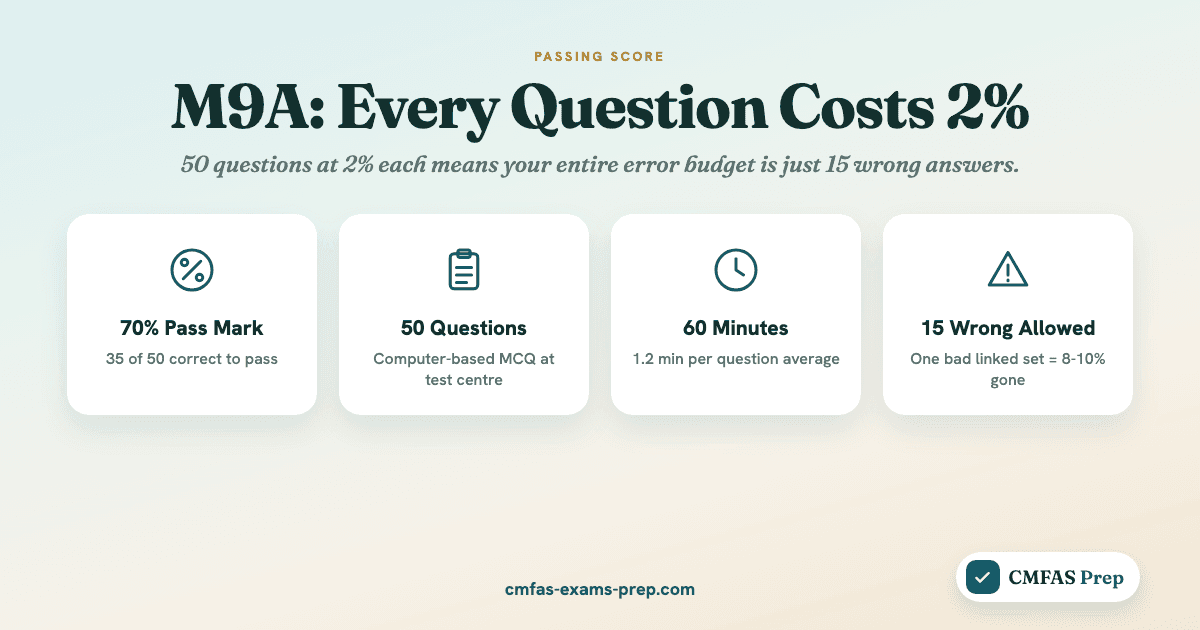
You pass M9A (Life Insurance and Investment-Linked Policies II) by getting at least 70% correct, which means 35 of the 50 questions. The paper is 50 multiple-choice questions in 60 minutes, sat on a computer at the test centre. That format reads as gentler than M9, and that impression is exactly what catches people out.
Here is the part most candidates miss. A shorter paper does not mean an easier one. It means every question carries more weight, so the margin you have for slips is thinner than it looks.
M9A at a glance
| Item | M9A |
|---|---|
| Pass mark | 70% (35 of 50 correct) |
| Questions | 50 MCQs |
| Duration | 60 minutes |
| Value per question | 2% |
| Wrong answers allowed | Up to 15 |
| Format | Computer-based at the test centre |
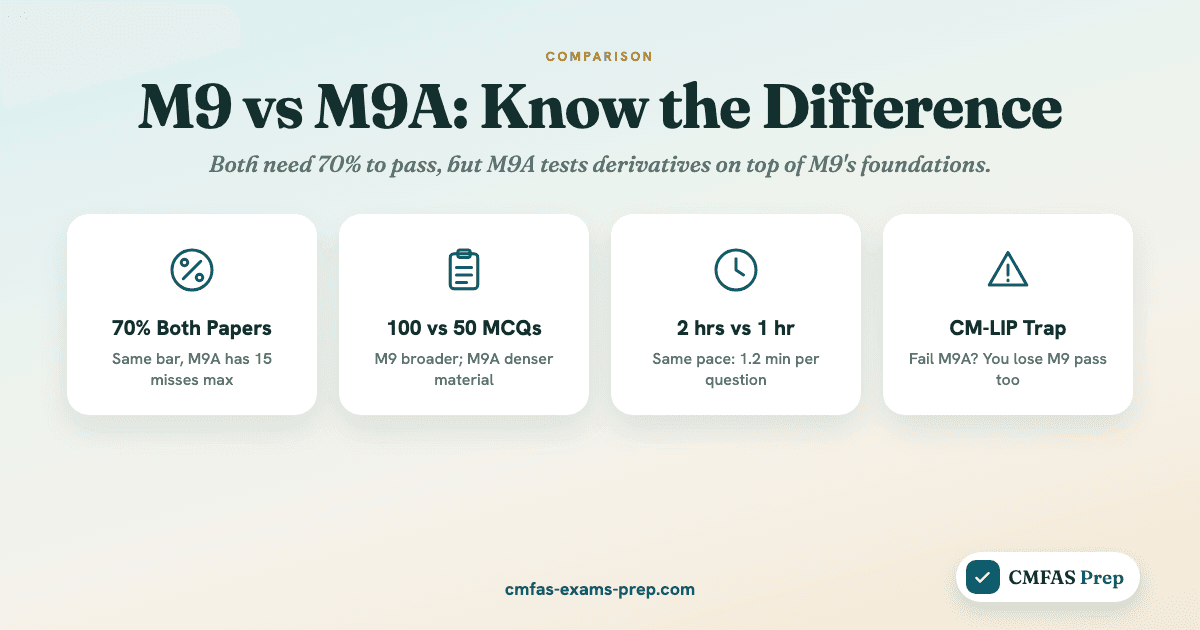
If you are still deciding between modules or weighing M9A against the first paper, the M9 vs M9A breakdown lays out who needs which.
Why fewer questions raises the stakes
Run the arithmetic and the pressure becomes obvious. On M9, a 100-question paper, one wrong answer costs you a single percentage point. You can drop 30 questions and still clear the bar.
M9A halves the question count but keeps the same 70% pass mark. So each question is now worth 2%, and your entire error budget is 15 questions across the whole paper. Get one section badly wrong and a big chunk of that budget is gone before you have even reached the topics you are strong on.
This changes how you should study. On a long paper you can afford a weak chapter and make it up elsewhere. M9A gives you no such cushion. A candidate who is excellent on policy fundamentals but shaky on investment-linked product mechanics can still fail, because there are not enough "easy" marks left over to absorb a cluster of mistakes in one area. The realistic goal is to be steady everywhere rather than brilliant in two places and exposed in a third.
The linked-question problem
The structural feature that does the most damage on M9A is the linked-question set. Instead of 50 standalone items, parts of the paper hang several questions off a single piece of source material: a product fact sheet, a structured product term sheet, or a short client scenario. You read one document, then answer a run of questions that all depend on reading it correctly.
When the questions are independent, a misread costs you one mark. When they are linked, a misread at the top can knock out the whole set. Misjudge the payoff condition on a structured note, or confuse the participation rate with a capped return, and you can lose four or five questions from one wrong assumption. At 2% each, that is 8% to 10% gone in a couple of minutes, and you are suddenly working with almost no room to spare.
The fix is not more memorising. It is reading discipline. Train yourself to pull the few facts that actually drive the answers out of a dense term sheet: the underlying, the protection level, the trigger or barrier, the maturity, and what happens in the worst case. Once you can extract those quickly and reliably, a linked set turns from a trap into a block of marks you can bank.
You can drill exactly this kind of question inside the M9A practice app, where case-study sets are grouped so you get repeated exposure to fact sheets and term sheets under timed conditions.
Pacing 50 questions in 60 minutes
On paper you have 1.2 minutes per question, the same average as M9. The catch is that M9A spends those minutes very unevenly.
Straight recall questions on definitions, product features, and disclosure rules take far less than a minute each. The calculation items and the linked case-study sets can swallow two to three minutes apiece, because you have to read the source, work out what is being asked, and check your reasoning. If you treat every question as if it deserves 1.2 minutes, you will arrive at the heavy questions with no spare time.
A pacing plan that works:
- Move fast through the recall questions and deliberately build a time surplus.
- Treat that surplus as fuel for the calculation and case-study sets, which are where the marks are genuinely earned.
- If one structured-product calculation refuses to resolve, flag it, lock in an answer you can revise, and move on. Never let a single hard item cost you three easy marks elsewhere.
- Leave a few minutes at the end to revisit anything you flagged.
Because the exam is on screen, use the flag-and-review tools the system gives you. You can move between questions freely, so there is no reason to stall on one item while the clock eats into the rest of the paper.
Where candidates actually lose marks
Most M9A failures are not knowledge gaps. They are precision gaps. The content that trips people up tends to be the investment-linked and structured product material: how returns are generated, where the risk sits, how charges affect the policyholder, and what the client is and is not protected against. These are also the topics most likely to appear as linked sets, which is why a weakness here compounds.
Careless definition errors do quiet damage too. Mixing up two similar product features, or misreading a question that hinges on a single qualifying word, costs the same 2% as a genuinely hard calculation. On a paper this short, sloppy losses on questions you actually knew are what push a 36 down to a 33.
If you want a sense of how thorough your preparation needs to be before you book, the best M9A mock exams comparison covers which practice sets carry the current 2026 syllabus and which are out of date.
How to know you are ready
Treat 35 out of 50 as the floor, not the target. Aim to sit your real attempt at a point where your timed practice scores land comfortably in the high 30s or low 40s, so a couple of unlucky questions on the day still leave you clear of the line. A score that hovers right at 35 in practice usually slips below it under exam pressure.
Practical readiness check before you register:
- You can read a term sheet and answer a linked set without second-guessing the source.
- You finish full 50-question timed papers with minutes to spare.
- Your wrong answers are spread out, not clustered in one weak topic.
- Your scores are stable across several attempts, not one good run among several poor ones.
When all four hold, you are sitting on the right side of the margin.
The most direct way to get there is repeated timed practice on the question types that decide M9A. Work through full-length papers and the case-study sets on CMFAS Prep, check where your marks leak, and keep going until 35 out of 50 stops being a stretch and starts being your worst day.
Practise M9A now
800+ exam-style M9A questions with instant explanations.
Frequently asked questions
Yes. The exam consists of 50 Multiple Choice Questions (MCQ) with 4 options each. There are no essay or open-ended questions.
While it varies, you can expect about 6-10 questions to be based on Case Studies or Product Fact Sheets. These are usually grouped (e.g., 3 questions referring to one scenario).
If you took them as separate modules, your M9 pass remains valid. If you took them as the combined "CM-LIP" paper, you fail the **entire** exam and must retake both parts.
The retake fee is the same as the first attempt: **S$130.80 (Day)** or **S$149.33 (Evening)**. Since there is no discount for retakes, it is financially smarter to invest in a proper simulator to pass on the first try.
M9A is less about memory (Recall) and more about **Application**. You will see fewer "What is X?" questions and more "Given Client A's risk profile and Product B's payoff structure, is this suitable?" questions. This requires a deeper understanding of the concepts.