A study plan for CMFAS M9A: fewer chapters, denser marking
A tutor's take on CMFAS M9A: 50 MCQs, 60 minutes, 70 percent to pass, and why the short textbook trips up candidates who breezed through M9.
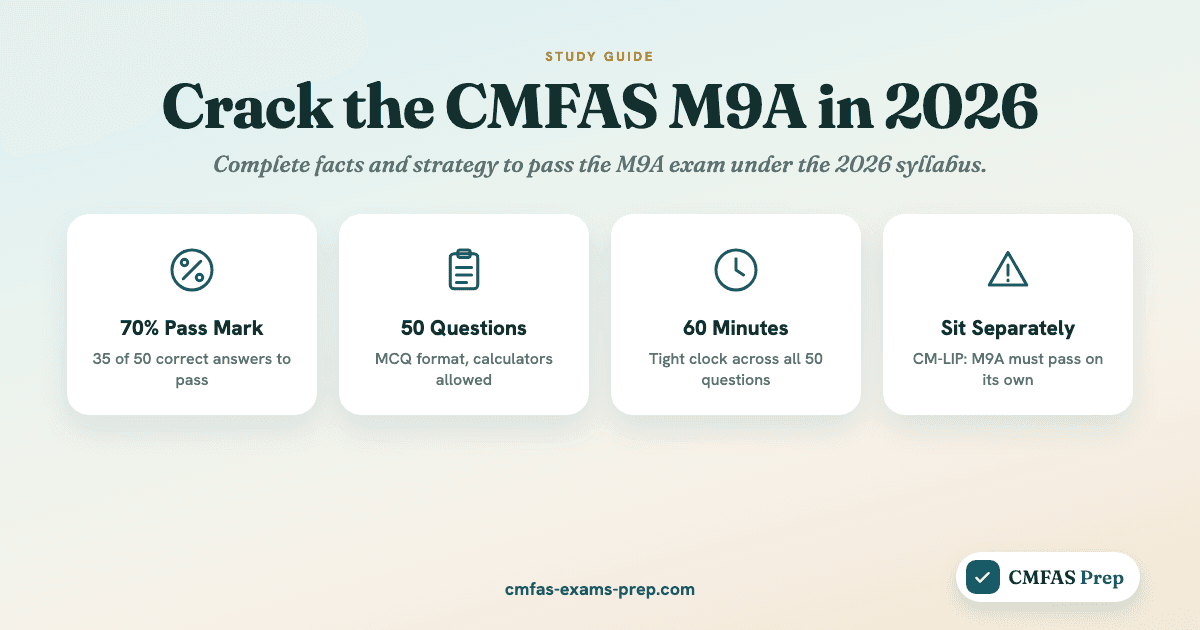
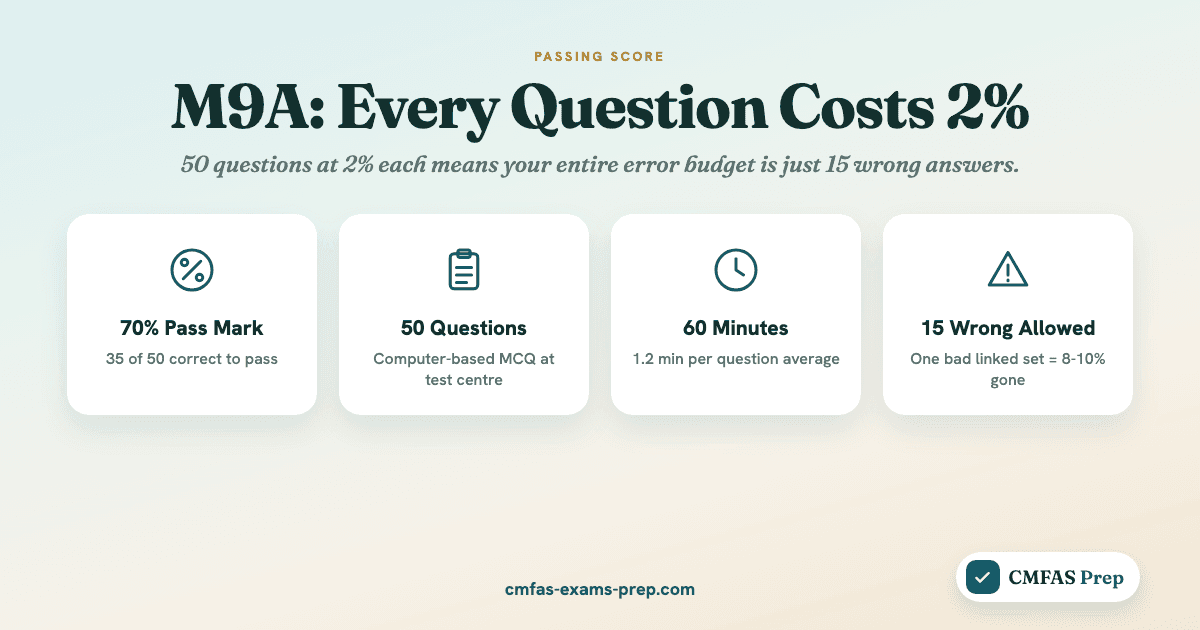
To pass the CMFAS M9A exam you need 35 correct answers out of 50 multiple choice questions in 60 minutes, which works out to a 70 percent pass mark. The paper covers life insurance investment-linked products built on derivatives and structured products, so the work is less about recalling rules and more about following how a payoff is built. If you already cleared M9 and assumed M9A would feel similar, that assumption is where most candidates lose marks.
M9A sits in the Securities and Futures examination series run by SCI. The full name is Life Insurance and Investment-Linked Policies II, and it goes deeper into the financial products that sit underneath an investment-linked policy. SCI has scheduled a minor syllabus revision that takes effect on 24 Feb 2026, so check that any material you buy reflects that date. The CMFAS Prep question bank already carries the updated content.
What the exam actually looks like
The format is short and the margin is thin:
- 50 multiple choice questions
- 60 minutes
- 70 percent to pass, so 35 correct answers
- Calculators are allowed, and you will need one for the payout questions
Each question is worth two percent. You can get 15 wrong and still pass, which sounds generous until you realise a single weak topic can cost you that whole buffer in one go. With only 50 questions spread across six chapters, the topic weighting is heavy. Skip derivatives entirely and you may have already failed before reading the case studies.
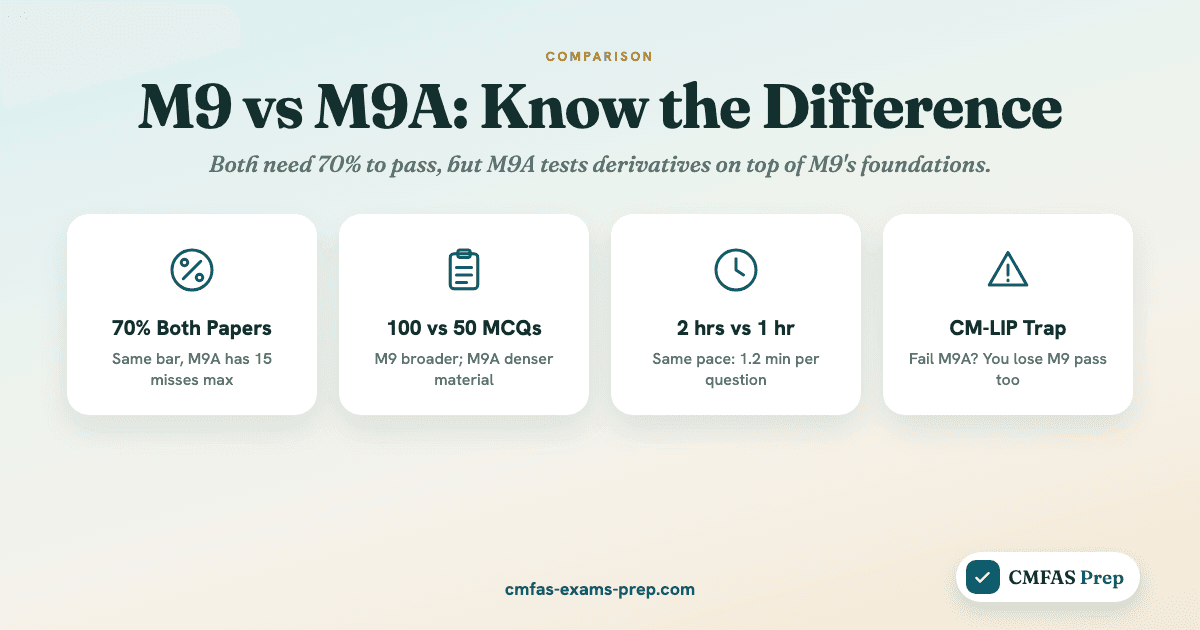
That short length is why people misjudge M9A. The textbook is roughly a third the size of the M9 book, so candidates schedule a third of the study time. The page count is small, but the concepts ask more of you per page than almost any other paper in the series.
Why M9 study habits fail here
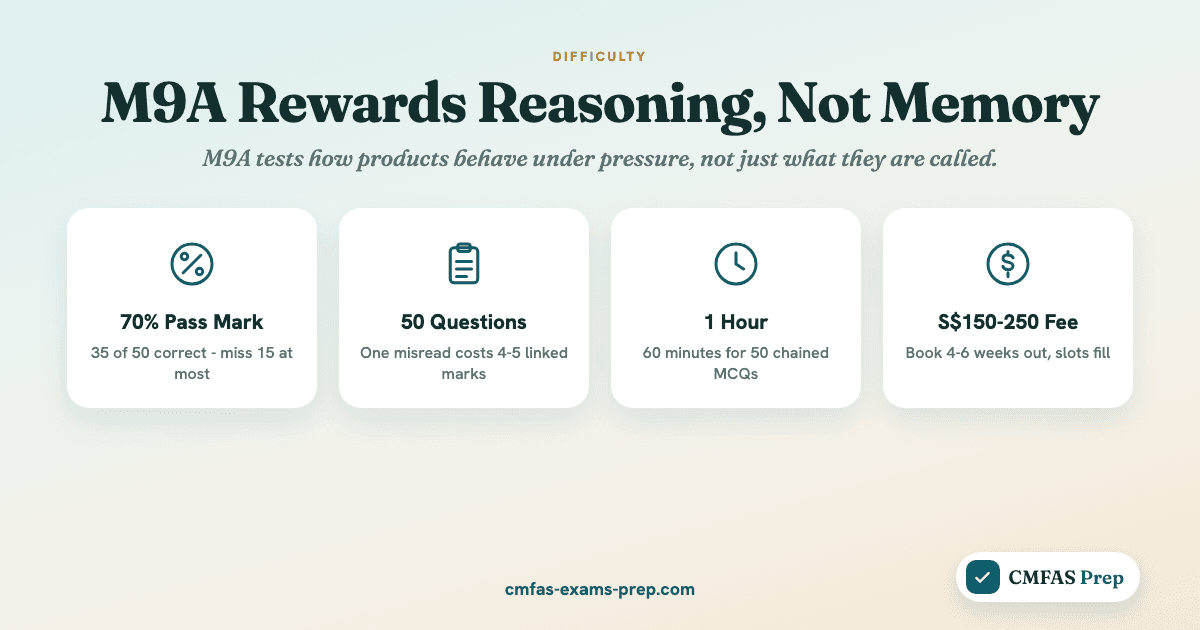
M9 rewards recall. You read the rule on disclosure or fair dealing, you remember it, you pick the matching option. M9A breaks that habit because you cannot memorise your way through a payoff diagram. You have to understand what happens to the holder of a call option when the underlying share moves, and then apply that to a number you have never seen before.
A typical M9A question gives you a strike price, a spot price, and a settlement method, then asks what the investor receives. There is no fact to recall. You either follow the logic or you guess. If you have only ever read the chapter and never worked through the arithmetic, the exam will expose that fast.
The topics that decide your result
Three areas carry most of the difficulty.
Derivatives is the first. You need to be solid on forwards, futures, options and swaps, and on the difference between holding a right and carrying an obligation. The buyer of an option has a choice; the seller has a duty if the buyer exercises. Mixing those two up is the single most common error, and the exam writes questions specifically to catch it. Get comfortable with moneyness too, so that in-the-money, at-the-money and out-of-the-money are second nature rather than terms you pause over.
Structured products is the second. These wrap a derivative inside a deposit or note. Equity-linked notes, dual currency investments and reverse convertibles all show up, and the questions usually hand you a scenario and ask for the outcome in cash or in shares. The trap is that the answer flips depending on whether the spot price finished above or below the strike. Read the settlement terms before you reach for the calculator.
Case studies are the third. M9A has a chapter built entirely around them, which is unusual for a CMFAS paper. You get a product fact sheet or a client situation and have to judge suitability and risk. Speed matters here. Practise pulling the strike price, the knock-in barrier and the protection level out of a term sheet quickly, because under time pressure that extraction is where candidates stall.
A three week plan that fits the syllabus
The book is short enough that three focused weeks beats a longer, looser schedule.
In week one, build the base. Work through the introductory chapters on structured products, risk and portfolio basics. The one idea to nail down early is the split between principal-protected and non-principal-protected products, because almost every later question assumes you know which is which.
In week two, live inside the derivatives material. This is where your marks are won or lost, so give it the most time. Draw the payoff for buying a call and for selling a put, by hand, until the shape comes without thinking. If you cannot sketch the diagram, you do not yet understand the position, and the exam will find that gap.
In week three, run case studies under the clock. Open timed sets, read the fact sheet, extract the numbers, decide on suitability, and check your reasoning against the worked answer. The goal is accuracy at speed, not perfection on a single question with unlimited time.
Practise by chapter, not by full mock
M9A is lopsided. The case study chapter has almost nothing in common with the opening chapters, so grinding full-length mocks can waste your strongest hours re-answering topics you already own. If your risk-management questions are solid but your case studies keep slipping, you gain nothing from a random 50-question set that buries the case studies among material you have mastered.
That is the reasoning behind the practice-by-chapter mode in CMFAS Prep. You isolate derivatives and drill them back to back until the option logic clicks, then switch to case studies and work only on reading speed. Targeting your weakest chapter directly is how candidates move from the low 60s to the low 80s without adding study hours.
A note on the combined CM-LIP paper
Many people sit M9 and M9A together as the combined CM-LIP. The pass rule is what trips them up: you have to clear the M9A component on its own, not average the two. Because the M9 textbook is so much larger, candidates pour their time into it and treat M9A as an afterthought. Score 85 on M9, score 68 on M9A, and you fail the whole paper and resit both halves.
If you are confident on derivatives, the combined route saves time. If you are not, sit M9A separately and lock the pass in. For the topic-by-topic breakdown of how the two papers differ, the M9 versus M9A guide covers it, and the mock exam comparison is worth reading before you commit money to any study pack.
Treat the thin book with respect
The short M9A textbook fails more candidates than its length suggests, and the reason is consistent: people who passed M9 by memorising assume the same approach carries over. It does not. M9A tests whether you can reason through an investment, not whether you can recall a rule.
When you are ready to find out where you actually stand, open the M9A question bank on CMFAS Prep and work a set of derivatives and case study questions under time. The gaps it surfaces are the ones worth fixing before exam day.
Practise M9A now
800+ exam-style M9A questions with instant explanations.
Frequently asked questions
For most people, yes. M9 is about *volume* (memorizing 17 chapters). M9A is about *concepts* (understanding complex derivatives). If you have no finance background, M9A is significantly harder to grasp.
Yes, SCI allows you to take them in any order. However, most candidates take M9 first as it lays the foundation for insurance products, while M9A focuses on the investment link.
A lot. You will need to calculate payoffs for Options, Futures, and Structured Deposits (e.g., "Calculate the return if the index is below the strike price").
The Case Study section (Chapter 6) typically presents a 1-page "Product Term Sheet" (e.g., for a Structured Note) followed by 3-5 linked questions. You will be asked to identify specific risks (Issuer vs Market), calculate potential returns in different scenarios, and determine if the product is suitable for a specific client profile.
Yes, but fewer than M9. For M9A, you must memorize the payoff logic for Derivatives (e.g., Max[0, Index - Strike]) and the calculation steps for Structured Deposits. The exam will not provide these formulas.