M9 or M9A first? How the two CM-LIP papers differ
M9 and M9A cover different ground under CM-LIP. This page shows what each paper tests, the pass marks, and why you should sit M9 first.
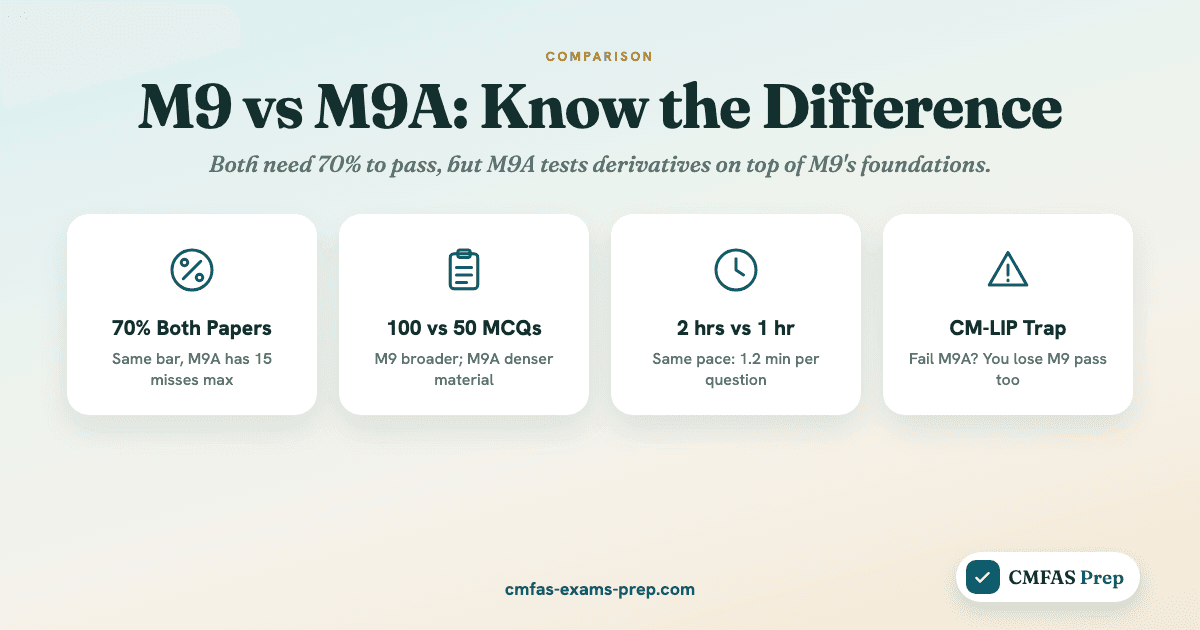
M9 and M9A share a name, Life Insurance and Investment-Linked Policies, but they test different ground. M9 is the products-and-law paper: how life policies are priced, what riders do, how nominations, wills and trusts work. M9A is the technical follow-on: derivatives, structured products, and the structured investment-linked policies built from them. Both are run by SCI, both need 70% to pass, and you can sit them as two separate papers or as one combined paper called CM-LIP.
If you take one thing from this page: sit M9 first, then M9A. M9 lays the groundwork that M9A assumes you already have.
Both modules are CMFAS requirements for representatives who advise on life insurance and ILPs in Singapore, so most candidates end up clearing the pair rather than choosing one.
What each paper covers
M9 is broad. It runs across 17 chapters, from how an insurer sets a premium through to claims, income tax and the legal side of agency, nominations and trusts. Most of it is conceptual, with a smaller set of calculation chapters around premiums and ILP computations such as net asset value and bid-offer pricing. The volume of material is the challenge here, not the depth of any single topic.
M9A is the opposite shape. Only 6 chapters, but the back half is dense. You start with structured products and their risks, then move into derivatives (futures, options and swaps), structured ILPs, building an investment portfolio alongside insurance, and a closing block of case studies. It does not re-teach life insurance basics. It takes them as read and asks you to work with the financial instruments layered on top.
That difference in shape explains almost everything else about the two papers.
Format and pass marks side by side
| M9 | M9A | |
|---|---|---|
| Full name | Life Insurance and ILPs I | Life Insurance and ILPs II |
| Questions | 100 MCQs | 50 MCQs |
| Duration | 2 hours | 1 hour |
| Pass mark | 70% (70 of 100) | 70% (35 of 50) |
| Wrong answers allowed | 30 | 15 |
| Chapters | 17 | 6 |
| Calculator | Bring your own | Bring your own |
| Exam body | SCI | SCI |
Both papers run at the same pace, roughly 1.2 minutes per question. The number that bites is the error budget. On M9 you can drop 30 questions and still pass. On M9A you can only drop 15, and each question is worth two percent, so a careless run of three or four wrong answers eats the margin fast.
A calculator is allowed in both, and you bring your own. Check it is a model you are permitted to use before exam day.
What each exam costs
| Session | SCI/IBF member | Non-member |
|---|---|---|
| Day (9am-5pm) | ~$109.00 | ~$130.80 |
| Evening (after 5pm) | ~$127.53 | ~$149.33 |
Prices are before GST. Since 1 April 2024 SCI charges the same fee whether it is your first attempt or a resit, so the fee itself carries no penalty for sitting again. A daytime slot is the cheaper booking, and the two papers cost the same per attempt as each other.
Which one is harder
M9A is the harder paper for most candidates, and the reason is the subject matter rather than the format.
M9 rewards steady coverage. The calculation chapters are formula-driven, so practice gets you most of the way. The law chapters need memory, but the logic holds together. Almost every question is testing whether you know and understand the material in front of you.
M9A asks for more. Derivatives are hard to picture if you have never worked with them, and the exam wants you to understand how an option or a swap behaves, not just recite a definition. The case-study chapter pushes further, asking you to judge whether a structured product suits a particular client. That is application, not recall. If you come from outside finance, this is where most of your study time will go.
For the longer version, we break both down in is the M9 exam difficult and is the M9A exam difficult.
Which paper to sit first
Sit M9 first. Three reasons, in order of weight.
M9A builds on M9. The product knowledge, ILP mechanics and net-asset-value calculations from M9 are assumed in M9A, so learning them first makes the second paper readable rather than baffling.
An M9 pass is banked once you have it. Sitting the papers separately means your M9 result stays yours regardless of how M9A goes.
M9 is the gentler start. Clearing the broad-but-theoretical paper builds the habit and the confidence before you reach the technical one.
The CM-LIP combined paper, and its catch
CM-LIP is M9 and M9A merged into a single sitting: 150 questions across 3 hours, with the 70% bar applied to each part. You pay one exam fee instead of two.
The saving is real, but so is the trap. In the combined paper the two halves are tied together. Fail the M9A portion and you do not keep the M9 portion. You lose both and resit the whole thing.
| Two separate papers | CM-LIP combined | |
|---|---|---|
| Questions | 100 + 50 | 150 in one sitting |
| Duration | 2 hrs + 1 hr | 3 hours |
| Pass mark | 70% on each | 70% on each part |
| If you fail one half | The other pass stands | Lose both, resit everything |
| Exam fee | Two fees | One fee |
CM-LIP is reasonable if you already work with derivatives and structured products and want one sitting over with. For everyone else, and for anyone meeting derivatives for the first time, the separate route is the safer bet. Saving one exam fee is not worth putting an M9 pass at risk.
How to study each paper
For M9, work through it in blocks rather than front to back in one pass. Group the product and rider chapters, then the ILP, sub-fund and annuity chapters together with the computation work, then the law, tax and claims chapters. Leave the final stretch for full mock papers and for drilling whatever keeps tripping you up. Three to four weeks is realistic if you are studying around a job.
For M9A, give derivatives the most time. It is the chapter the rest of the paper leans on. Get structured products straight first, spend the bulk of your study on derivatives, then move to structured ILPs and portfolio construction, and finish on the case studies once the mechanics are solid. Three to four weeks works here too, with mock papers held back for the last week.
If you want a fuller plan, read how to pass CMFAS M9 and how to pass CMFAS M9A.
Practising by chapter is the quickest way to find weak spots, because both papers have a handful of chapters that decide most passes: premiums and the law chapters in M9, derivatives and case studies in M9A.
Where to practise
You can run unlimited practice questions for both papers on CMFAS Prep, with an explanation on every question and a by-chapter mode so you can target the chapters that carry the most weight. Move to the M9A question bank when you reach the harder paper, and check your options first with our M9A mock exam guide or a set of free M9A practice questions.
Sit M9 until you are clearing mock papers comfortably, bank the pass, then put your full attention on M9A.
Practise M9A now
800+ exam-style M9A questions with instant explanations.
Frequently asked questions
M9 (Life Insurance & ILPs I) covers life insurance theory—products, premiums, contract law, wills and trusts. M9A (Life Insurance & ILPs II) covers advanced topics—derivatives, structured ILPs, and client suitability case studies.
Take M9 first. It builds the foundational knowledge that M9A requires. M9A assumes you already understand ILP basics, NAV calculations, and product types from M9.
Yes. M9A covers derivatives and structured products, which are more technical than M9 content. M9A also has more calculation questions and case studies that require synthesis, not just memorization.
CM-LIP is the combined M9 + M9A exam (150 MCQs, 3 hours). It saves one exam fee but carries significant risk—if you fail M9A, you lose your M9 pass too. We recommend taking them separately unless you have a strong finance background.
Yes, both have similar fees: ~$109 (member, day session) to ~$149 (non-member, evening session), excluding GST. Since April 2024, first-timers and retakers pay the same fee.