How hard is CMFAS M9? The chapters that fail candidates
CMFAS M9 fails people on volume, not hard ideas. This guide names the chapters that drain your score, from premium maths to nomination law.
There is a stubborn belief among new financial advisers that M9 is the soft option. It covers life insurance, the product most people already half-understand, so how hard can it be? That assumption is exactly why M9 has a reputation for catching people out: the difficulty is real, but it hides inside the volume of material rather than the complexity of any single idea.
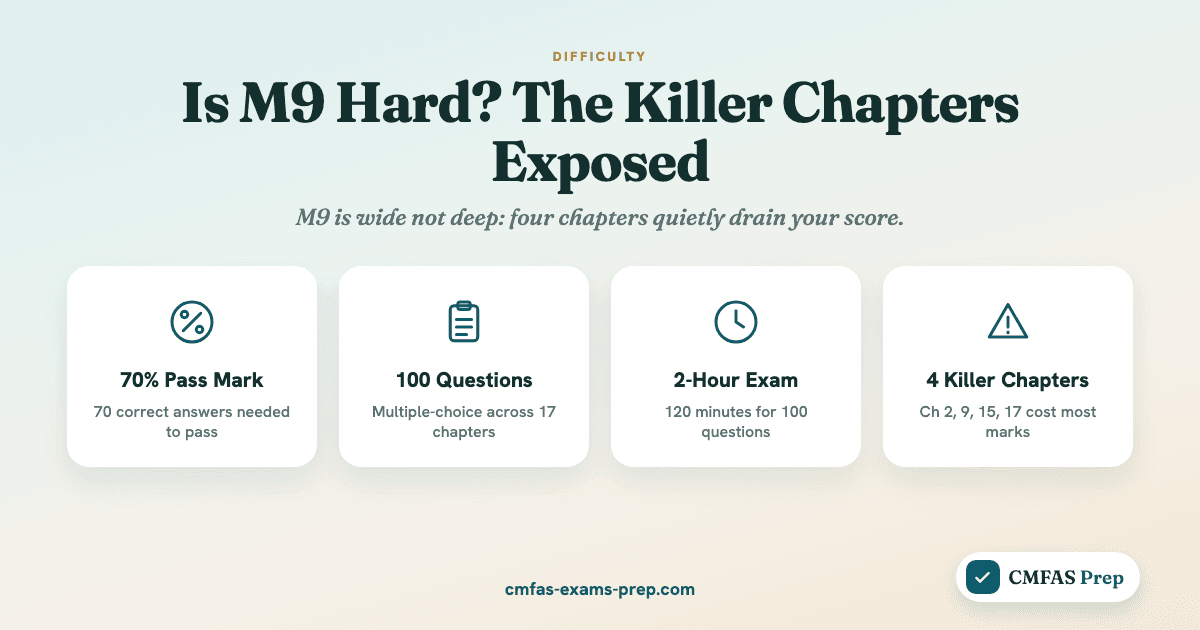
M9 is hard because of how much you have to hold in your head at once, not because the concepts are abstract. There are 17 chapters and over 300 pages of textbook, the paper runs to 100 multiple-choice questions, and you need 70 correct to pass in two hours. None of those questions is individually brutal. The problem is that the marks you lose are scattered across a handful of dense chapters, and most candidates only discover which ones after they have already failed.
This guide breaks down where the difficulty actually sits, which chapters quietly drain your score, and how to study so the hard parts turn into reliable marks.
Quick answer for people short on time
- The exam is wide, not deep. Volume is the enemy, not logic.
- Two chapters carry calculations that punish small mistakes: premiums and investment-linked policy pricing.
- Two chapters carry legal detail that candidates routinely confuse: the law of agency and nomination of beneficiaries.
- Scoring 60 percent is easy on general knowledge alone. The last ten marks come from technical precision, and that gap is where people fail.
Where the marks actually disappear
If you tally up real post-exam debriefs, failure clusters in the same four chapters every time. The product chapters such as term, whole life, and endowment feel familiar and most people clear them. The damage happens in the calculation chapters and the law chapters.
The calculation chapters
Chapter 2 deals with premium structure. You are expected to work out the relationship between gross and net premium and to read mortality figures correctly. A single misplaced decimal turns a correct method into a wrong answer, and the exam offers you that wrong answer as one of the options.
Chapter 9 is the one candidates dread, and for good reason. It covers investment-linked policy mechanics, which means forward and backward pricing, the bid-offer spread, and net asset value per unit. These are the questions that load the stem with extra numbers you do not need, so the test is partly whether you know which figures belong in the formula and which are there to distract you. If you have never drilled these under time pressure, you will either freeze or guess. There is a full set of worked premium and ILP examples if you want to see how the distractors are planted.
A short reality check on the maths chapters: the formulas never change. Once you have run forty of these by hand, they stop being intimidating and start being free marks. That is the whole argument for practising them rather than re-reading them.
The law chapters
Insurance is a contract, and the exam treats the legal side as fair game for technical questions.
The law of agency is where wording matters. You need to separate actual authority from apparent authority and apply the distinction to a short scenario about who bound the insurer and who is liable. Reading the definitions once is not enough, because the exam never asks "what is apparent authority?" outright. It describes a situation and makes you decide which type of authority was in play.
Nomination of beneficiaries is the other trap. You have to keep Section 49L of the Insurance Act, which governs a revocable nomination, separate from Section 49M, which creates a trust nomination. The difference affects who controls the policy proceeds and whether the policyholder can change the nominee later. Swap the two in your head and you can drop three to five questions in a single run, because the exam tests this from several angles.
Here is the split most candidates miss:
| Section | Type of nomination | What it means in practice |
|---|---|---|
| 49L | Revocable | Policyholder keeps control and can change or revoke the nominee |
| 49M | Trust | Creates a trust over the proceeds; the policyholder gives up control |
Memorise that table cold. It is some of the cheapest marks in the paper once it sticks, and some of the most expensive when it does not.
If you want to see how M9 law compares with the heavier quantitative reasoning in the derivatives module, the M9 versus M9A breakdown lays out why the two exams feel difficult for opposite reasons.
The retention problem nobody warns you about
The single biggest reason capable people fail M9 is decay. You study risk and the meaning of peril versus hazard early in the week. By the time you reach trusts and nomination at the end, the early definitions have faded, and the exam tests both ends of the syllabus equally.
This is a spacing problem, not an intelligence problem. Reading 17 chapters once, front to back, leaves you sharp on whatever you covered last and foggy on everything else. The fix is to revisit early chapters while you study later ones, and to test recall rather than re-read. Active retrieval is what makes the law of agency stick when you also have ILP formulas competing for the same memory.
What changed for 2026
The style of questioning has moved away from flat definitions toward applied scenarios. Older papers leaned on "what is the penalty for X." Current papers describe a situation and ask you to reason through it.
A 2026-style agency question does not ask you to define authority. It gives you a client who did one thing, an agent who did another, and asks who is liable under the law of agency. You cannot answer that by recognising a keyword. You have to apply the rule to facts, which is exactly why passive reading fails and worked scenarios do not.
The upside is that this content is fixed. Mortality maths, ILP pricing, and the Insurance Act sections do not drift the way market conditions do. Once you have practised the recurring scenarios, they repeat in recognisable shapes on exam day.
So, is M9 difficult?
Yes, because of how much ground it covers and how precise the calculation and law questions are. No, in the sense that it is predictable. The hard chapters are known, the formulas are stable, and the legal distinctions are finite. Difficulty here rewards preparation more than raw ability.
The candidates who struggle are usually the ones relying on a single read of the textbook or on static notes that skip the applied questions. The candidates who pass comfortably are the ones who drilled chapters 2, 9, 15, and 17 until the answers were automatic.
If you are deciding where to put your hours, weight them toward the four chapters above and toward repeated scenario practice rather than re-reading. When you have a study rhythm going, book your M9 sitting so you have a fixed deadline to work against.
You can drill the killer chapters directly on CMFAS Prep, and the M9 practice set lets you target premiums, ILP pricing, agency, and nomination one topic at a time instead of grinding the whole syllabus blind. Start with the chapters that cost the most marks and work outward from there.
Practise M9 now
800+ exam-style M9 questions with instant explanations.
Frequently asked questions
Most candidates find Chapter 9 (ILP Computations) and Chapter 17 (Wills & Trusts) the hardest. Chapter 9 involves complex math, while Chapter 17 involves dense legal memorization.
They are difficult in different ways. RES 5 is harder because of "Ambiguous Ethics" questions (Part II). M9 is harder because of "Volume" (17 Chapters) and "Calculations."
We strongly advise against it. Calculation questions make up a significant portion (approx 15-20%) of the exam. Skipping them removes your safety buffer for the rest of the paper.
For a complete beginner, we recommend 30-40 hours of study time. However, if you use a focused simulator to drill specific weak chapters (instead of reading the whole textbook), you can often cut this time down to 15-20 hours.
The content volume remains similar, but the style of questions is shifting. SCI is moving away from direct memory recall (e.g., "What is X?") toward scenario-based application questions (e.g., "Given Client A's situation, how does Clause Y apply?"), which requires a deeper understanding of the concepts.