CMFAS M9 format and pass mark, measured against the clock
CMFAS M9 pass mark is 70 of 100 in two hours, no negative marking. Learn the pacing rule and flag-tool strategy so time does not cost you marks.
What you need to score to pass M9
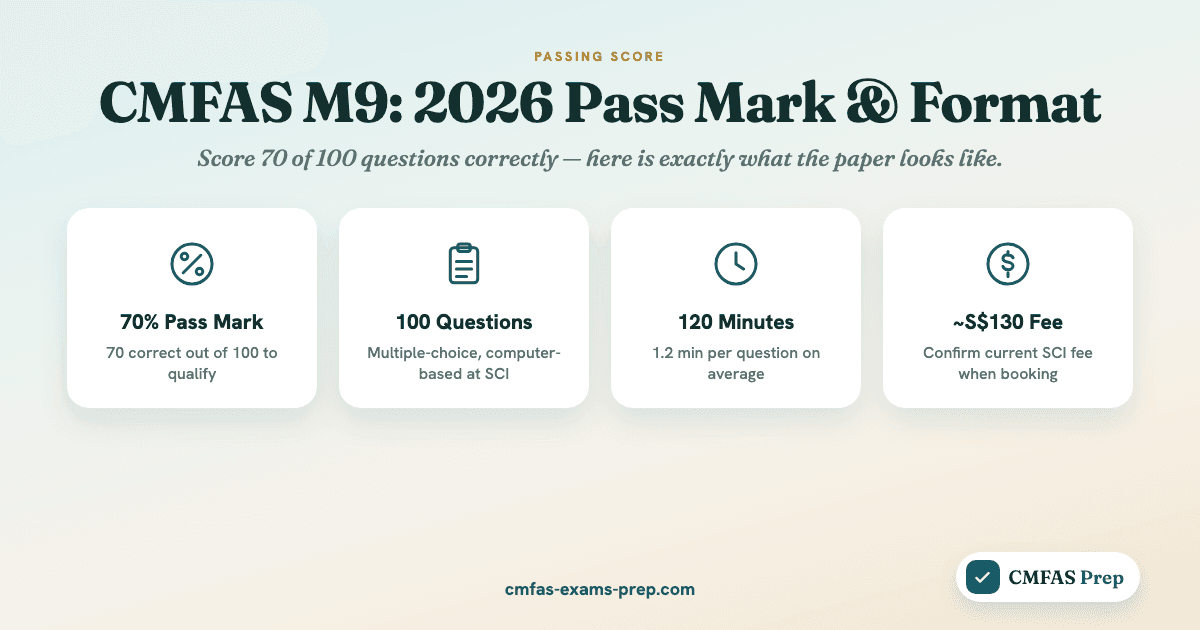
The CMFAS M9 exam (Life Insurance And Investment-Linked Policies) has a pass mark of 70 percent. You answer 100 multiple-choice questions in two hours, and 70 of them have to be correct. Get 69 right and you sit the paper again.
That single number changes how you should study. School exams hand you a pass at 50 percent, so half-knowing the material is enough. A licensing paper set by the Securities and Investment Institute (SCI) under the MAS framework works differently. The bar sits higher because the qualification lets you advise real clients on life policies, so the standard is closer to "you actually know this" than "you scraped through."
Here is what the M9 paper looks like in 2026, where candidates lose the marks they assume are safe, and how to spend your two hours so the clock never beats you.
M9 at a glance
| What | Detail |
|---|---|
| Pass mark | 70% (70 of 100 correct) |
| Questions | 100 multiple-choice |
| Duration | 2 hours (120 minutes) |
| Average time per question | About 1.2 minutes |
| Negative marking | None |
| Format | Computer-based exam at an SCI test centre |
| Exam fee | Around S$130 (confirm the current SCI fee when you register) |
You can see the full topic breakdown and book a timed run on the M9 exam page.
Why the 30-question buffer is smaller than it looks
Thirty wrong answers sounds generous. You can fail roughly a third of the paper and still walk out licensed. Most candidates read that and relax, which is exactly the wrong response.
The buffer disappears in clusters, not one question at a time. M9 has a handful of topic areas that punish weak preparation, and they tend to take double-digit chunks out of your score together rather than costing you a mark here and there.
The biggest one is calculation. M9 asks you to work out premiums, surrender values, and figures tied to investment-linked policies. If arithmetic under time pressure is your weak spot, a run of these can cost you 15 marks before you have done anything wrong on the theory side. Pair that with shaky knowledge of the law of agency and the duties an adviser owes a client, and another 10 marks can go. Add a couple of careless slips on questions you actually knew, and 100 minus those losses lands you on 70 or below. The pass became a fail without a single "hard" question that you couldn't, in principle, have answered.
This is why aiming for exactly 70 in practice is a trap. If your mock scores sit at 70 to 75 at home, where there is no exam-hall pressure and no two-hour fatigue, the live paper will likely drag you under. Set your target at 85 in practice so a bad day still clears the line. When you can hold that consistently across full-length mocks, the real exam stops being a coin flip. There is a side-by-side look at the available practice options in our M9 mock exam comparison.
How the two-hour clock actually plays out
The arithmetic of pacing is simple: 120 minutes over 100 questions is 1.2 minutes each. The trap is that questions do not cost the same.
A straight recall question (what a rider does, how an annuity pays out) takes 20 to 40 seconds. A premium calculation can eat three or four minutes once you set up the working and check it. So the average is a lie. You are really running a paper of fast questions that bank time and slow questions that burn it.
The mistake that fails people is fighting a calculation early. You hit a tough surrender-value problem at question 12, refuse to let go, and spend five minutes on it. That five minutes was supposed to cover six or seven easy theory questions near the end of the paper. Now you are rushing the cheap marks to fund one expensive one, and rushing is where careless errors live.
The fix is a hard rule you decide before you sit down: if a question is still resisting after about 90 seconds, flag it and move. The marks you can grab quickly are worth more than the one you are wrestling with, and you can come back once the easy points are banked.
Practising against a real countdown is the only way to build this instinct. Reading the syllabus teaches you the content; a timed run teaches you when to walk away from a question. You can start a timed M9 mock and watch where your own clock leaks.
No negative marking, so never leave a blank
M9 does not penalise wrong answers. A correct answer is one mark, a wrong answer is zero, and a blank is also zero. A guess can only help you.
That makes the endgame strategy obvious. With two minutes left and four questions unanswered, pick an option for every one of them. Each guess on a four-option question carries a one-in-four chance of a free mark, and four guesses will, on average, hand you one point you would otherwise have thrown away. A blank guarantees nothing.
So the rule is to finish the paper fully answered, every time, even if "finished" means a last-minute sweep of educated guesses on the questions you flagged.
The computer-based exam features worth knowing
M9 runs on a computer at the SCI test centre, not on paper. Two features change how you play the paper.
The flag tool lets you mark any question and return to it before you submit. This is what makes the "90 seconds then move on" rule workable. Flag the slow calculation, clear the easy run after it, and circle back with your remaining time and a calmer head.
The on-screen calculator exists, but it is slow to click through for multi-step premium working. Bring your own approved financial calculator and know its functions cold before exam day. Check the current SCI list of permitted models when you book, because the approved set is set by them, not by you, and turning up with the wrong device is an avoidable problem.
A study plan that protects the 70
Think of M9 as a marks-defence exercise rather than a memory test. You are not trying to know everything. You are trying to make sure the marks you can win stay won.
Lock down the recall topics first. Riders, annuities, policy types, and the basic features of investment-linked policies are pure knowledge, and they are the cheapest, fastest marks on the paper. Missing these is unforgivable because they cost you almost no time to earn.
Then drill the calculations until the method is automatic. The danger with premium and surrender-value questions is not that they are conceptually hard, but that they are slow when you are figuring out the steps live. Work through enough of them that the setup is muscle memory. There is a focused set of worked examples in our M9 premium calculation questions guide.
Last, treat your 30-mark buffer as insurance, not a target. When a question stumps you, flag it, guess it if time runs short, and keep moving. Panic is what turns one unknown answer into three lost marks on the questions that follow it.
When you can sit a full 100-question mock under the two-hour clock and clear the mid-80s without rushing the back end, you are ready. Run a few timed papers on CMFAS Prep and let your scores tell you when the real M9 is just a formality.
Practise M9 now
800+ exam-style M9 questions with instant explanations.
Frequently asked questions
No. RES 5 has a split score (75% for Part I, 80% for Part II). M9 has a single, flat passing score of 70% for the entire paper.
You fail. There is no rounding up. SCI is very strict, and results are final. You will need to register and pay for the exam again.
No. The M9 exam consists entirely of 4-option Multiple Choice Questions (A, B, C, D). You must select the best answer.
Yes. For the purpose of applying for a license, CMFAS exam results are generally valid for 3 years from the date of the exam. You must be appointed by a financial institution within this timeframe, or you may have to retake the paper.
No. Unlike some other driving or professional exams, there is no mandatory "cooling off" period. You can book the next available slot immediately, provided there are seats left at the SCI center.