How hard is CMFAS M9A? Derivatives decide most fails
CMFAS M9A looks like the shorter paper, but derivatives are what fail most candidates. See where the marks are actually lost and how to prep for them.
Yes, M9A is hard, but not for the reason most people think. The paper has fewer pages of reading than M9, so candidates assume it is the lighter sitting and book it with a couple of days of prep. The reading is shorter because the material is conceptual, and concepts take longer to learn than facts.
M9A (CM-LIP) covers investment-linked policies and the products that sit underneath them. To answer the questions you have to understand how the underlying instruments behave, not just what they are called. If options, structured notes and payoff behaviour are unfamiliar to you, no amount of definition-memorising will get you to 70%.
What the paper actually looks like
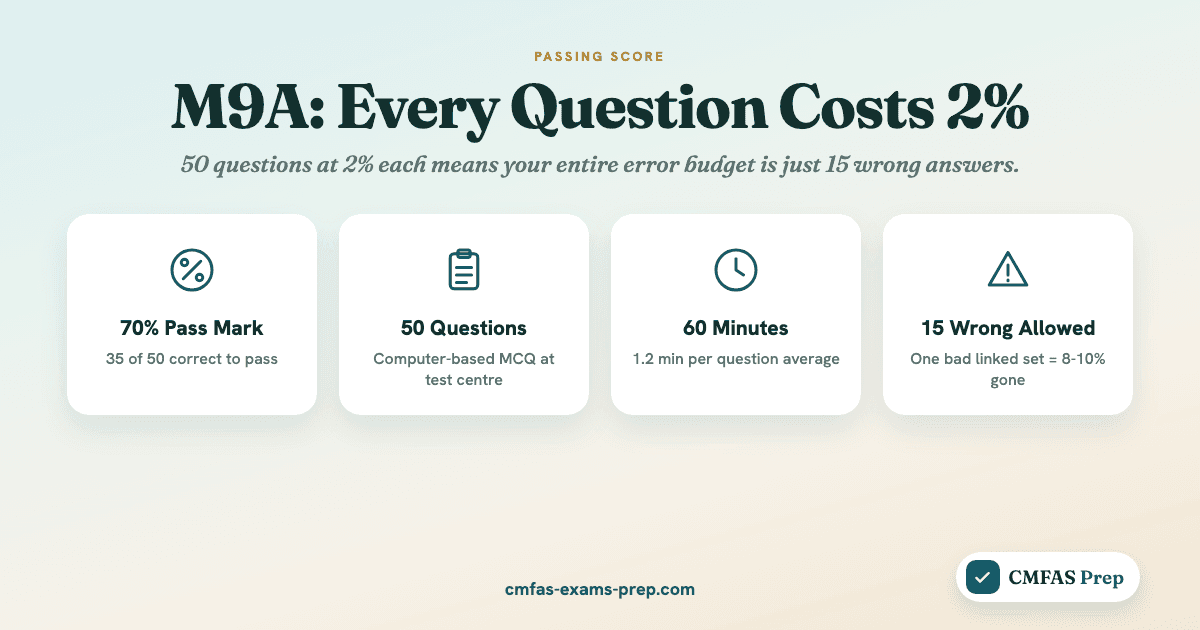
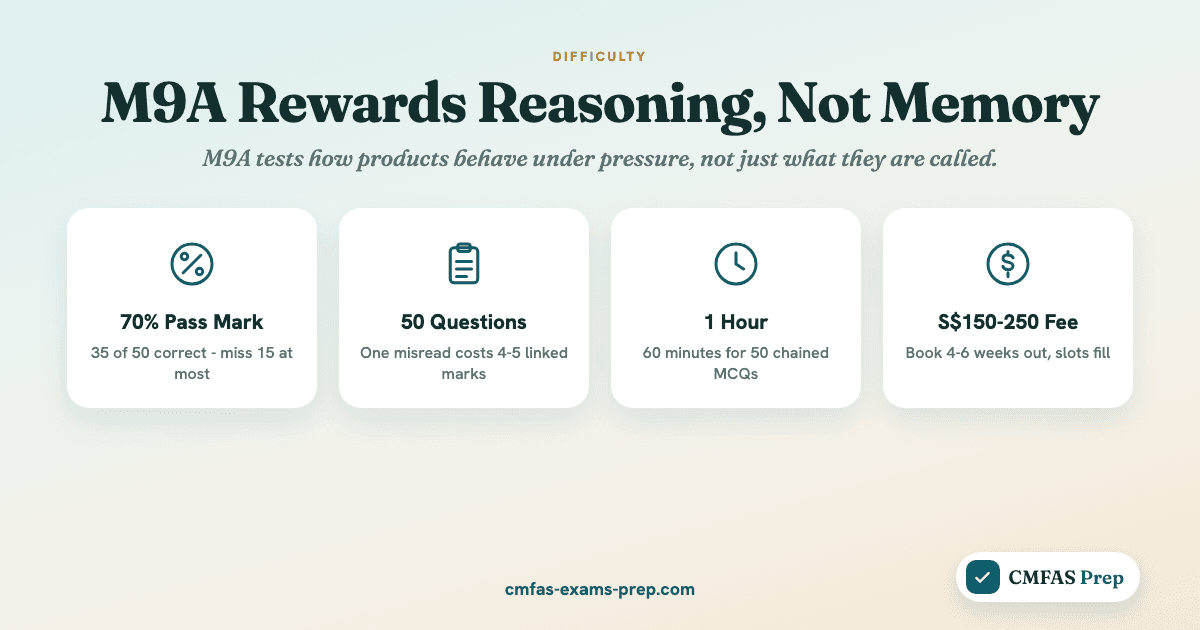
The sitting is 50 multiple-choice questions in 1 hour, and you need 70% to pass. That is 35 correct answers, with room to miss 15. It sounds generous until you realise the questions are not evenly spread in difficulty. A block of them hangs off the same product scenario, so one early misread can cost you four or five marks in a row.
You register through the Singapore College of Insurance, and the fee runs S$150-250 including GST depending on peak or non-peak slots. Slots fill, so book four to six weeks out.
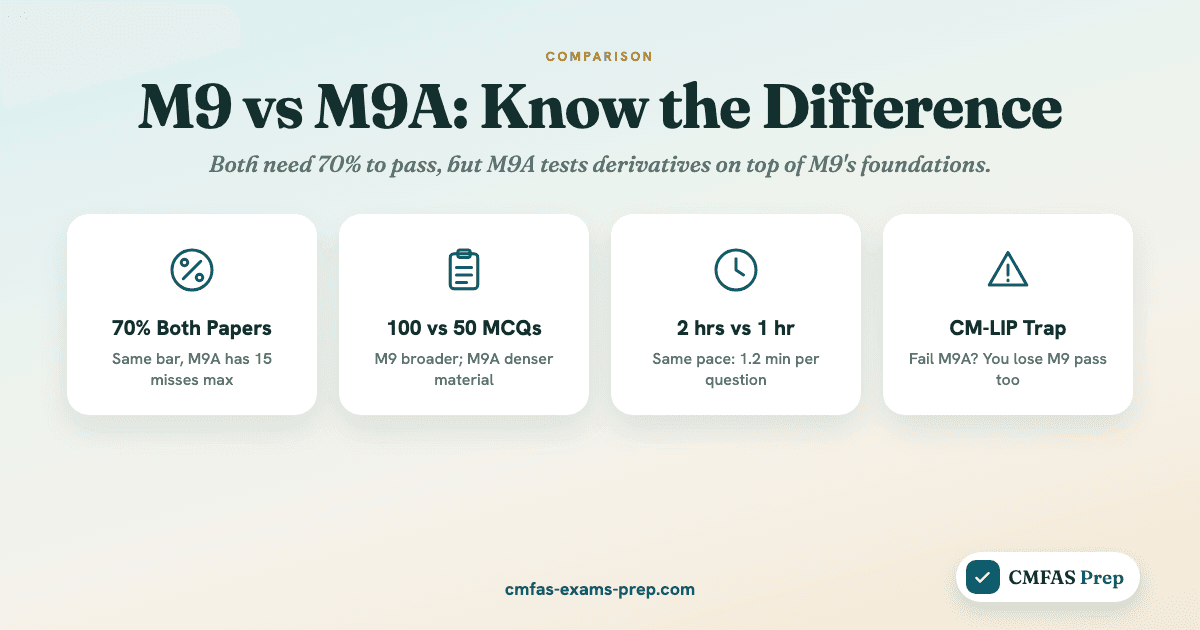
For how M9A differs from its sibling paper in style and content, see the M9 vs M9A breakdown. The short version: M9 rewards recall, M9A rewards reasoning.
Where most people lose the marks
The derivatives material is where the paper separates candidates who read from candidates who understood. You are expected to tell the difference between a future and a forward, between buying a call and writing a put, and to read what a position does when the market moves against it.
The textbook teaches this as definitions. The exam tests it as a situation. You will not get "define a call option." You will get something closer to:
A client expects the market to rise gently over the next year but cannot stomach a large loss if he is wrong. Which structure fits?
To answer that you have to know what each instrument pays out under different market moves, and pick the one that matches the client's view and risk tolerance. That is a reasoning task. Flashcards do not build it.
The trap is that the definitions feel manageable on day one, so people close the book thinking they know derivatives. They knew the vocabulary. The exam asks for the behaviour.
The product fact-sheet questions
The other place people bleed marks is the product-analysis section. Instead of standalone questions, you get a detailed term sheet, say a five-year equity-linked note with a knock-out feature, and then several linked questions about that one product.
You have to pull the right numbers out fast: strike level, tenure, coupon, and the barrier that triggers early redemption. Then you answer questions about the product's risk and payoff. If you misread the knock-out barrier in the opening paragraph, every answer built on it is wrong. One reading error, four or five marks gone.
This is why passive revision struggles with M9A. Reading a worked example once does not train you to extract the right figures under time pressure. You build that by doing it repeatedly until the structure of a term sheet is familiar. The mock-exam comparison guide goes into which formats actually rehearse this skill versus which just quiz you on theory.
The thin-book problem
Here is the failure pattern, played out over a long weekend:
- Day one: read the early, easier material on ILP structures and charges. Feels fine. Confidence high.
- Day two: hit the derivatives material. The concepts are abstract and do not click on a first read. Confidence drops.
- Day three: rush the product fact-sheet section, run out of time, walk in underprepared on the two areas that decide the result.
The fix is to invert it. Start with the derivatives and the term-sheet questions, the parts that take longest to sink in. Give them your freshest days. The ILP structures and charges are closer to straight recall and can be picked up later. If you have already beaten the hard half, the rest of the paper feels short.
How to prepare for a reasoning paper
Three things move the needle on M9A:
- Isolate the derivatives topic and drill it until you can read a payoff and name the strategy without thinking. Volume matters here because you need to see enough variations that the logic becomes automatic.
- Practise full term sheets against the clock. Extract strike, tenure, coupon and barrier in under a minute, then answer the linked questions. Speed and accuracy on the extraction is half the battle.
- After every wrong answer, read why the right answer is right. On a reasoning paper the explanation is the lesson, not the score.
CMFAS Prep is built for exactly this. The practice-by-chapter mode lets you isolate the derivatives questions and grind only those until they stop catching you, and every question comes with the reasoning behind the correct option so you learn the logic rather than the label. The analytics show which topics you are still losing marks on, so your last few days go to real gaps instead of the chapters you already know.
So, is it difficult?
Yes, conceptually. M9A asks you to think the way someone structuring a product thinks, not the way someone reciting an insurance glossary thinks. The pass mark is the same 70% as the other papers, but the route to it is different: you get there by analysing, not by memorising.
Respect the thin book. The page count is low because the ideas are dense, and dense ideas need repetition to stick.
Open the M9A practice on CMFAS Prep, start with the derivatives questions, and work them until the payoffs read themselves. That is the part of the paper that decides your result, so make it the part you have done most.
Practise M9A now
800+ exam-style M9A questions with instant explanations.
Frequently asked questions
Without a doubt, **Chapter 3 (Understanding Derivatives)** is the hardest. It introduces abstract concepts like Futures, Options, and Swaps which are new to most insurance agents.
Chapter 6 is entirely Case Studies, usually making up about 20-30% of the questions. However, concepts from Chapters 3 and 4 are often tested *within* these case studies.
No, but having a background in finance helps with the derivative concepts. If you are new to finance, you will need to spend extra time visualizing how Options and Futures work.
They are incomparable. RES 5 is about Ethics/Law. M9A is about Financial Engineering/Math. Most people find M9A harder to understand, but RES 5 harder to score due to tricky wording.
No. Derivatives form the foundation for Structured Products (Chapter 4). If you skip Chapter 3, you will likely fail Chapter 4 as well, making it mathematically impossible to pass.