How hard is RES 5? What the two-part marking really means
Is the CMFAS RES 5 exam difficult? We analyze the 2026 pass rates, the 3 biggest reasons candidates fail (including the two-part scoring trap), and the strategy you need to pass on your first try.
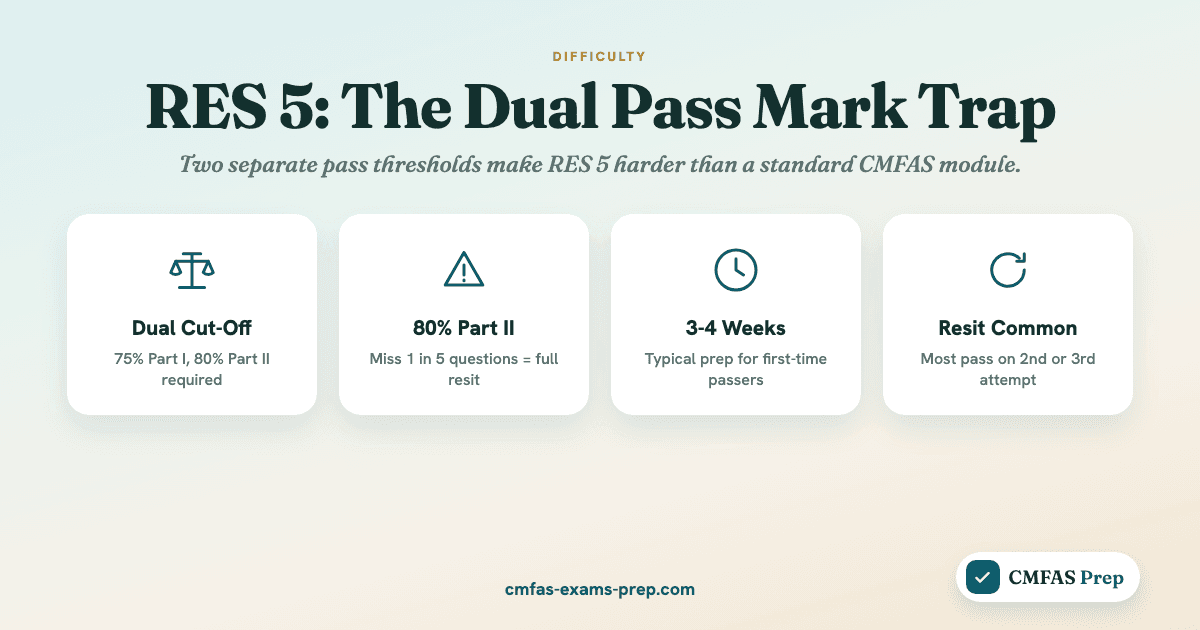
Most candidates clear RES 5 on a second or third attempt, not the first, which is a fair sign that the paper is harder than the average CMFAS module. The Securities & Investment Institute (SII/SCI) does not publish official pass rates, so nobody can quote you a clean percentage, but the structure of the exam itself explains why so many people stumble: you have to clear two separate score thresholds in the same sitting, and the questions reward judgment over memory.
If you understand why those two things trip people up, you can prepare for them directly instead of guessing.
What makes RES 5 harder than a single-pass module
The exam is the regulatory paper a representative needs before advising on or dealing in life policies and certain investment products. The content sits across the Financial Advisers Act, MAS Notices and Guidelines, the rules on fair dealing and conduct, and anti-money-laundering and countering-financing-of-terrorism obligations. None of that is conceptually exotic. The difficulty comes from how much of it there is and how the questions are written.
A module like M9 or M9A gives you a single overall cut-off. RES 5 splits the paper and makes you clear each half on its own. That changes the maths of passing in a way most people don't account for until they fail.
The two-part cut-off, and why strong students still fail
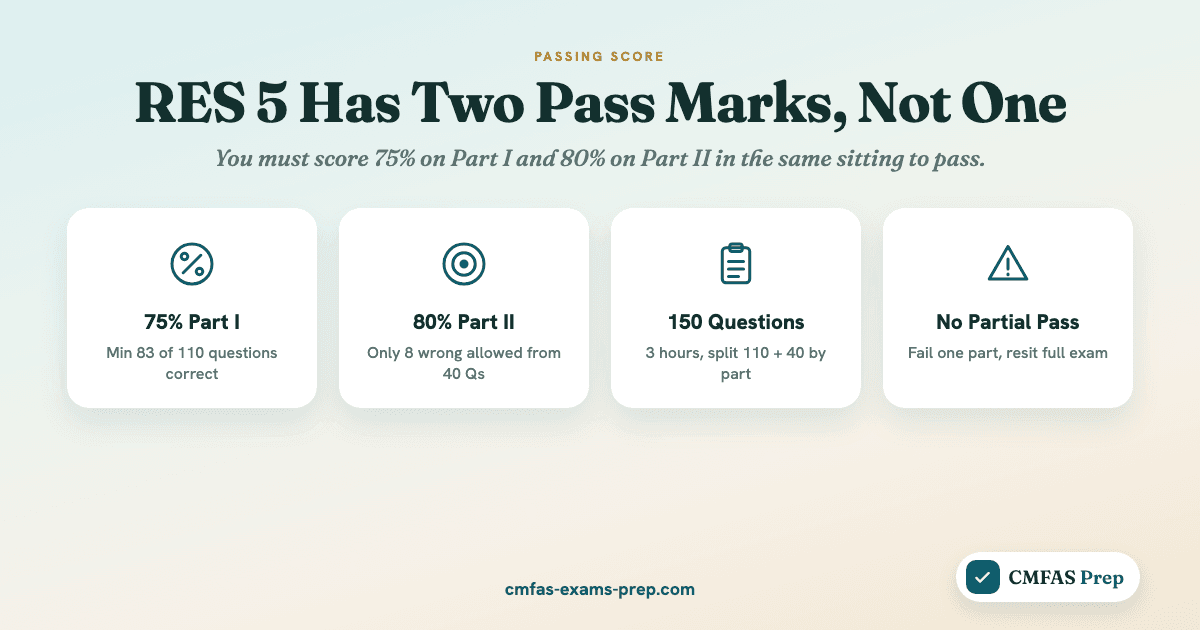
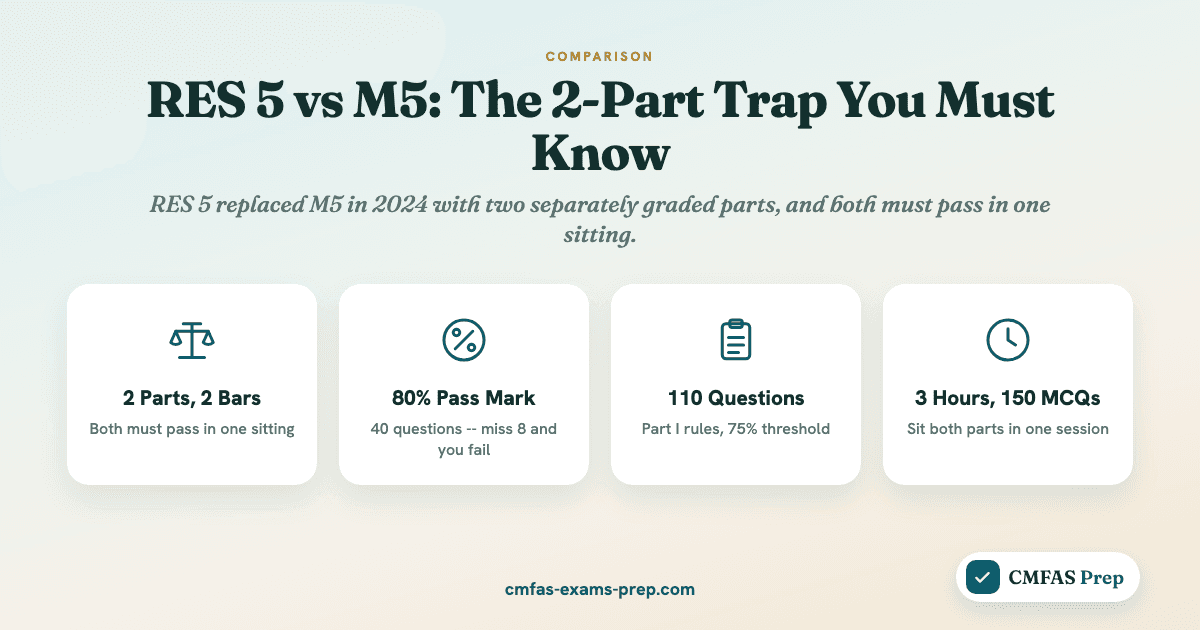
RES 5 is scored in two parts, and you need 75% on Part I and 80% on Part II in the same attempt. Miss either threshold and the whole paper is a fail, no matter how well you did on the other half.
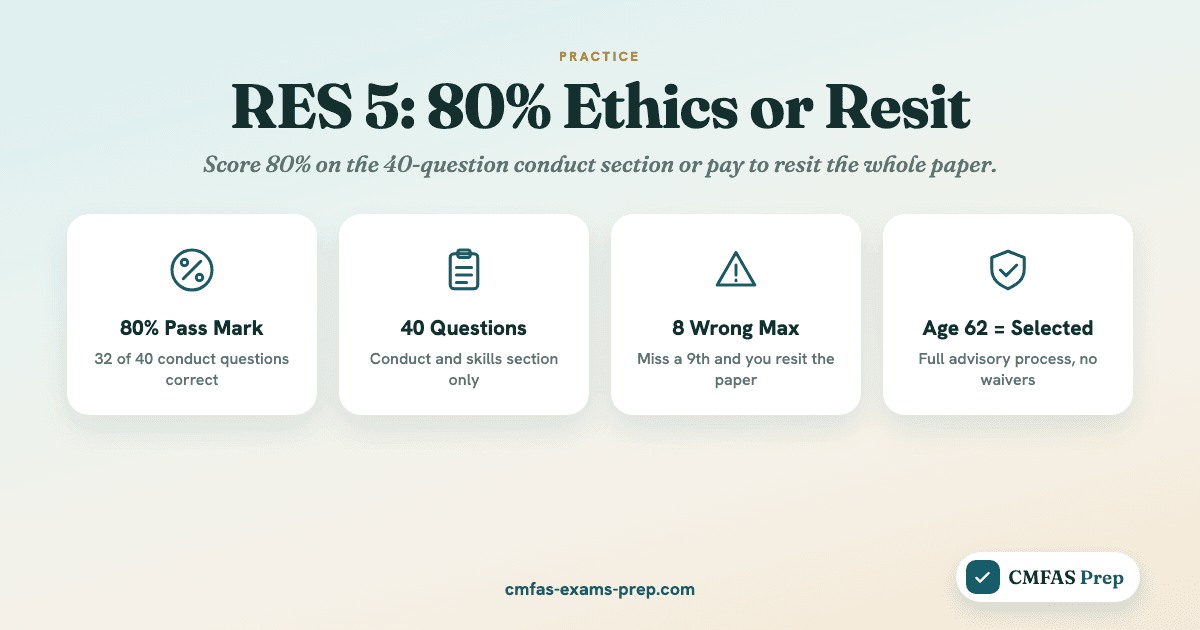
Here is the trap. Part II carries the higher bar at 80%, and it covers the conduct, ethics, and fair-dealing material where the answers feel less black-and-white. Plenty of candidates walk out confident because they crushed the regulatory recall in Part I, then find out they landed in the high 70s on Part II and have to resit the entire exam. An 80% requirement means you can only afford to miss one in five of those questions. That is a thin margin on the section people tend to under-practise.
The practical takeaway: treat Part II as the part that decides your result. A 90% on Part I buys you nothing if Part II sits at 78%.
Why a single total score misleads you
If you only ever look at your overall percentage on a mock paper, you are measuring the wrong thing. An 82% total could hide a 90% Part I and a 74% Part II, which is a fail under the real rules. You need your score broken out by part, every time you practise, so you know whether you are actually over the 80% line that matters.
This is where most cheaply-sourced practice material falls short. Many secondhand PDFs and photocopied papers floating around just hand you a final mark. The CMFAS Prep RES 5 simulator reports Part I and Part II separately so you can see which threshold you are missing before exam day instead of after.
The questions test application, not recall
The second reason RES 5 feels hard is the question style. A lot of items are scenario-based: you are given a short client situation and asked what the representative should do, or which course of action is correct under the relevant guideline. Two of the four options will usually look defensible. Only one is the best answer when you apply the actual rule.
Rote memorising of penalties and definitions does not get you through those. You need to have practised reading a scenario, spotting which rule is in play, and choosing the response the regulator would expect. The skill is pattern recognition across many worked examples, which you only build by doing question after question and reading why the wrong options are wrong.
If your notes are old or borrowed from someone who sat the previous version of the paper, check that they match the current syllabus before you rely on them. The exam content and emphasis have shifted, and stale material teaches you to answer a test that no longer exists.
How much study time RES 5 actually needs
Most first-time passers describe roughly three to four weeks of steady work, assuming an hour or two on weekdays and a longer block at the weekend. Treat that as a planning baseline, not a promise; people coming straight from industry experience often need less, and people new to financial regulation often need more.
A workable shape for those weeks:
| Stage | Focus |
|---|---|
| First week | Read the syllabus through once, then sit a full diagnostic mock to find your weak chapters |
| Middle stretch | Drill your weakest Part I topics and start daily Part II scenario questions |
| Final week | Timed full-length papers until you clear both 75% and 80% on repeat |
The one rule that holds across every profile: do not skip Part II ethics practice, because that is where repeat failures cluster. People who resit almost always lost on the conduct section, not the regulatory recall.
How to study so the odds work for you
The candidates who pass first time are not working harder across the board. They are working narrowly on the parts that are dragging them down. That means three habits.
Watch your split score, not your total, so you always know your Part II standing. Practise scenario questions daily rather than rereading notes, because the exam rewards applied judgment. And drill by chapter once you know your weak spots, instead of rereading the whole book from page one.
A practice-by-chapter mode helps here: if you keep losing marks on the fair-dealing or AML/CFT material, you spend your limited hours on exactly that, with immediate feedback on why each answer is right or wrong. Tracking your performance per chapter over a few sessions shows you whether the gap is closing before you book the real sitting.
You can build that routine on the RES 5 exam page, which sets up timed papers and chapter drills against the current syllabus.
So, is it difficult?
Yes, RES 5 is one of the tougher CMFAS papers, mostly because of the dual 75%/80% cut-off and the scenario-style questions. It is not a paper you pass by cramming definitions the night before. But the difficulty is predictable, which means it is preparable. Respect the Part II bar, practise applied questions, and use your split scores to fix weak chapters before they cost you a resit.
When you are ready to lock in a deadline, register for your RES 5 sitting so your study has a fixed target, and compare your options first with our RES 5 mock exam comparison.
When you want to practise under real conditions, start a timed RES 5 paper on CMFAS Prep and check your Part I and Part II scores separately after each attempt.
Practise RES 5 now
800+ exam-style RES 5 questions with instant explanations.
Frequently asked questions
While official pass rates are not published by SCI, industry feedback suggests the new Two-Part Scoring System has significantly increased the failure rate compared to the old M5 exam, making it one of the most challenging CMFAS papers.
The primary reason is the two-part scoring system. Candidates often score well in regulations but fail the Ethics section (Part II), which requires a higher 80% score.
Yes. The RES 5 exam has a more complex syllabus and a stricter passing requirement (separate scores for Part I and Part II) compared to the single-score structure of the old M5.
You can take a full-length, timed RES 5 mock exam on the CMFAS Prep platform to see how you perform. If you score at least 75% on Part I and 80% on Part II, you are ready to take the exam.
The AI Recommendation Engine in CMFAS Prep will identify your weakest chapters and create personalized quizzes for you to focus on. You can also use the practice by chapter mode to drill your weak spots.