RES 5 syllabus: Part I and Part II, chapter by chapter
The RES 5 syllabus in full: all 27 chapters across Part I and Part II, the MAS notices each one covers, the 75% and 80% pass marks and how to split study time.
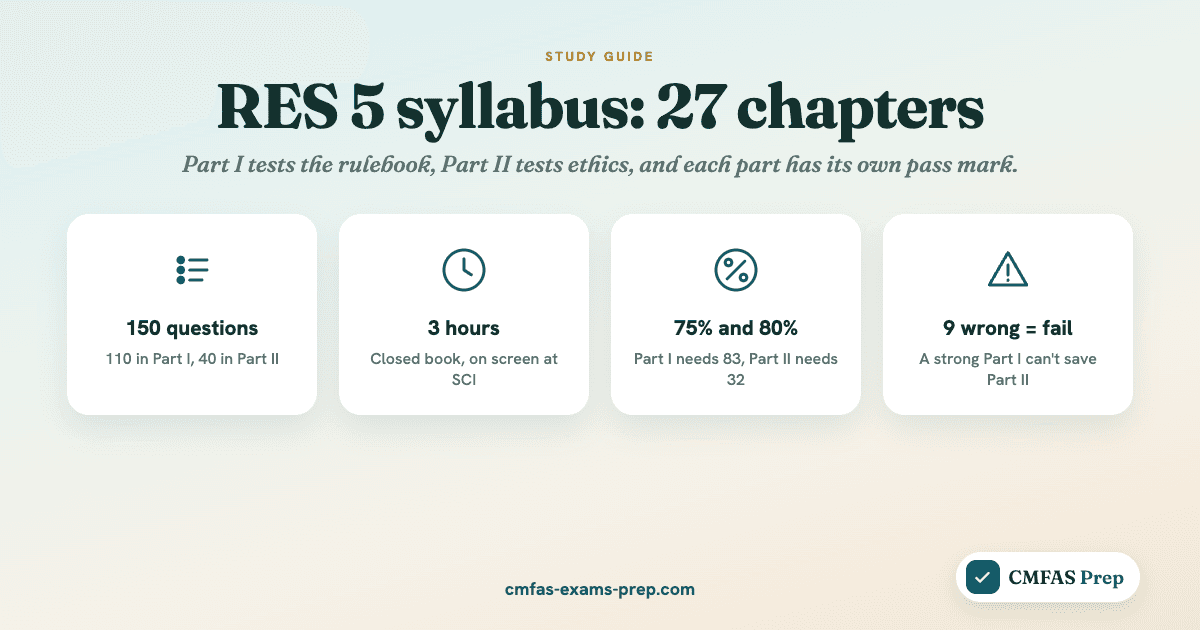
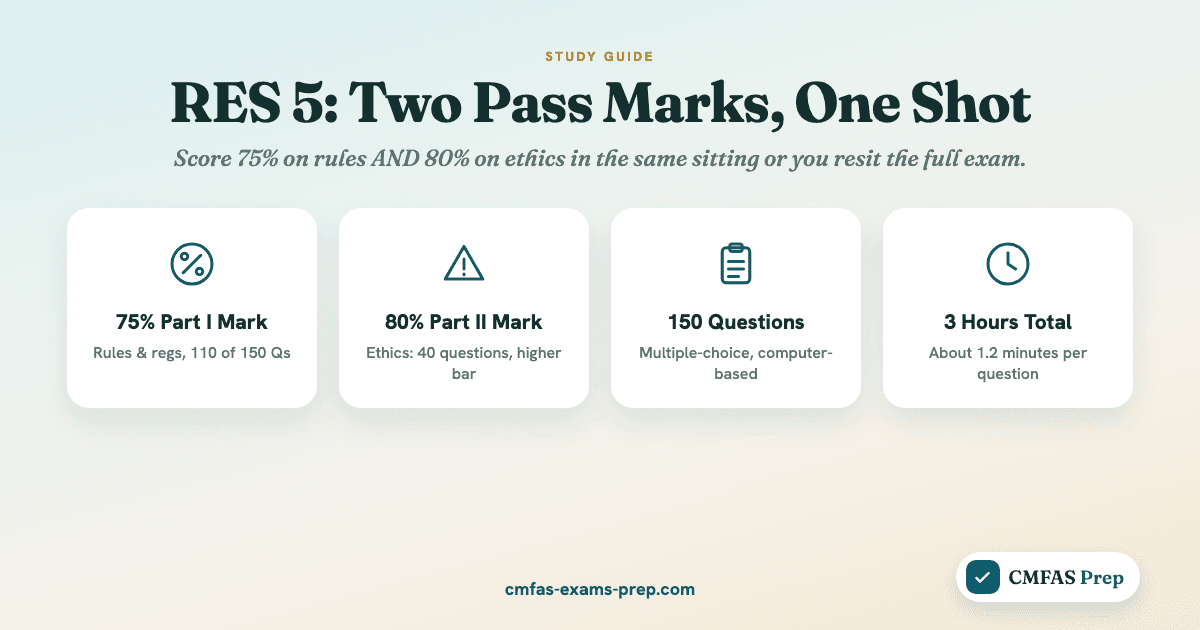
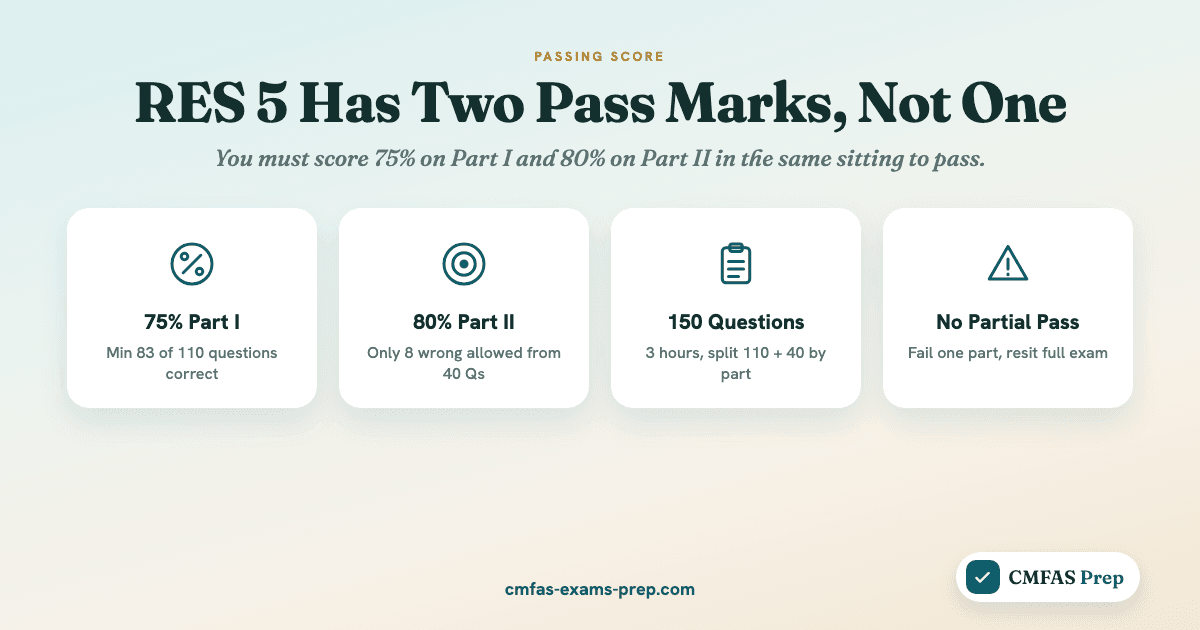
The RES 5 syllabus has 27 chapters in two parts. Part I, chapters 1 to 13, is the rulebook: the Financial Advisers Act, MAS notices and guidelines, the code on collective investment schemes, market conduct and CPF. Part II, chapters 14 to 27, is ethics and the advice process. Part I supplies 110 questions and needs 75%. Part II supplies 40 and needs 80%, in the same sitting.
The two parts at a glance
| Part | Chapters | Questions and pass mark |
|---|---|---|
| Part I: rules and regulations | 1 to 13 | 110 questions, at least 75% (83 right) |
| Part II: ethics and skills | 14 to 27 | 40 questions, at least 80% (32 right) |
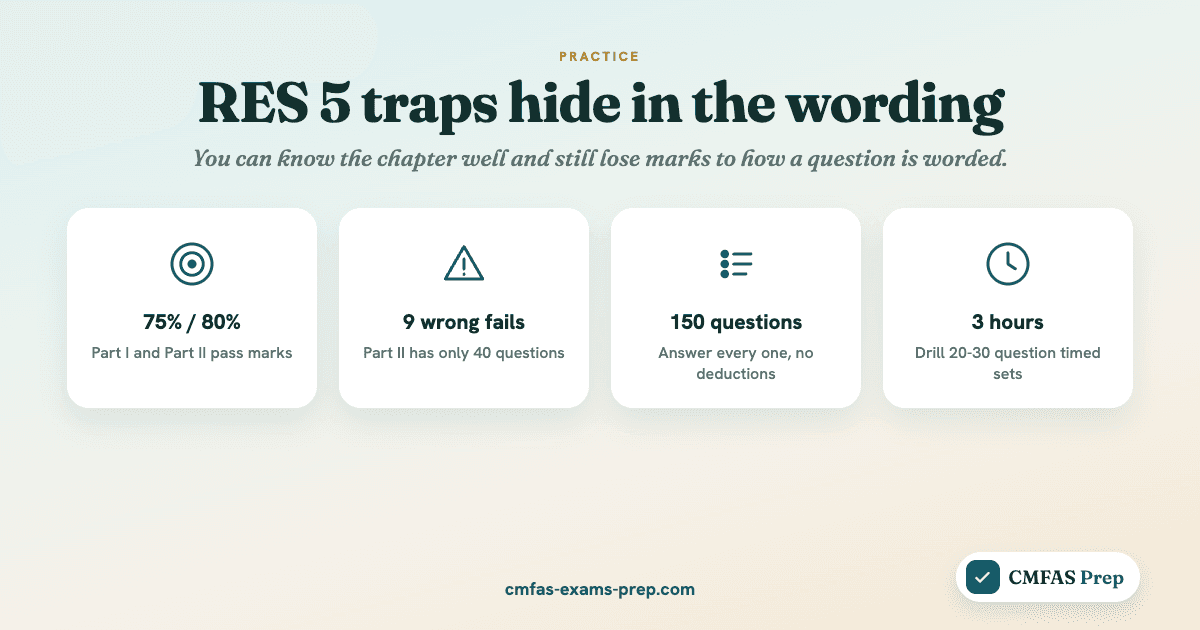
The whole paper is 150 questions in 3 hours, closed book, on a computer screen at SCI. Each correct answer earns a mark, and a wrong or blank answer costs nothing. The two parts are marked separately, so a high Part I score can't carry a weak Part II. Get 9 of the 40 Part II questions wrong and the paper is a fail.
Part I, chapter by chapter
SCI's contents list names the MAS notices and guidelines each chapter covers. The titles in the middle column are MAS's own names for them.
| Chapter | What it covers | Instruments named |
|---|---|---|
| 1 | Financial advisers and their representatives under the Financial Advisers Act and Regulations | FAA, FAR |
| 2 | Conduct of business, MAS's powers and offences | FAA, FAR |
| 3 | Recommendations on investment products; information to clients and product disclosure; dual currency investments | FAA-N16, FAA-N03, FAA-N11 |
| 4 | Introducers; prohibited representations by exempt persons; provisional representatives; reporting misconduct; the balanced scorecard; competency requirements | FAA-N02, FAA-N10, FAA-N12, FAA-N14, FAA-N20, FAA-N26 |
| 5 | Anti-money laundering and countering the financing of terrorism | FAA-N06 |
| 6 | Reporting suspicious activity and fraud; technology risk; cyber hygiene; direct purchase insurance | FAA-N17, FSM-N23, FAA-N19, FSM-N24 |
| 7 | Investment-linked policies | MAS Notice 307 |
| 8 | Guidelines, part I, including fit and proper criteria and standards of conduct | FAA-G01, FSG-G01, FAA-G04, FAA-G05, Circular CMI 01/2011 |
| 9 | Guidelines, part II, including fair dealing and the balanced scorecard framework | FAA-G09, FAA-G10, FSG-G04, FAA-G14 |
| 10 | Guidelines, part III | FAA-G13, FAA-G15, FAA-G16, CMG-G02, FSG-G02 |
| 11 | The Revised Code on Collective Investment Schemes | CIS Code |
| 12 | Securities dealing and market conduct | Securities and Futures Act |
| 13 | The Central Provident Fund | CPF |
That's 13 chapters and well over twenty separate instruments feeding 110 questions. Part I questions reward precise recall: which notice a rule comes from, whether a duty sits with you or your firm, and the exact condition that switches a requirement on. Knowing that a notice is legally binding while a guideline isn't is itself examinable.
Chapters 3 and 4 hold nine notices between them, and chapters 8 to 10 hold thirteen guidelines and a circular. If you're short of time, a one-page summary for each instrument pays off there: its number, what it requires and who it applies to.
Part II, chapter by chapter
Part II has 14 chapters in two blocks. The first block is professional ethics:
- 14: why professional ethics matter
- 15: professionalism
- 16: ethical behaviour
- 17: unethical behaviour
- 18: conflict of interest
- 19: fair dealing
- 20: ethical marketing and sale of financial products
The second block follows the advice process with one client, in the order you'd do it:
- 21: developing the client-representative relationship
- 22: fact finding and needs analysis
- 23: analysing and evaluating the client's financial status
- 24: developing strategies and solutions
- 25: presenting the analysis and solutions to the client
- 26: reviewing the client's portfolio
- 27: a basic financial planning guide
Part II questions are mostly short client scenarios. The question asks what you should do next or which action is ethical, and the wrong options are usually things a representative might plausibly do. Knowing the order of chapters 21 to 26 settles many "most appropriate next step" questions, because a step from later in the process makes a tempting wrong option.
The arithmetic that makes Part II dangerous
SCI doesn't publish how many questions come from each chapter, so averages are the best guide. Part I spreads 110 questions over 13 chapters, roughly 8 or 9 a chapter. Part II spreads 40 over 14, under 3 a chapter.
| Part I | Part II | |
|---|---|---|
| Questions per chapter, on average | about 8.5 | about 2.9 |
| Wrong answers you can afford | 27 | 8 |
| Cost of skipping one chapter, on average | about a third of your margin | about a third of your margin, with far less room left |
Skipping a Part I chapter is survivable if you're strong elsewhere. Skipping a Part II chapter spends roughly 3 of your 8 allowed misses before you've made a single ordinary mistake.
A worked example of our own: a candidate scores 100 of 110 on Part I, which is 91%, and 31 of 40 on Part II. That's 131 of 150 overall, about 87%, and it's a fail, because Part II needed 32.
How to split your study time
Part II is 27% of the questions and 14 of the 27 chapters, and it has the higher pass mark. With only 8 wrong answers allowed, each Part II chapter carries real risk.
Our suggestion, not SCI's, is to give Part II about as much study time as Part I, even though it supplies far fewer questions. In practice:
- Work through Part I in chapter order and test each chapter the day you finish it. Keep a list of notice numbers and what each one requires.
- Do Part II in two passes, the ethics block and then the advice-process block, with scenario questions after every chapter.
- Track how you do on Part II questions separately on every mock, because one combined score can hide a failing Part II.
Our RES 5 study plan turns this into four weeks, and the pass marks guide works through the arithmetic of the two hurdles.
Where the syllabus meets the current rules
The instruments in Part I change on their own schedule. FAA-N16 was last updated on 29 December 2025, and the current FAA-N06 took effect on 1 July 2025. SCI folds updates into the eBook and lists them in its version control record, so the edition you're given is the one you're examined on. If a rule you read on MAS's site differs from your text, answer the exam from the text and use the current rule with clients. Our note on where the study text is out of date has examples.
Practise both parts
The RES 5 page shows what our practice covers, with a free sample question. Our full mocks are 150 questions in 3 hours, marked against 80%, the higher of the two pass marks, and you can start RES 5 as a single paper for chapter practice across all 27 chapters.
Sources
- SCI, RES5 exam details (contents, format, passing grade), read 12 October 2026
- MAS, Notice FAA-N16 on recommendations on investment products, read 12 October 2026
- MAS, Notice FAA-N03 on information to clients and product information disclosure, read 12 October 2026
- MAS, Notice FAA-N20 on the balanced scorecard framework, read 12 October 2026
- MAS, Notice FAA-N06 on prevention of money laundering and countering the financing of terrorism, read 12 October 2026
- MAS, Notice 307 on investment-linked policies, read 12 October 2026
- MAS, Guidelines on standards of conduct for financial advisers and representatives (FAA-G04), read 12 October 2026
- MAS, Guidelines on fair dealing (FSG-G04), read 12 October 2026
- MAS, supervisory approach and regulatory instruments, read 12 October 2026
Practise RES 5 now
700+ exam-style RES 5 questions with instant explanations.
Frequently asked questions
27. Part I is chapters 1 to 13 on rules and regulations, and Part II is chapters 14 to 27 on ethics and the advice process.
110 from Part I and 40 from Part II, 150 in total. Part I needs at least 75% and Part II at least 80%, in the same sitting.
SCI's contents list names FAA-N16, FAA-N03, FAA-N11, FAA-N02, FAA-N10, FAA-N12, FAA-N14, FAA-N20, FAA-N26, FAA-N06, FAA-N17, FSM-N23, FAA-N19, FSM-N24 and MAS Notice 307.
Our suggestion is roughly equal time, even though Part II supplies far fewer questions, because it has the higher pass mark and only 8 wrong answers are allowed.