RES 5 exam traps: how the wording catches you
Eight RES 5 exam traps in how questions are worded, from NOT stems to look-alike rules and steps out of order, most with a practice question and answer.
The RES 5 exam traps that cost the most marks sit in how a question is worded: a NOT you skimmed, two rules that sound alike, a step taken out of order, or a clock that starts on the wrong day. You can know the chapter well and still pick the wrong option. Below are eight traps, most with a practice question we wrote for this guide.
Why RES 5 wording matters more than most papers
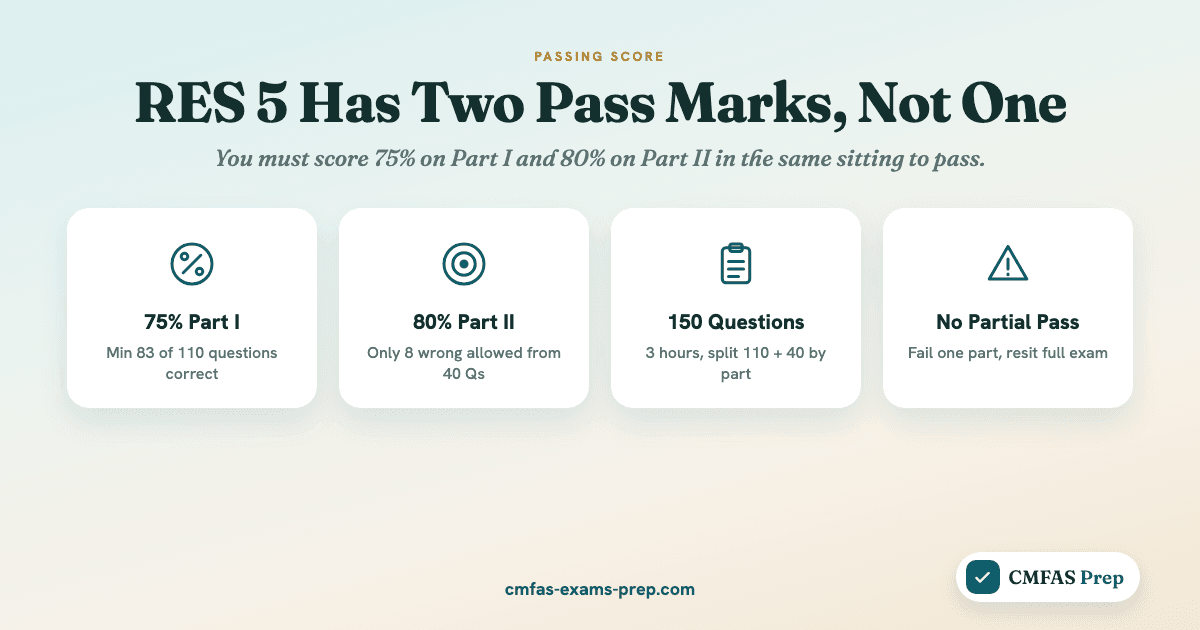
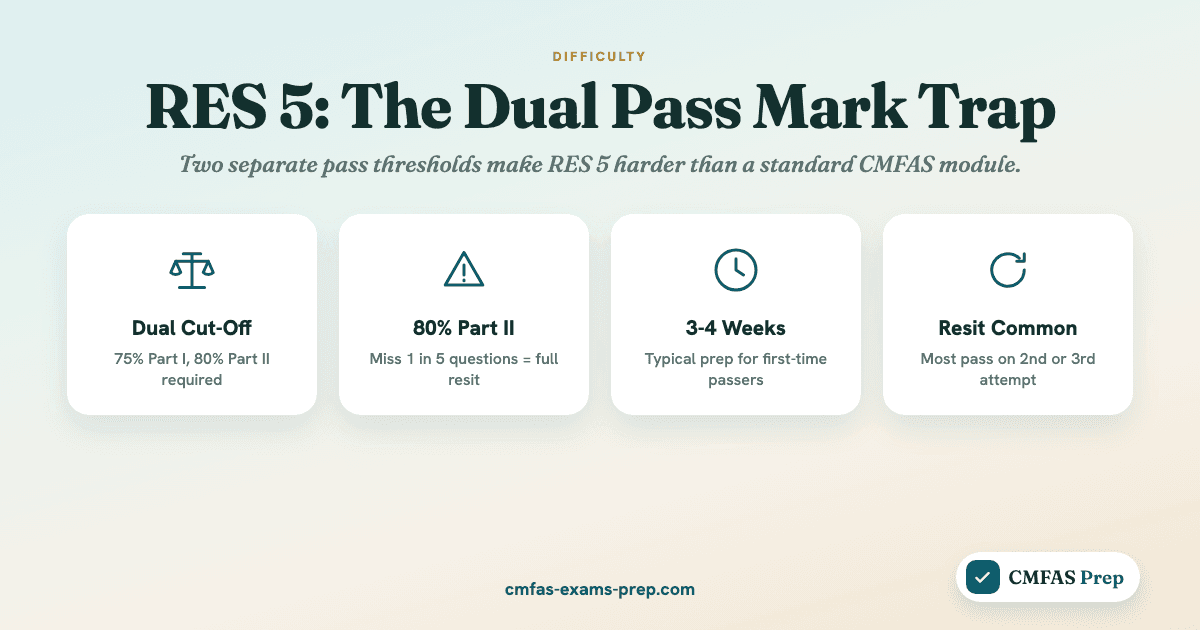
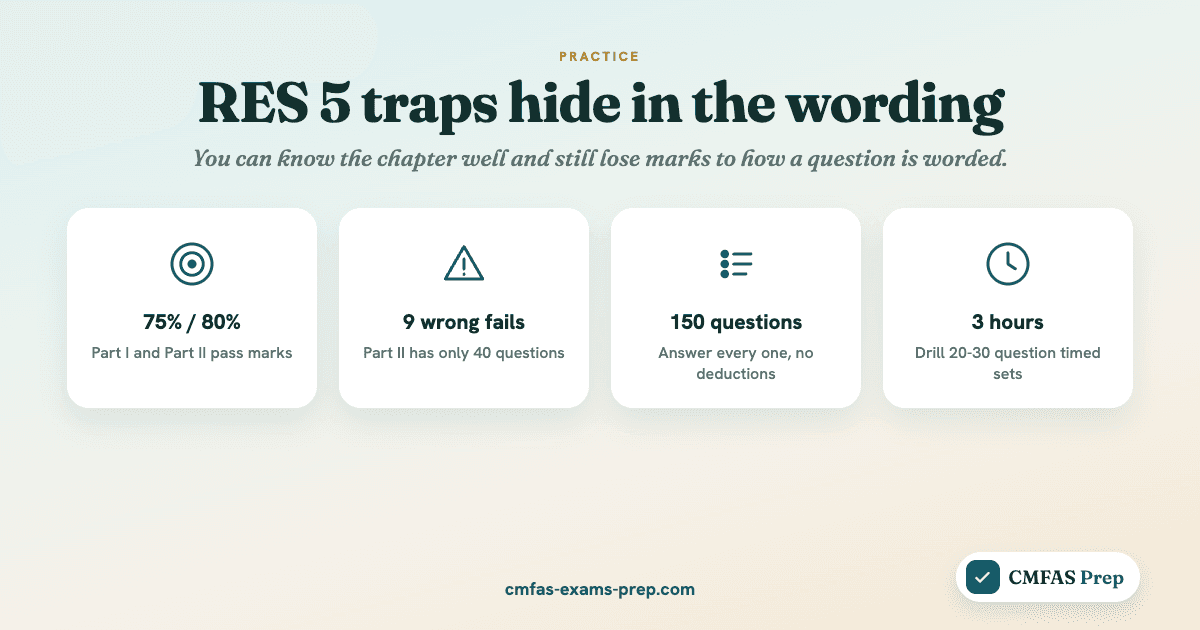
RES 5 gives you 150 questions in 3 hours, and you need 75% on Part I and 80% on Part II in the same sitting. Part II has 40 questions, so 9 wrong answers there fail the whole paper, however well Part I went. That leaves very little room for marks lost to misreading.
A wrong answer costs nothing beyond the missed mark, and neither does a blank, so every question deserves an answer. The traps below are about making sure the answer you give is the one you meant.
Trap 1: the NOT you didn't see
Negative stems flip the question. You read four options, three of which are true, and pick a true one because it looks familiar.
Try this one:
Which statement about MAS Guidelines is NOT correct?
- A) They set out principles or best-practice standards.
- B) How well a firm observes them can affect MAS's risk assessment of that firm.
- C) Contravening a Guideline is a criminal offence.
- D) Firms are expected to observe their spirit.
The answer is C, because MAS says contravening a guideline isn't a criminal offence and doesn't attract civil penalties, while a Notice imposes legally binding requirements. A candidate who misses "NOT" goes looking for a true statement and finds three.
The fix is mechanical. When the stem has NOT, EXCEPT or LEAST in it, say it to yourself before you read the options, then mark each option true or false in your head.
Trap 2: one criterion mistaken for the whole test
Some rules need two conditions out of three, and the exam gives you a client who meets one.
Madam Goh is 66. She speaks and reads English fluently and holds a polytechnic diploma. Under MAS Notice FAA-N16, must she be treated as a selected client?
- A) Yes, every client aged 62 or over is a selected client.
- B) No, because only one of the three criteria applies to her.
- C) Yes, because she is retired.
- D) Only if she asks to be treated as one.
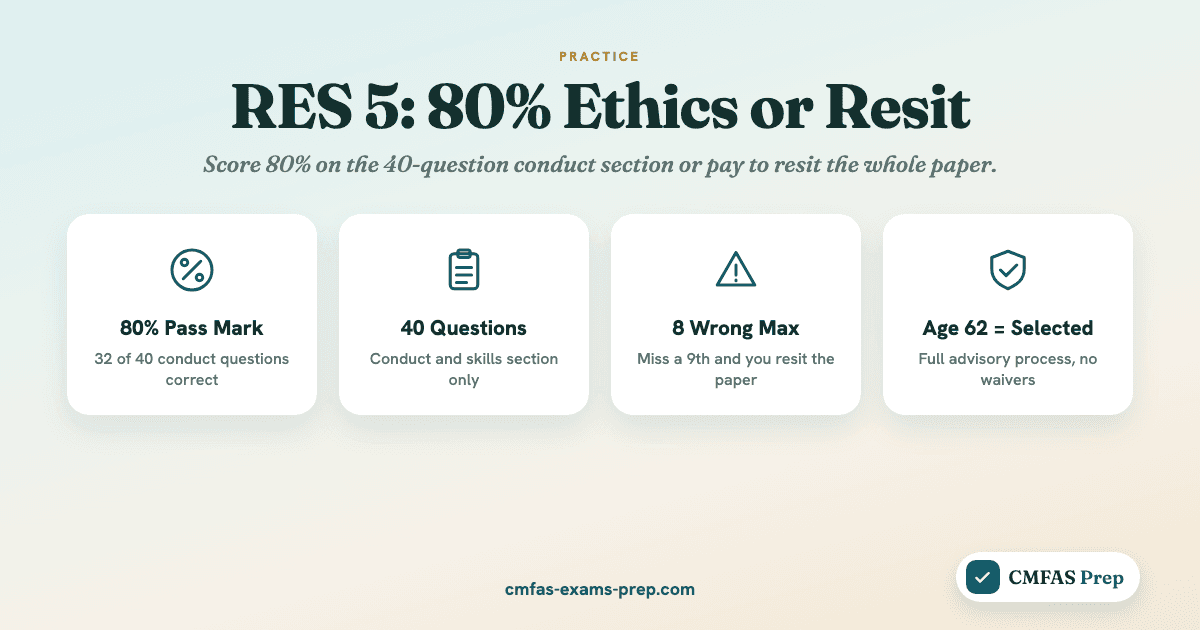
The answer is B. FAA-N16 has the adviser ask three things as part of knowing the client: is the client under 62, are they proficient in the language the advice is given in, and do they have at least O Level or N Level certificates or an equivalent. A client is treated as a selected client only if at least two of the answers are no. Madam Goh fails only the age question.
Age is the detail everyone remembers, which is why the question leads with it.
Trap 3: look-alike rules with different numbers
Several RES 5 rules come in pairs that sound the same and differ in one number or one word. Learn them side by side:
| Pair | One side | The other side |
|---|---|---|
| CKA and CAR | Customer Knowledge Assessment: unlisted SIPs, outcome good for one year | Customer Account Review: listed SIPs, 3 years |
| Notice and Guideline | Notice: legally binding | Guideline: not an offence to contravene, but counts in MAS's risk assessment |
| Selected client | Two of three criteria answered no | Not age alone |
| Free-look period | 14 days | Counted from when the client receives the policy documents |
| EIP and SIP | Excluded Investment Product: any product listed in Annex 1 of FAA-N16 | Specified Investment Product: every investment product not on that list |
| CDD and enhanced CDD | Customer due diligence: the baseline checks under FAA-N06 | Enhanced CDD, for example for a politically exposed person: senior management approval, source of wealth and funds, closer monitoring |
| Reporting and telling | A suspicious transaction report goes to the Suspicious Transaction Reporting Office (STRO), not to MAS | Letting the customer know is tipping-off, an offence under section 57 of the CDSA |
When a question turns on one of these, the wrong options are usually the other half of the pair. Seeing "3 years" next to a Customer Knowledge Assessment should set off an alarm. So should an option that says a product is a SIP because it "feels complex": FAA-N16 decides it by the Annex 1 list, and anything not on the list is a SIP.
Trap 4: the clock that starts on the wrong day
Time-limit questions test when the count begins as much as how long it runs.
From when is the 14-day free-look period on a life policy counted?
- A) The date the client signed the proposal form
- B) The date the first premium was paid
- C) The date the insurer issued the policy
- D) The date the client received the policy documents
The answer is D. MoneySense, the national financial literacy site, says the free-look period starts from the day you receive the policy documents. Options A, B and C are all real dates in the sale, which is what makes them tempting.
Trap 5: the right step at the wrong time
Part II covers chapters 14 to 27, and its last chapters follow the advice process in order: fact finding and needs analysis, then analysing the client's financial status, then developing strategies, then presenting them, then reviewing the portfolio. Scenario questions ask for the "most appropriate next step", and the wrong options are often good steps from later in that sequence.
You've just completed a fact-find with a new client who wants a plan for her children's education. What is the most appropriate next step?
- A) Show her the brochure for your firm's education plan
- B) Analyse her financial status against the needs she described
- C) Ask her to sign the application form
- D) Set a date to review her portfolio
The answer is B. Every option is something you'll do at some point with this client, but only B comes next in the process.
Trap 6: confusing who does what
RES 5 likes to ask whether a duty sits with you or with your firm. For example, it's your firm, not you, that lodges the notice of intent to appoint you with MAS and certifies that you're fit and proper. When a question names a representative, a firm and a client, decide whose duty it is before you read the options.
Trap 7: the study text and the current rules
MAS updates notices, and SCI's study text follows on its own schedule. FAA-N16 was last updated on 29 December 2025, for example, and its current selected-client paragraphs also let an adviser not treat a client as selected where the client has enough knowledge and experience in a class of products and the advice stays within it. If your edition of the text doesn't say that, answer the exam from the text and give clients the current rule. Our note on where the study text is out of date covers how to handle the gaps.
Trap 8: one question eating five minutes
You have 180 minutes for 150 questions, about 72 seconds each. A scenario you can't crack will happily take five minutes, and those minutes come out of easy questions at the back of the paper. When an answer isn't coming, pick your best option, flag it and move on. Come back at the end with whatever time is left. A guess you revisit is worth more than a question you never reached.
How to train out of these traps
Reading the study text again won't fix a reading habit, but timed questions will. Do sets of 20 to 30 questions against the clock, and when you miss one, write down the trap that caught you next to the right answer. After a week the same two or three traps usually account for most of your misses, and those are the ones to drill before you move on to full papers.
In the final week, stop opening new chapters. Go back through your list of misses, sit one more timed paper and sleep properly the night before, because tired reading is how a NOT slips past.
Our RES 5 sample questions walk through five more scenarios with worked answers, and the pass marks guide explains why Part II needs most of your attention. The RES 5 page has a free sample question from our bank, and you can start RES 5 as a single paper for full mocks marked against both pass marks, with an explanation on every answer.
Sources
- SCI, RES5 exam details (format, pass marks, chapter list), read 12 October 2026
- MAS, Notice FAA-N16 on recommendations on investment products, read 12 October 2026
- MAS, Notice FAA-N06 on prevention of money laundering and countering the financing of terrorism, read 12 October 2026
- MAS, supervisory approach and regulatory instruments, read 12 October 2026
- MoneySense, interpreting your insurance documents, read 12 October 2026
- MAS, FAQs on the Financial Advisers Act, representative notification framework, read 12 October 2026
Practise RES 5 now
700+ exam-style RES 5 questions with instant explanations.
Frequently asked questions
Through the wording: a NOT they skimmed, two rules that sound alike, a clock that starts on the wrong day or a step from later in the advice process. Say NOT, EXCEPT or LEAST to yourself before reading the options.
No. FAA-N16 has the adviser ask whether the client is under 62, proficient in the language of the advice, and holds at least O Level or N Level certificates or an equivalent. Only a client with at least two answers of no is treated as a selected client.
A Customer Knowledge Assessment covers unlisted Specified Investment Products and its outcome is good for one year. A Customer Account Review covers listed ones and runs on 3 years.
No. A wrong answer costs nothing beyond the missed mark, and neither does a blank, so always give an answer.