CMFAS M8 sample questions: try the calculation style before you book
Try the 5-question M8 calculation mock, mark it yourself, and see if future value and Sharpe ratio still trip you up before exam day.
The fastest way to find out if you are ready for M8 is to sit a short set of real-style questions, mark yourself honestly, and see how the calculation items go. Below is a free five-question mini paper covering the exact question types that decide most M8 results, with worked answers you can check against.
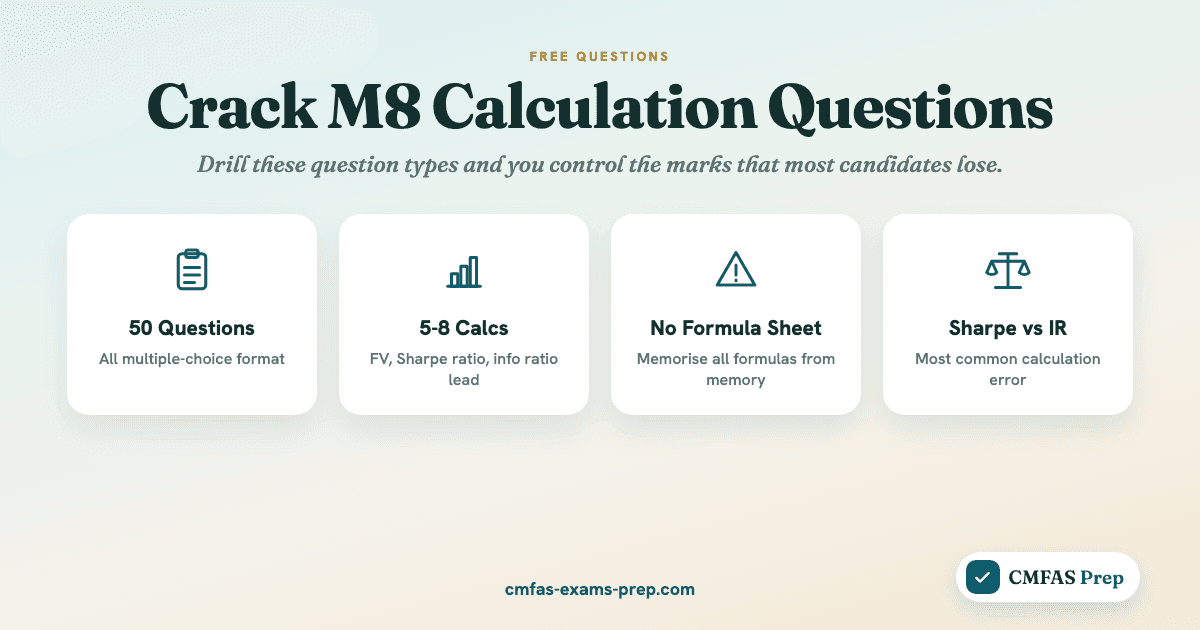
M8 gives you 50 multiple-choice questions, and roughly 5 to 8 of them are calculations. You don't get a formula sheet. If you can't write out the future value or Sharpe ratio formula from memory under time pressure, those marks are gone before you start. The theory chapters reward reading. The math chapters only reward practice.
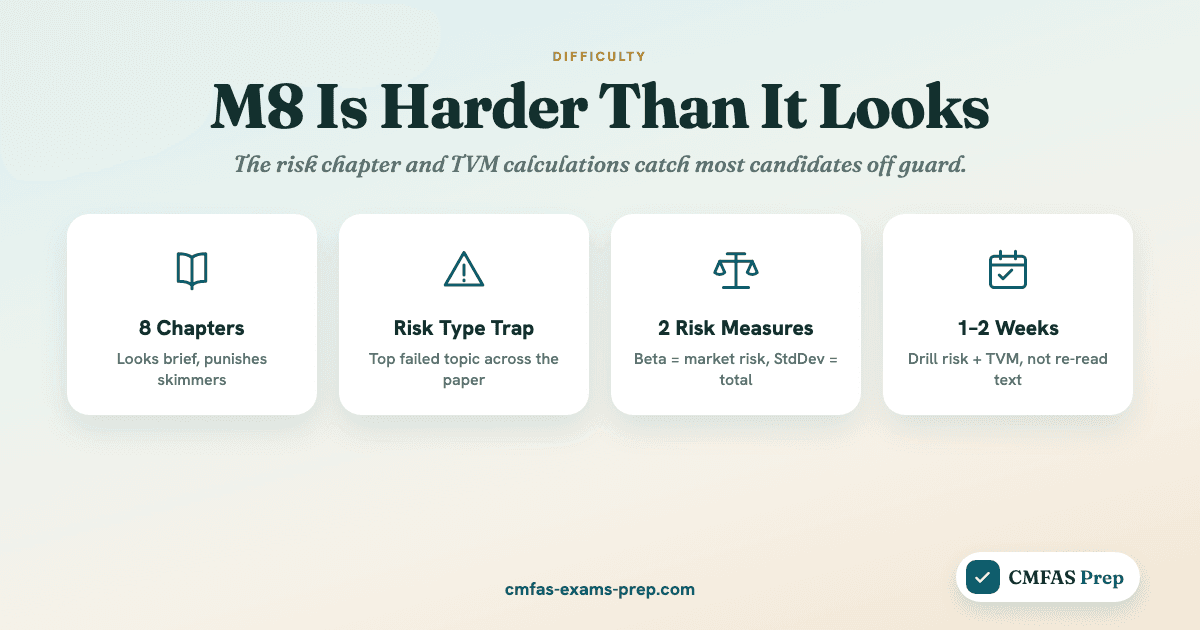
So the candidates who fail rarely fail on definitions. They fail because they treated chapter 4 (risk and return) and chapter 5 (time value of money) as reading material instead of drilling the formulas until the answers came out clean.
What this mini paper tests
The five questions below map to the parts of M8 that separate a pass from a near miss: compounding, the two return-per-risk ratios that look almost identical, money market fund characteristics, and matching a product to an investor's time horizon. Work them on paper before you read the answers. If you peek, you learn nothing about your real readiness.
Question 1: compounding a single sum
An investor puts S$250,000 into a commercial unit she expects to compound at 3% a year. What is it worth after 12 years, to the nearest S$1,000?
A) S$340,000 B) S$344,000 C) S$356,000 D) S$362,000
The correct answer is C.
This is the future value formula: FV = PV × (1 + r)^n. Put in PV = 250,000, r = 0.03, n = 12, and you get 250,000 × (1.03)^12 = 356,440, which rounds to S$356,000.
The mistake here is almost always the exponent. People multiply by 17 instead of raising to the 17th power, or fumble the power function on the calculator. Practise keying it in until the sequence is automatic.
Question 2: Sharpe ratio
A fund returns 9% a year against a benchmark's 7%. The risk-free rate is 3%. The fund's standard deviation is 8% and its tracking error is 4%. What is the Sharpe ratio?
A) 0.25 B) 0.5 C) 0.75 D) 1.5
The correct answer is C.
The Sharpe ratio is (fund return − risk-free rate) ÷ standard deviation, so (9% − 3%) ÷ 8% = 0.75.
The trap is the denominator. Sharpe uses standard deviation. If you reach for tracking error (4%) out of habit you get 1.5, and if you subtract the benchmark instead of the risk-free rate you land on a different figure again. Two numbers in the question, 4% and 8%, are there to see whether you know which ratio uses which.
Question 3: information ratio
A unit trust returns 12% while its benchmark returns 9%. The tracking error is 5%. What is the information ratio?
A) 0.4 B) 0.6 C) 0.75 D) 1.8
The correct answer is B.
The information ratio is (portfolio return − benchmark return) ÷ tracking error, so (12% − 9%) ÷ 5% = 0.6.
Read questions 2 and 3 back to back and the pattern is clear. Sharpe measures return above the risk-free rate per unit of total risk (standard deviation). Information ratio measures return above the benchmark per unit of active risk (tracking error). Same shape, different inputs. Mixing them up is the single most common calculation error on M8.
Question 4: money market funds
Which of these statements about money market funds is FALSE?
A) Their prices barely move when interest rates shift. B) They fit investors who cannot stomach large swings. C) Much of the portfolio sits in bonds maturing beyond five years. D) They sit near the bottom of the risk spectrum.
The correct answer is C, the false statement.
A money market fund holds short-term, high-quality debt, normally maturing in under a year. That short duration is exactly why it is low risk and barely moves when rates change. Anything holding paper with maturities beyond five years is a bond fund, and it carries the interest rate risk that comes with longer duration.
This is a knowledge question dressed up to look technical. If you understand why short maturity means low rate sensitivity, you don't have to memorise the answer.
Question 5: matching risk to the investor
All else equal, which investor should carry the LEAST investment risk?
A) A 62-year-old planning to draw on her savings within three years. B) A 40-year-old adding to his portfolio every month. C) A 28-year-old investing for a retirement three decades away. D) An investor who shrugs off a 20% drawdown.
The correct answer is A.
Someone near retirement has a short time horizon and little time to recover if markets fall just before they need the money. Capital preservation matters more to them than growth. The other three each have either time or appetite on their side. Suitability questions like this run through chapter 6, and they test judgement rather than arithmetic, so don't switch off your brain after the math chapters.
How did you do
Mark yourself out of five. If you got both ratio questions right under your own time pressure, you are in good shape for the calculation block. If you mixed up Sharpe and information ratio, or stalled on the exponent in question 1, that is your study list for this week. Those errors cost real marks, and the exam won't tell you which formula it wants.
You can see the full M8 format and what counts as a pass on the M8 passing score and format guide, and there is a fuller study plan in the 2026 M8 study guide.
Common questions about M8 mock papers
How many M8 questions are calculations?
About 5 to 8 of the 50 questions involve a calculation. Future value, Sharpe ratio, and information ratio show up the most, so those three formulas are worth memorising first.
Are formulas given in the M8 exam?
No. You sit M8 without a formula sheet, which is why rote practice on the calculation chapters matters more than re-reading them.
Should I buy second-hand notes for M8?
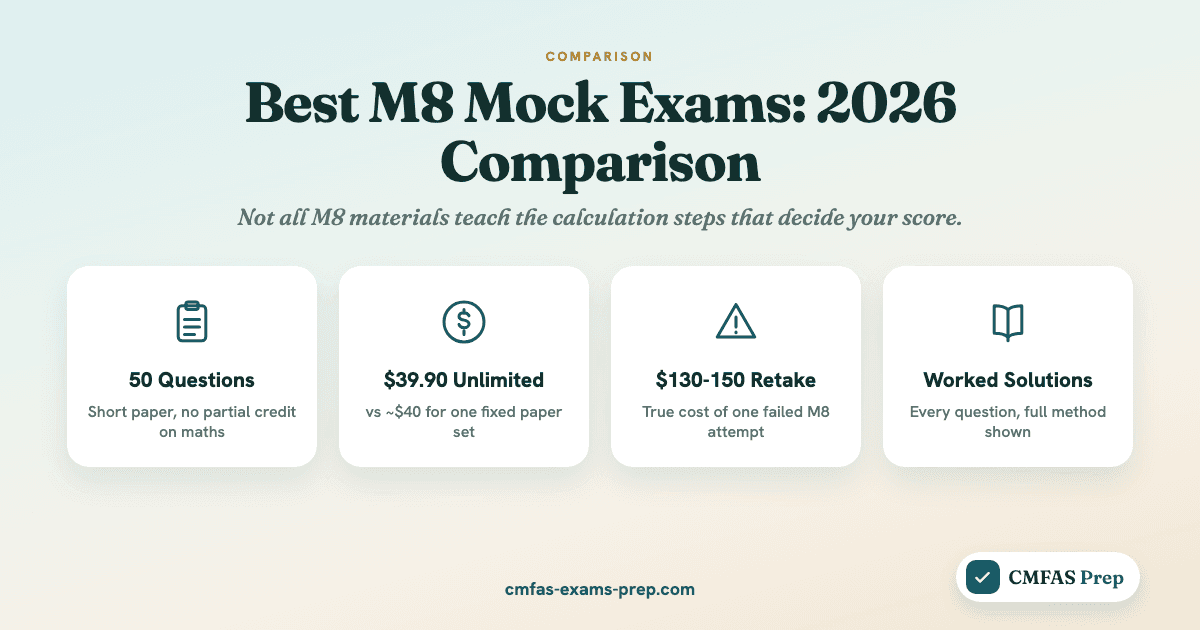
Old notes can be out of sync with the current CM-CIS syllabus, and they can't tell you which formula you keep getting wrong. A question bank that marks your answers and explains them is more useful for the math chapters. The trade-offs are laid out in our best M8 mock exams comparison.
Practise the math until it's boring
The calculation questions are the part of M8 you can fully control. Drill them by chapter, get the answer wrong a few times in practice instead of in the exam, and the ratios stop being a coin flip.
CMFAS Prep lets you practise M8 by chapter, marks every answer with a worked explanation, and tracks which topics you keep missing so you spend your time where it counts. The question bank follows the current 2026 CM-CIS syllabus.
Start on the M8 exam page, or go straight to the practice app and run a chapter 4 set today.
Practise M8 now
800+ exam-style M8 questions with instant explanations.
Frequently asked questions
You can find updated M8 mock questions on CMFAS Prep. We offer a bank of over 500 questions covering Calculations, Risk Analysis, and Product Knowledge.
Typically about 10-15% of the paper (5-8 questions). They usually cover Time Value of Money (Chapter 5) and Risk Ratios (Chapter 4). Knowing the formulas is mandatory.
No. Unlike some university exams, the CMFAS M8 exam does NOT provide a formula sheet. You must memorize the formulas for Sharpe Ratio, Information Ratio, and Future Value.
No, we do not recommend taking M8 and M8A together. It is easier to conquer it one by one as the concepts are dense.
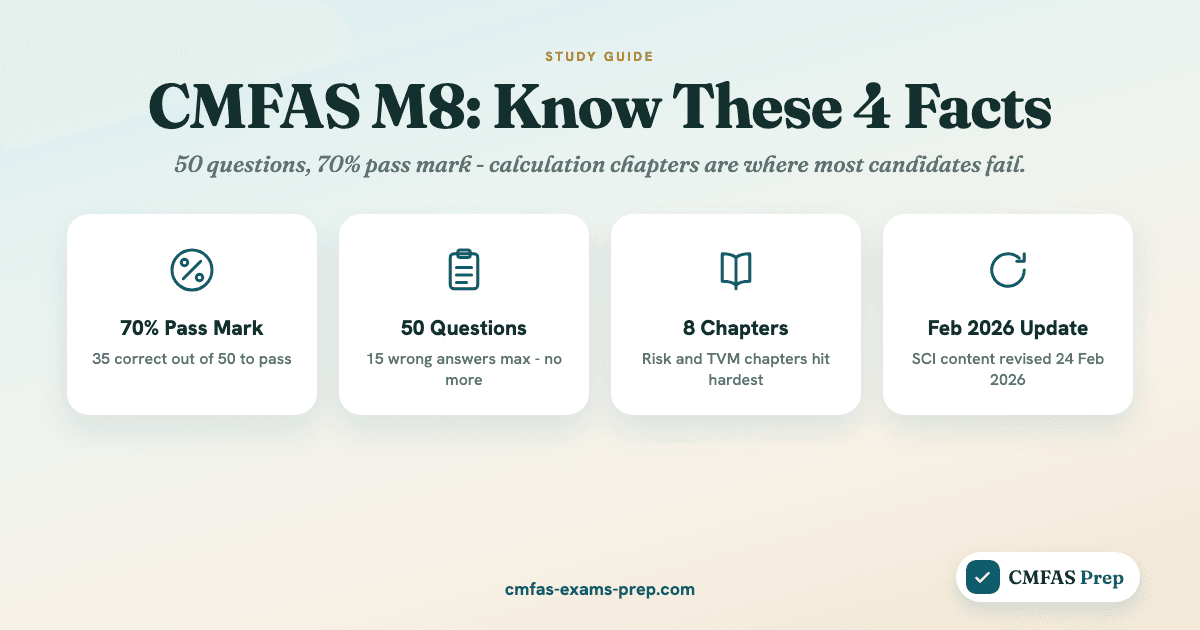
You need to answer 35 questions correctly out of 50 to pass.