How hard is CMFAS M8? The risk chapter is the real filter
CMFAS M8 looks short but the risk and return chapter decides who passes. See why standard deviation, beta, and diversification trip up candidates.
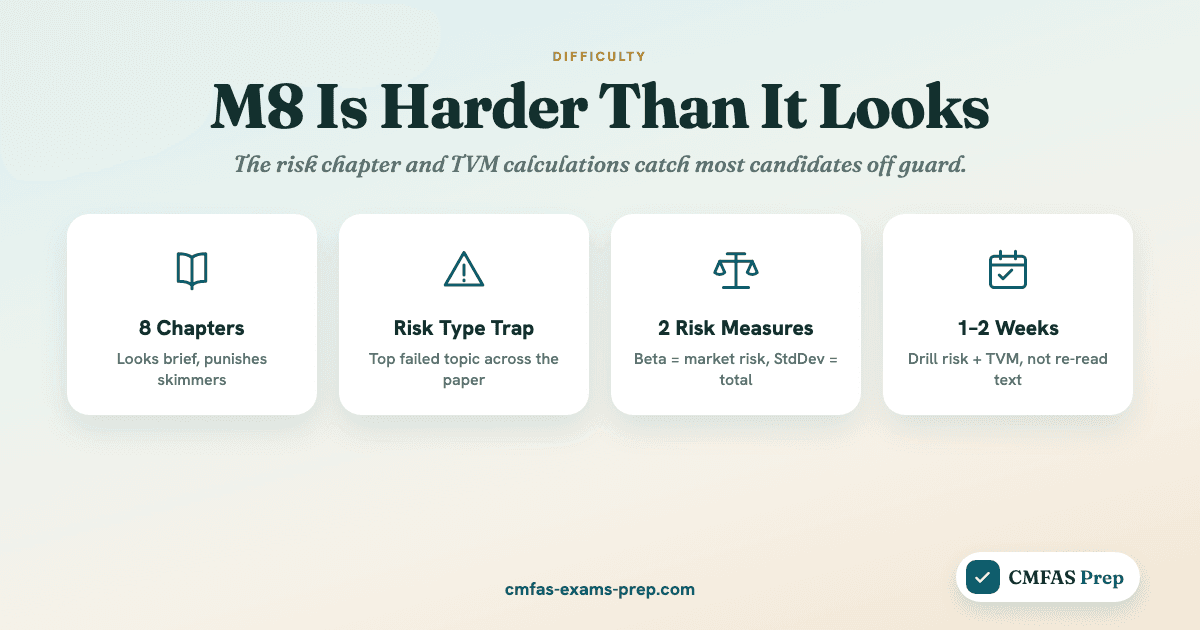
Yes, M8 is harder than its page count suggests, and the reason is plain: it asks you to calculate, not just recall. The module is shorter than M9, but it runs on finance maths like standard deviation, beta, and the time value of money, so anyone planning to skim the textbook the night before tends to lose marks on the application questions.
The textbook is what fools people. Eight chapters of Collective Investment Schemes looks like a one-evening job. Then the exam hands you a portfolio's beta alongside a six-month interest rate and asks you to do something with both numbers, and memorising definitions gets you nowhere.
Here is where the marks actually go, and which chapters cause the most damage.
What makes M8 harder than it looks
Three things separate M8 from the modules that came before it.
The first is arithmetic. You have to compute future value and a real rate of return, not just define them. The second is conceptual depth around risk, where the difference between systematic and unsystematic risk is the single most misread idea in the paper. The third is product knowledge, because you need to tell a real estate investment trust apart from a business trust and an exchange-traded fund under exam pressure.
If maths is your weak spot, this is the module where that shows up. For a full study plan, see our 2026 M8 study guide. If you are still deciding which paper you sit, the M8 versus M8A comparison explains who needs which.
The risk and return chapter is where people fail
Most lost marks trace back to one chapter on risk and return. Two ideas inside it do the damage.
The first is the gap between standard deviation and beta. Both measure risk, but they measure different things, and the exam will deliberately give you values for both and ask which one tells you a fund is more volatile than the market.
| Measure | What it tells you | Reference point |
|---|---|---|
| Standard deviation | Total risk, the spread of returns | The fund's own average return |
| Beta | Market risk, how the fund moves with the index | The market, where beta of 1 equals the index |
A fund can have a high standard deviation and a beta below 1. Read the question for which benchmark it is asking about. If the comparison is against the market index, beta is your answer.
The second idea is the split between systematic and unsystematic risk. Systematic risk is market-wide: interest rate moves, recessions, a war. You cannot diversify it away because it hits everything at once. Unsystematic risk is specific to one company: a fraud case, a factory fire, a strike. Spreading your money across many holdings cancels most of it out.
The classic question reads, "Which of the following risks can be reduced through diversification?" The answer is the unsystematic one, every time. Candidates who blur the two terms get this wrong, and the exam includes more than one version of it.
We built a free mini mock with the five M8 question types that catch most candidates so you can see these traps before exam day.
Know your products: REITs, business trusts and ETFs
Beyond the maths, M8 tests whether you can keep the product types straight. A real estate investment trust holds income-producing property and has to distribute most of its income to keep its tax treatment. A business trust can hold and run an operating business, and it can pay distributions out of operating cash flow rather than only accounting profit. An exchange-traded fund tracks an index and trades on the exchange like a share.
The exam mixes these into scenario questions, so reading a one-line definition is not enough. You need to recognise which structure a described product is, then answer a follow-up about how it pays out or what it can hold.
The maths barrier in time value of money
The time value of money chapter is pure calculation, and it has a specific trap built in.
You work out future value with the compound interest formula:
FV = PV x (1 + r)^n
The catch is the period. The question often quotes an annual interest rate but asks for the value after six months, or compounds quarterly. If you leave r and n on a yearly basis when the question is sub-annual, you pick a wrong answer that the examiner has placed there on purpose. Halve the rate and double the periods for semi-annual compounding; divide by four and multiply by four for quarterly.
The fix is not understanding the formula once. It is doing enough of these that "compounded quarterly" stops making you freeze. On CMFAS Prep, calculation questions come with a worked step-by-step solution, so you can see exactly where your period adjustment went wrong instead of guessing.
How to study for it
Reading the textbook again does little once you have read it once. What moves your score is repetition on the two or three chapters that carry the difficult marks.
Use the practice by chapter mode to drill the risk and return chapter on its own, then the time value of money chapter, until you can clear both without hesitating. Run a full timed paper only after those two feel automatic. You can start drilling M8 by chapter here.
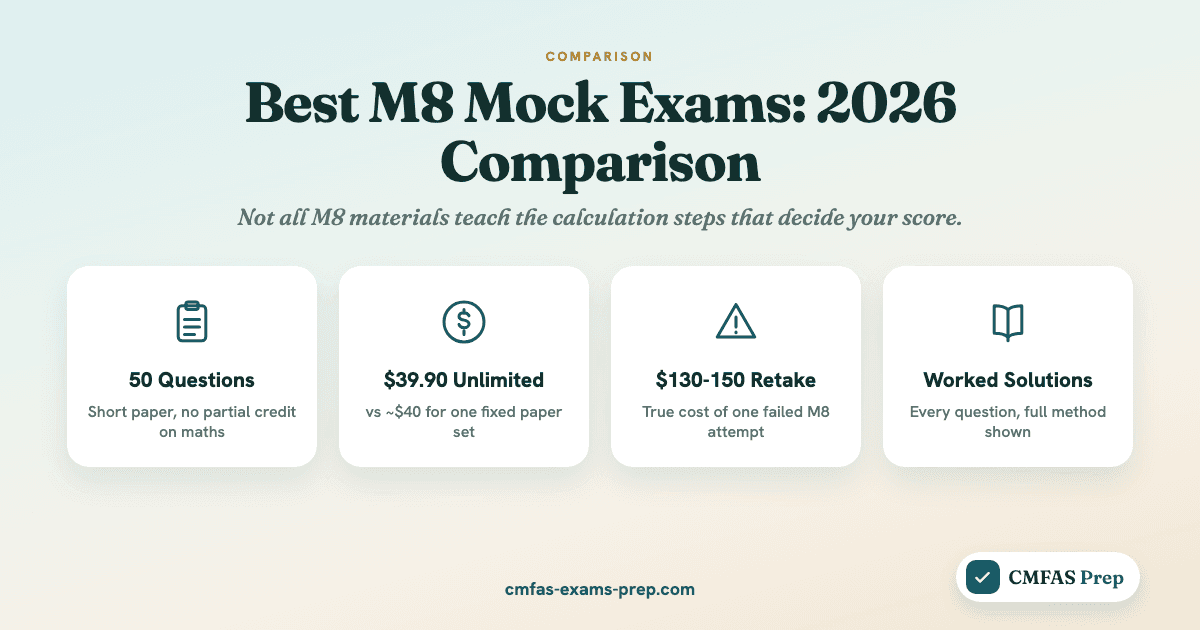
For exam logistics like the pass mark, number of questions and timing, check the M8 passing score and format guide. Before you commit to study materials, the M8 mock exam and study guide comparison is worth a read.
Common questions on M8 difficulty
Is M8 harder than M9?
They are hard in different ways. M9 covers more ground and rewards reading volume. M8 is shorter but more technical, so it punishes anyone who skips the calculations. If you are comfortable with finance maths, M8 can feel easier; if you are not, it is the tougher of the two.
Can I pass M8 without being good at maths?
You can, but only if you practise the calculation questions until the method is second nature. The maths is not advanced. It is compound interest and a handful of risk measures. The failures come from not practising the period adjustments and the standard deviation versus beta comparison, not from the difficulty of the formulas themselves.
How long should I study for M8?
Plan for more than one evening despite the short textbook. Most candidates need several sessions spread across one to two weeks, with the bulk of the time spent on the risk chapter and the time value of money chapter rather than re-reading product definitions.
What is the most failed topic in M8?
The systematic versus unsystematic risk distinction, closely followed by the standard deviation versus beta question. Both appear in more than one form on the paper, so getting them solid early pays off across several marks.
Practise instead of re-reading
M8 rewards repetition on the chapters that hurt. Drill risk and return and the time value of money on CMFAS Prep until the calculations stop slowing you down, then sit a full paper. That is the difference between recognising the trap and walking into it.
Practise M8 now
800+ exam-style M8 questions with instant explanations.
Frequently asked questions
**Chapter 4 (Risk and Return)** is widely considered the hardest because it introduces abstract financial metrics like Beta, Variance, and Standard Deviation which are new to most non-finance candidates.
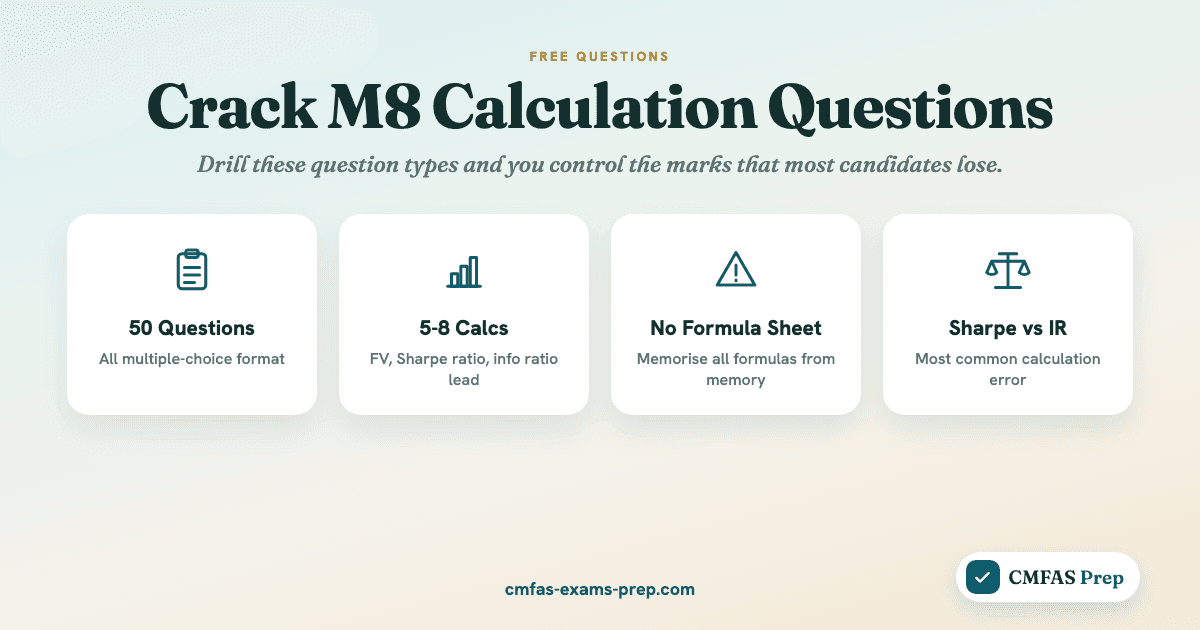
Expect about **10-15%** of the paper to be calculations, primarily from **Chapter 5 (Time Value of Money)** and **Chapter 7 (Unit Trust Pricing)**. You must be comfortable with Future Value formulas.
They are different. M5 (now RES 5) is about Rules & Ethics (Memory). M8 is about Investment Products & Math (Concepts). If you are good at memorizing laws, M8 might actually feel harder due to the calculations.
No, we do not recommend taking M8 and M8A together. It is easier to conquer it one by one as the concepts are dense.
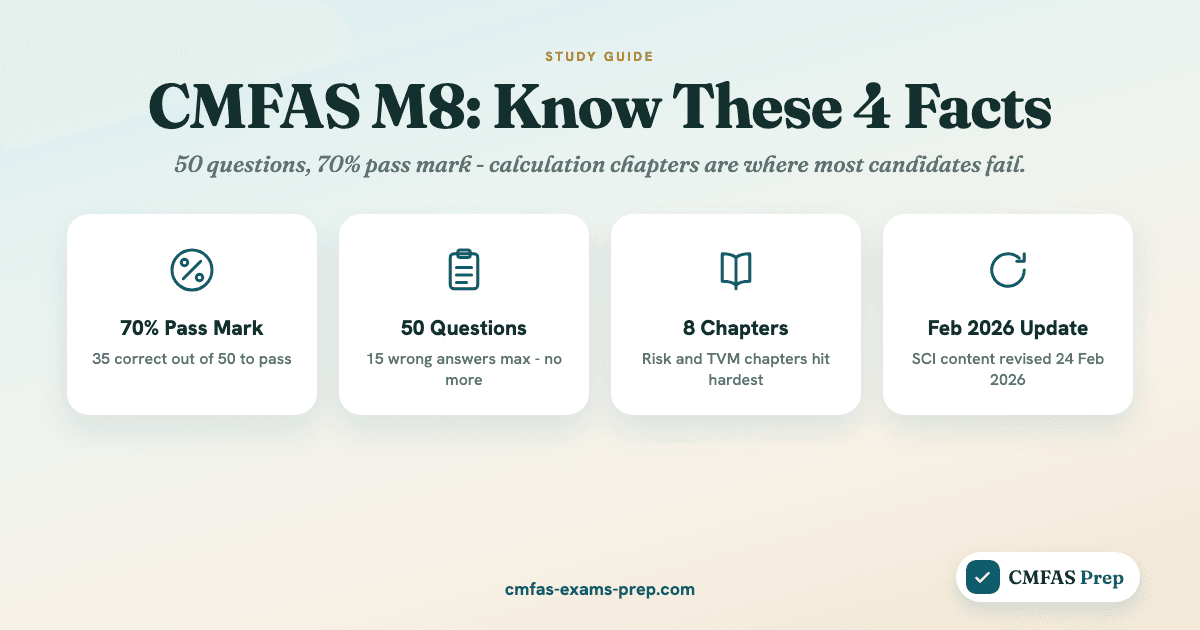
You need to answer 35 questions correctly out of 50 to pass.