CMFAS M8 format and pass mark: why the short paper punishes guessing
CMFAS M8 is 50 questions in 60 minutes and you need 35 right to pass. See why the short format punishes guessing and how to avoid losing marks.
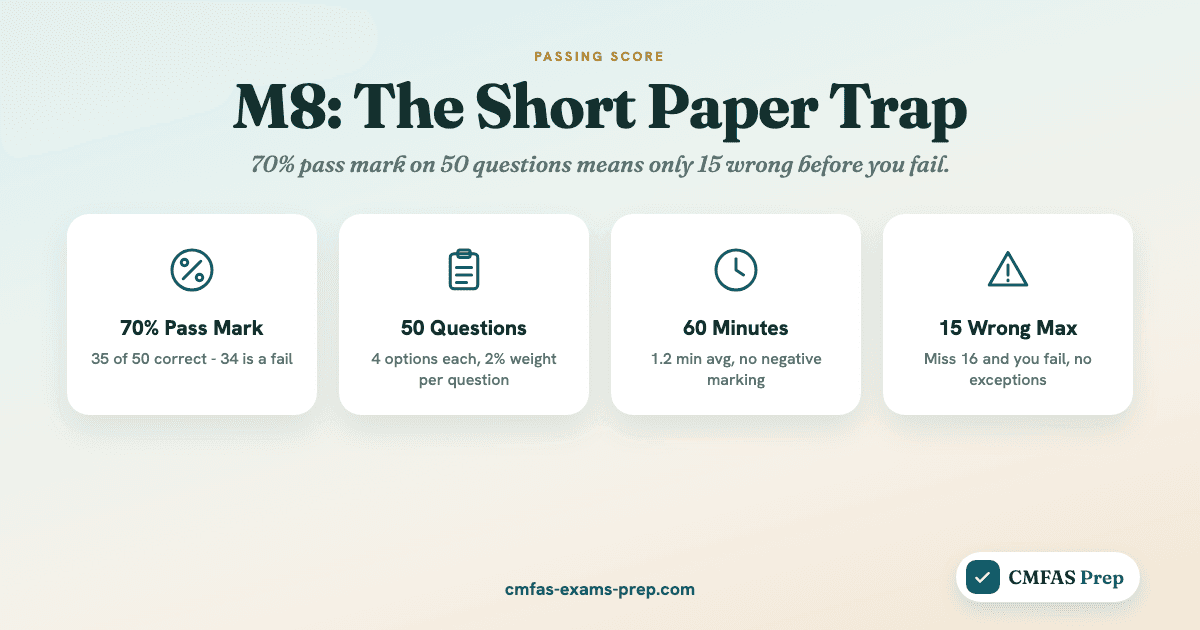
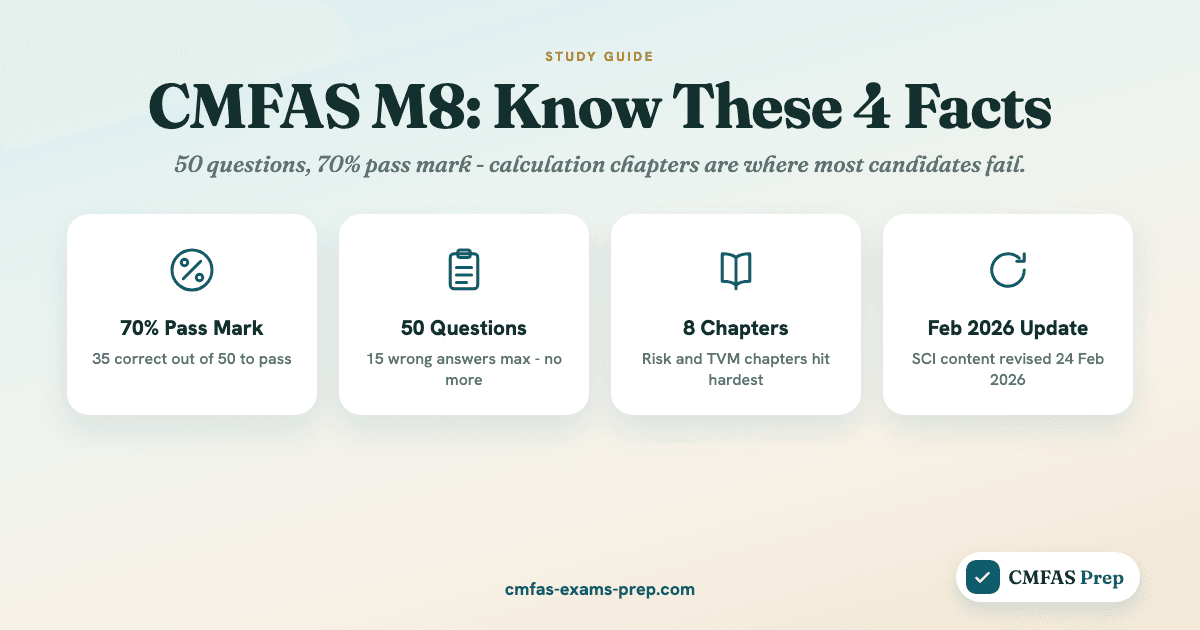
The M8 exam asks for 70%, which means 35 of the 50 multiple-choice questions correct. Get 34 right and you score 68%, which is a fail. The format is one hour, no negative marking, and a calculator you bring yourself.
That short runtime is where candidates get careless. Fifty questions in sixty minutes sounds generous, so people slow down, second-guess, or assume they will breeze through and leave early. The math underneath tells a different story.
What the M8 paper actually looks like
M8 is the Collective Investment Schemes paper, one of the Capital Markets and Financial Advisory Services modules administered through the Singapore College of Insurance (SCI). Here is the shape of it.
| Item | Detail |
|---|---|
| Questions | 50 multiple choice, 4 options each |
| Duration | 60 minutes |
| Pass mark | 70% (35 correct) |
| Per-question weight | 2% |
| Negative marking | None |
| Calculator | Required; you bring your own |
Every question carries the same weight, and with only 50 of them, that weight is 2% each. Compare that to a 100-question paper like M9, where one wrong answer costs 1% and you can drop 30 questions and still pass. On M8 your entire margin for error is 15 questions. Not 15 percent. Fifteen questions.
Why a short paper is harder, not easier
The instinct on a short paper is to relax. The correct response is the opposite.
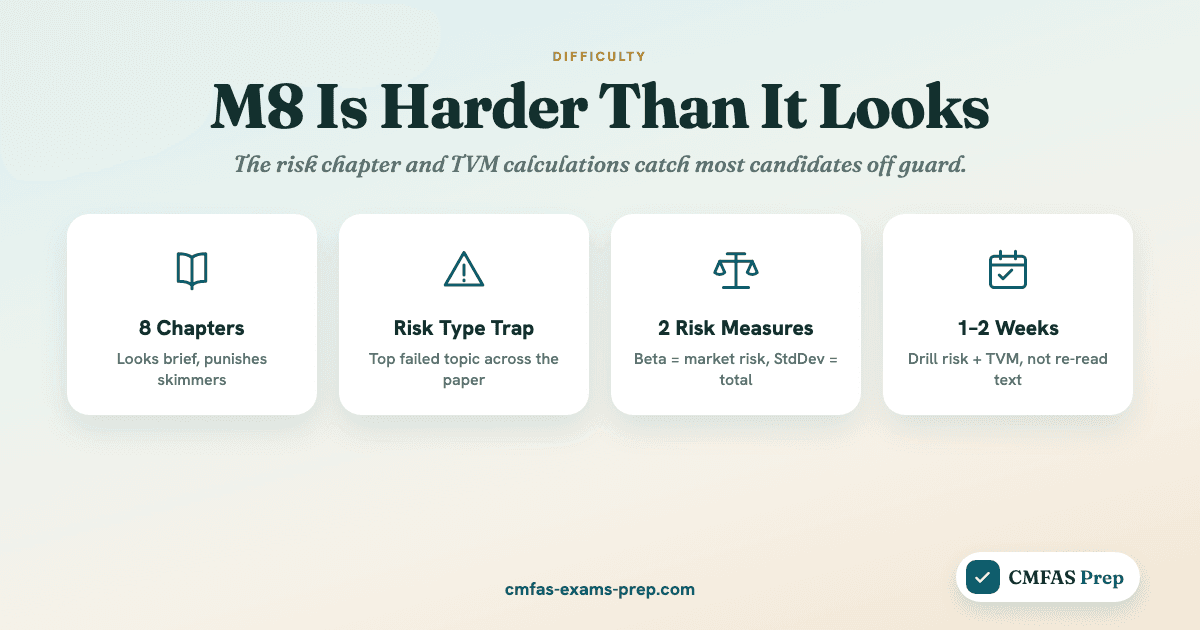
Think about where those 15 spare marks go. M8 mixes straightforward definitional content with a real amount of arithmetic, and the arithmetic is concentrated in a few chapters. If you walk in shaky on the calculation material and lose five questions there, you have spent a third of your buffer before you have made a single careless slip on the easy theory. From that point you are capped at 90% with no room left for the silly mistakes everyone makes under time pressure.
So the marks you bank on the definitional chapters are what keep you alive on the harder ones. You cannot treat any section as optional. Skipping a topic on a 100-question paper is survivable; on M8 it is most of your error budget gone in one decision.
The chapters that drain time
The calculation load on M8 surprises people who expected a product-knowledge paper. Risk and return (chapter 4) and the performance-measurement material are where the numbers cluster, and each of those questions eats far more than the 1.2 minutes you have on average.
Two examples of what you will face:
- Real rate of return: given a nominal rate of 5% and inflation of 2%, work out the real return. The exact-formula answer differs from the quick subtraction, and the options are written to catch whichever one you skip.
- Net asset value per unit: given the fund's total value and the number of units in issue, find the NAV per unit.
The trap is rarely the formula itself. It is the extra numbers. A question will hand you a management fee, a sales charge, and a redemption figure when the calculation needs only two of them. The surplus data is there to see whether you actually know which inputs the formula uses, or whether you just plug in everything on the page. Reach for the calculator on every one of these and the clock becomes your real opponent.
If your arithmetic is slow, the fix is repetition under a timer. The practice-by-chapter mode on CMFAS Prep lets you drill time value of money, real return, and NAV questions in isolation until you can clear each in well under a minute. Speed on the routine calculations is what frees up time for the ones that need thought.
The theory questions that look easy and aren't
Chapter 7 on unit trusts is where reading too fast costs marks. The duties of the manager and the trustee are distinct, and the exam writes options that swap one for the other. The manager runs the investment decisions; the trustee holds the assets and watches the manager on behalf of unit holders. A question can describe a responsibility in one clean sentence, and the wrong answer is simply the same responsibility attributed to the wrong party. Slow down on every option here. The difference between right and wrong is often a single role swapped.
Logistics worth sorting before exam day
A few practical points that catch people out.
SCI does not hand out calculators. You bring your own, and it has to be a standalone unit such as the Casio FC-100V. Your phone is not allowed as a calculator, so do not plan around it.
There is no negative marking, which means a blank answer is strictly worse than a guess. If a question stumps you, eliminate what you can and pick from the rest. Never leave anything unanswered. On a four-option question even a blind guess returns a quarter of a mark on average, and an educated one returns far more.
How to actually pace it
The 1.2 minutes per question is an average, not a budget for each one. Definitional questions should take 20 to 30 seconds, which is how you build the surplus time the calculation questions demand. Move fast through what you know, mark anything uncertain, and come back. The danger is not running out of time. It is finishing with twenty minutes to spare and a stack of avoidable errors because you rushed the wrong questions and lingered on the easy ones.
Read every option before you commit, especially on the unit-trust and regulatory material where two choices look almost identical. The careless-mistake rate on M8 is what fails competent candidates, not the difficulty of the content.
Test where you actually stand
Strategy on paper is worth less than a timed run. Take a full mock under exam conditions, see whether you clear 35, and find out which chapters are leaking marks before it counts. You can sit a timed M8 paper on the M8 exam page, and the free M8 mock questions give you the five calculation types that trip up most candidates.
Before you spend money on second-hand notes from a marketplace listing, read the M8 mock exam and study guide comparison so you know what is worth paying for.
When you are ready, run timed M8 papers on CMFAS Prep until 35 out of 50 is comfortable rather than a coin toss.
Practise M8 now
800+ exam-style M8 questions with instant explanations.
Frequently asked questions
The passing score is **70%**. Since there are 50 questions, you must answer at least **35 questions** correctly. Scoring 34/50 (68%) results in a fail.
No. M8 is a closed-book exam. You are not allowed to bring any notes into the exam center. You must memorize formulas for Ratios and Returns.
Yes. A significant portion of the exam involves calculating returns, NAV, and Time Value of Money. SCI does not provide calculators, so bring an approved model (e.g., Casio FC 100V).
You have **1 hour** (60 minutes). This gives you approximately 1.2 minutes per question. Speed is critical for the calculation questions.
You will have to retake the exam and pay the full fee again. There is no waiting period, so you can book the next available slot immediately.