A study plan for CMFAS M8
A three-week study plan for CMFAS M8 (Collective Investment Schemes): where marks disappear and how to hit 35 out of 50 to pass.
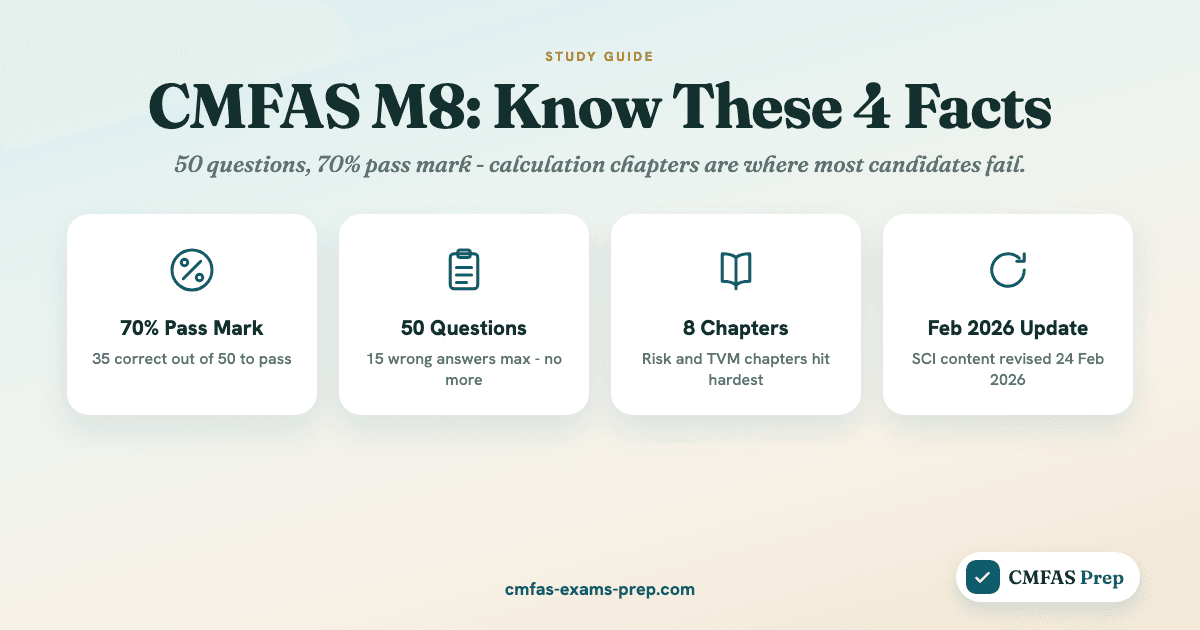
To sell unit trusts and other collective investment schemes in Singapore, you need to pass the CMFAS M8 (Collective Investment Schemes) exam, and the bar is 70% across 50 questions. That works out to 35 correct answers, so your margin for error is 15 questions and not one more. Most people who fail M8 do so because they treated it as a memory test when half of it is applied calculation.
The exam covers 8 chapters, which sounds light next to M9's 17. That false sense of ease is the first thing that catches candidates out. M8 packs real finance into those eight chapters: standard deviation, beta, the time value of money, and how a fund's net asset value gets priced. You can recite the definition of beta and still miss every question that asks you to use it.
Here is the short version before the detail.
- Scope: 8 chapters spanning financial markets, risk and return, and the unit trust products you will actually sell.
- The pass: 50 questions, 70% to pass, which is 15 wrong at most.
- The usual failure points: risk and return (Chapter 4) and time value of money (Chapter 5).
- What fixes it: drilling the calculations until present value, future value, and the Sharpe ratio are reflexes rather than puzzles.
Note on the syllabus: the SCI content has a small revision that takes effect on 24 Feb 2026. Our question bank and mock papers already reflect those changes, so you are not studying against an outdated version.
Should you bundle M8 with M8A?
Agencies often push candidates to sit M8 and M8A together as the combined CM-CIS paper, the same way they bundle M9 with M9A. The pitch is efficiency. The reality depends entirely on your background.
If you hold a banking or finance degree and the words "derivative" and "structured product" don't make you flinch, the combined sitting can save you a trip. If they do, sit M8 on its own.
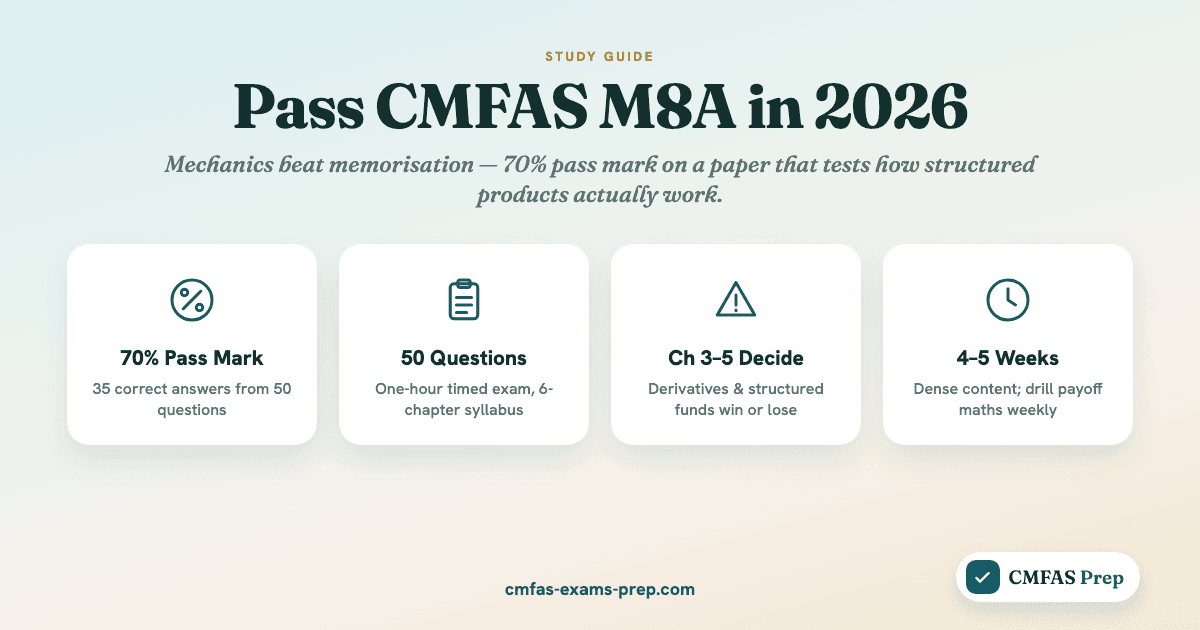
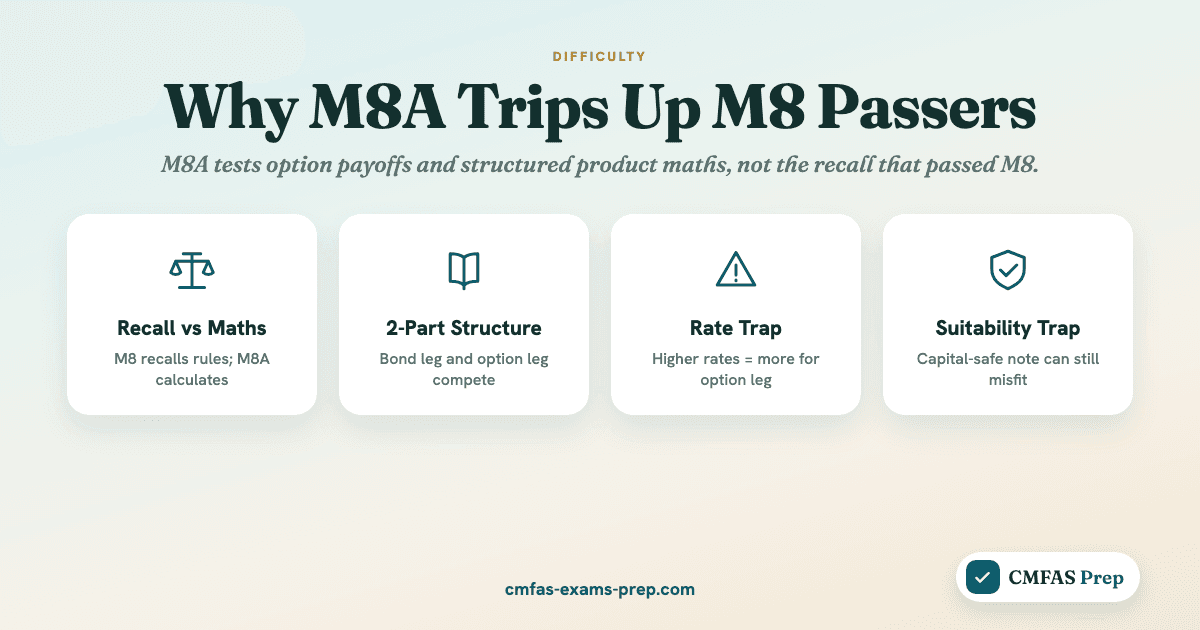
The reason is mechanical, not motivational. M8 tests foundational investment theory. M8A tests derivatives and structured products, which are a different order of difficulty. When you combine them, a weak M8A performance can sink the whole paper and take your M8 result with it. Passing M8 first locks in that result and lets you face M8A as a separate problem later. We laid out the full split in our M8 vs M8A breakdown.
The chapters where marks actually disappear
Because the paper is only 50 questions, no chapter is "minor." A topic that gets four or five questions is worth roughly a tenth of your score. Three of the eight chapters cause most of the damage, and they are the technical ones.
Risk and return (Chapter 4)
This is the chapter people underestimate most. It asks you to keep two kinds of risk straight and measure each correctly.
Systematic risk is market risk. It hits the whole market, you cannot diversify it away, and beta is how you measure it. Unsystematic risk is specific to one company or holding, you can diversify it away by spreading your portfolio, and standard deviation captures it. Mix these up and the wrong-answer options on the paper are written to catch you.
Then there is the Sharpe ratio, which measures return per unit of risk. Expect at least one question that hands you the numbers and asks you to compute a risk-adjusted return rather than define one.
Time value of money (Chapter 5)
Chapter 5 is arithmetic with a finance label. You calculate future value (what a sum grows into) and present value (what a future sum is worth today). There is no way to talk your way around it; you either run the calculation or you don't.
The trap here is vocabulary. A question may call the same number a discount rate in one line and an interest rate in another, and if you treat them as different inputs you will land on a wrong figure that the paper has helpfully listed as an option.
Unit trusts (Chapter 7)
This is the product at the centre of your future job, so the exam expects precision, not familiarity.
On pricing, know the difference between forward pricing, where your deal is struck at the next valuation point, and historic pricing, where it uses the last published price. On charges, keep three apart: the subscription or front-end fee you pay on entry, the annual management fee charged on the fund's assets, and the trustee fee. Questions love to swap one for another.
We put the five trickiest M8 question types into a free mini mock you can sit right now if you want to see where you stand before committing to a full study block.
If beta and alpha still blur together, the "practice by chapter" mode on CMFAS Prep lets you sit only Chapter 4 questions and work the systematic-versus-unsystematic distinction until it sticks, instead of rereading the textbook. Every calculation question shows the working step by step, so you see how the Sharpe ratio or a present value figure was reached rather than just whether you got it right.
A three-week study plan that matches the difficulty curve
The plan below front-loads definitions, spends the middle week on the maths, and finishes on products. Adjust the pace to your own start date, but keep the order.
Week one: the groundwork (Chapters 1 to 3)
Cover financial markets and instruments. The core split is equity (shares, where you own a piece of the company) versus debt (bonds, where you lend to it), plus the money market instruments that sit at the short end. This material is definition-heavy, so flashcards or quick-recall quizzing will serve you better than slow reading.
Week two: the calculation core (Chapters 4 to 6)
This is risk and return, time value of money, and portfolio construction, including asset allocation. Reading these chapters again will not help once you understand them; doing problems will. Drill present value and future value sums, work through Sharpe ratio questions, and use the practice-by-chapter mode to hammer Chapters 4, 5 and 6 until the maths feels routine.
Week three: the products (Chapters 7 and 8)
Finish on unit trusts and the wider fund family: REITs, ETFs, and business trusts. Two areas reward memorisation here. Learn the tax transparency treatment for REITs, and learn the CPF Investment Scheme (CPFIS) rules that govern which unit trusts CPF money can buy. Both show up as pointed, detail-specific questions.
What "understanding" actually buys you on exam day
M8 rewards causal understanding over recall. The classic example is interest rates and bond prices. If you can explain why a bond's price falls when interest rates rise (because newer bonds pay more, so the older, lower-yielding one is worth less to a buyer), you will handle the questions that test it from three different angles. If you only memorised "a bond is a debt instrument," those same questions will read like a foreign language.
So track where you are weak as you practise, watch those gaps close, and don't sit the real paper until your calculation chapters are scoring as well as your definition chapters.
Two more things before you book a date. If you are tempted by cheap notes off a resale marketplace, read our comparison of M8 mock exams and study guides first so you know what you are actually paying for. And when you are ready to register, our step-by-step registration guide walks through the booking.
When you want to find out whether the risk-and-return questions hold up under timed conditions, run a full M8 practice paper on CMFAS Prep and see your score by chapter. That is the cleanest way to know you are ready.
Practise M8 now
800+ exam-style M8 questions with instant explanations.
Frequently asked questions
M8 is considered moderately difficult due to Chapter 4 (Risk and Return) and Chapter 5 (Time Value of Money), which involve abstract financial concepts and math. The rest is largely product knowledge.
The passing score is **70%**. You must answer at least 35 out of 50 multiple-choice questions correctly.
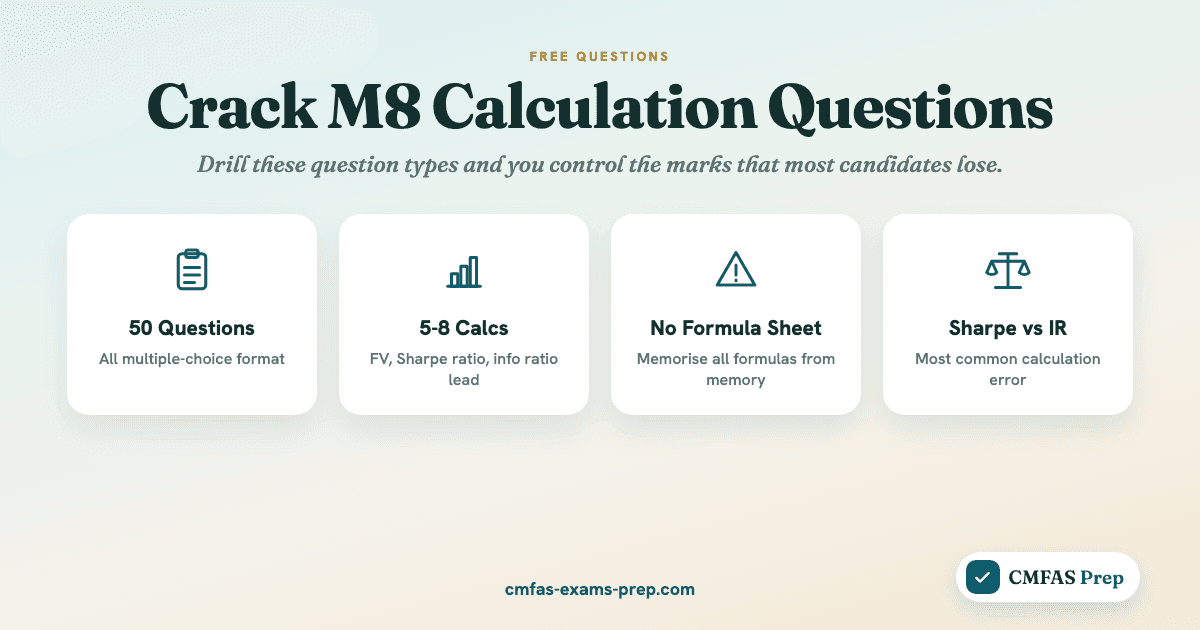
Yes. You will encounter calculation questions regarding Future Value, Present Value, and Unit Trust pricing (NAV). You must bring an approved calculator.
M8 covers the basics of Collective Investment Schemes (Unit Trusts, REITs). M8A covers advanced concepts like Structured Funds and Derivatives. M8A is generally considered harder conceptually.
No, we do not recommend taking M8 and M8A together. It is easier to conquer it one by one as the concepts are dense.