A study plan for CMFAS M8A that survives the derivatives chapters
CMFAS M8A needs 35 of 50 to pass. This four-week plan shows where to put your hours: derivatives, structured funds, then case studies.
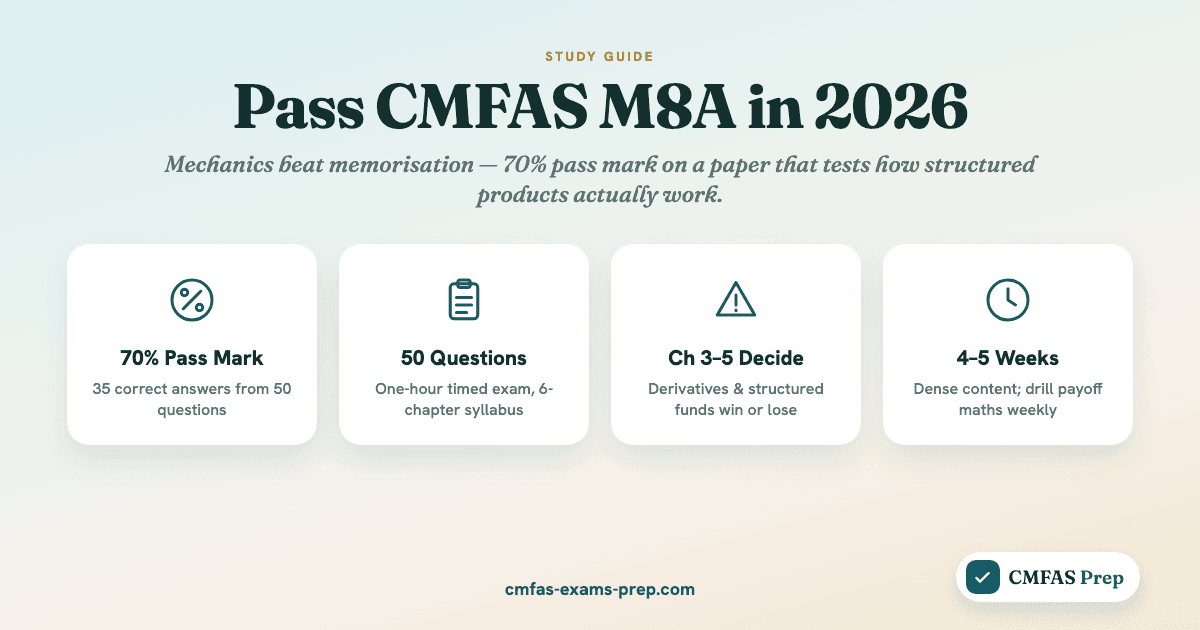
To pass CMFAS M8A you need 35 correct answers out of 50 questions, which is a 70% score, and the paper rewards people who understand how a structured product is built rather than people who can recite definitions. That single difference is why candidates who breezed through M8 sometimes stumble here.
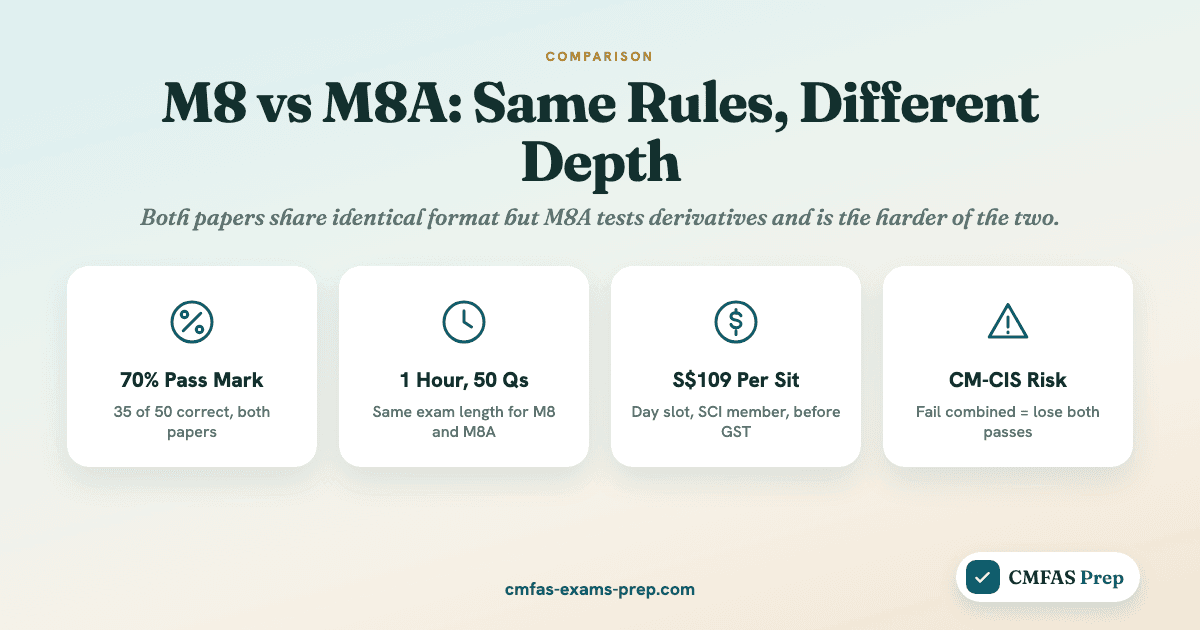
M8 leans on calculations and the regulatory wording around collective investment schemes. M8A asks a harder question: take a product apart, see which pieces create the payoff, and work out what happens to it when markets move. If you are still deciding which paper applies to your licensing, our M8 vs M8A guide sorts out the scope of each.
The syllabus is run by the Singapore College of Insurance (SCI). A minor revision took effect on 24 Feb 2026, and the question bank and mock papers on CMFAS Prep already match the current version.
Quick version
If you only read one paragraph: spend most of your study time on derivatives and how they sit inside structured funds. Learn to read payoff diagrams by hand, not by skimming notes. Expect the final section to throw client case studies at you. Block out four to five weeks because the content is dense, not because it is long.
Why memorisation fails this paper
M8A has only six chapters, so the syllabus looks short. The trap is treating "short" as "easy". A question rarely asks you to state what a call option is. It gives you a product, names the option embedded in it, and asks what the investor gets back if the underlying finishes 10% higher, or who carries the loss if the issuer defaults. You cannot answer that from a flashcard. You answer it by understanding the mechanics.
That is the whole reason static PDFs let people down on this exam. A PDF can tell you a principal-protected note combines a bond and a derivative. It cannot show you what the note is worth when rates rise and the equity leg expires worthless. You have to work through that yourself, repeatedly, until the relationship is obvious.
How the six chapters actually score you
Group the syllabus by where candidates lose marks, not by chapter number.
Chapters 1 and 2 set up the product types and their risks. This is the closest M8A gets to straight definitions, and it is the cheapest place to bank marks. You meet principal-protected notes (PPNs) and credit-linked notes (CLNs), plus the documentation, governance, and disclosure rules around them. Know the structural split between principal-protected and non-principal-protected products, and be ready for questions on the liquidity and credit risk that structured products carry even when they look safe. If you are weighing whether to buy second-hand notes off a marketplace, read our breakdown of the best M8A mock exams and study guides first.
Chapters 3, 4, and 5 are where results are won or lost. This is the part most candidates underestimate, and it deserves the bulk of your hours.
Chapter 6 is the application test, and it punishes people who learned the mechanics but never practised judgement.
The chapters that decide your result
Derivatives, chapter 3
Everything else in the paper is built on this chapter, so do not rush it. You cover exchange-traded instruments (futures and options) and over-the-counter ones (swaps and forwards). The four building blocks you must own cold are forwards, futures, calls, and puts.
For each one, know the long and the short position, and be able to calculate the maximum gain and the maximum loss. The exam then takes it a step further: it asks how that derivative behaves as a component inside a structured product. So a question about a call option is really a question about the growth leg of a fund you will meet two chapters later.
Drill these with payoff scenarios, not prose. The Practice by Chapter mode on CMFAS Prep lets you stay on chapter 3 until the long-call and short-put diagrams come to you without thinking.
Structured funds, chapters 4 and 5
Here you combine the blocks. A typical structured fund pairs a zero-coupon bond, which handles capital preservation, with a derivative, which provides the upside. Your job in the exam is to look at a specific fund, name its components, and judge how it performs under different conditions: rising rates, falling equity, a credit event at the issuer.
One distinction comes up often enough to memorise the reasoning behind it. A guaranteed fund is rare. A principal-protected fund is common, and its "protection" is only as good as the credit quality of the issuer. If the issuer fails, the protection fails with it. Questions like to test whether you understand that the label does not remove credit risk.
Practise pricing movement directly. Take a fund, move the derivative leg by plus or minus 10%, and work out what happens to the fund value. Do that enough times and the dynamic stops feeling abstract.
Case studies and suitability, chapter 6
The last chapter checks whether you can apply the suitability rules to a real client. You get a product and a client profile, and you decide whether the two match against three things: the client's risk tolerance, financial situation, and investment objectives.
Suitability questions are written to look like they have two right answers. The correct one usually turns on a single mismatch, a specific risk the client cannot bear or a regulatory constraint that rules the product out. Read for that mismatch rather than for the answer that sounds reasonable.
A four-week plan
| Week | Focus | What to do |
|---|---|---|
| 1 | Products and risks (ch. 1-2) | Read the notes once. Build a comparison of PPNs, CLNs, and structured funds, including their governance and disclosure rules. |
| 2 | Derivatives (ch. 3) | Your heaviest week. Drill the four basic derivatives, long and short, until max gain and max loss are automatic. |
| 3 | Structured funds (ch. 4-5) | Practise component analysis. Calculate fund value when the derivative leg moves plus or minus 10%. |
| 4 | Application (ch. 6) and mock papers | Work through case studies. Sit at least three full one-hour mock exams and review every wrong answer from chapters 3 to 5. |
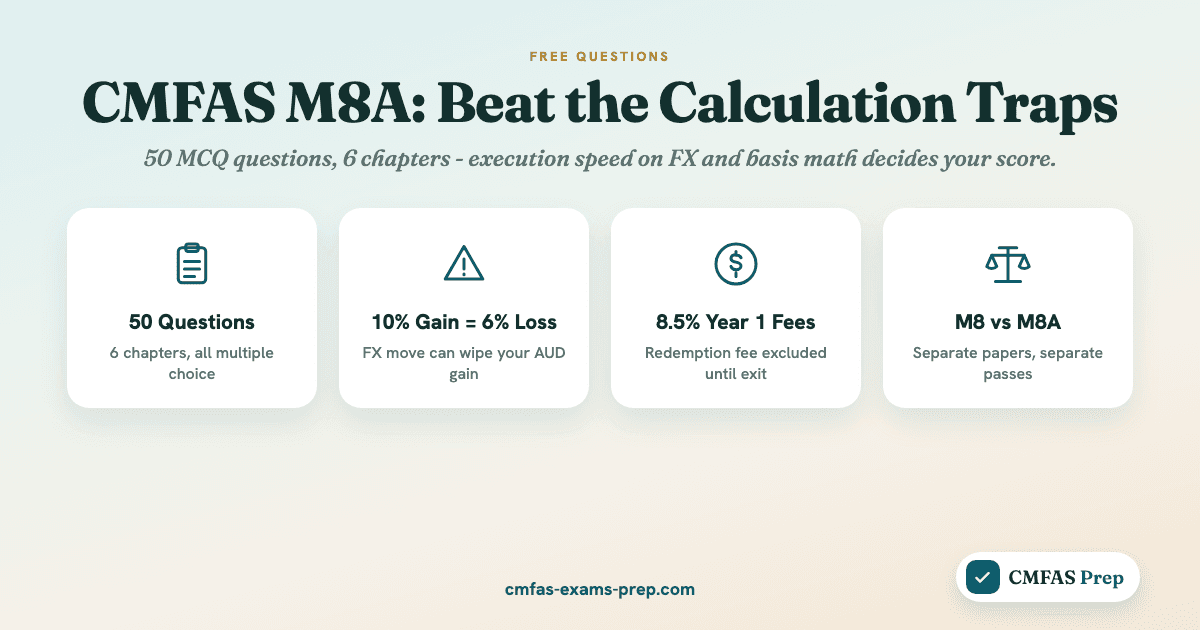
We also keep a set of free M8A mock questions, weighted toward the harder derivatives and structured-fund items, so you can test yourself before paying for anything.
Where to practise
A PDF cannot tell you which chapter is dragging your score down. The M8A simulator on CMFAS Prep gives instant feedback with worked explanations, and the Practice by Chapter mode lets you hammer chapter 3 or chapter 4 on its own. The progress tracker shows your accuracy per chapter, so your revision time goes where the marks are leaking.
If you are still deciding whether the paper is worth the effort, read our take on whether the M8A exam is difficult.
M8A is demanding but well within reach once you stop memorising and start working through the mechanics. Put your hours into the math and the structural detail, then test yourself on real questions.
Ready to start? Run a few timed chapters on the M8A practice platform and see where your score actually stands.
Practise M8A now
800+ exam-style M8A questions with instant explanations.
Frequently asked questions
Due to the complexity of Derivatives and Structured Products, a minimum of 4 weeks (40-60 hours) of focused study and practice is recommended, especially if you do not have a strong finance background.
Chapter 3 (Derivatives) and Chapters 4 & 5 (Structured Funds) are the most difficult. They require understanding the mechanics of payoff diagrams and risk components, not just memorization.
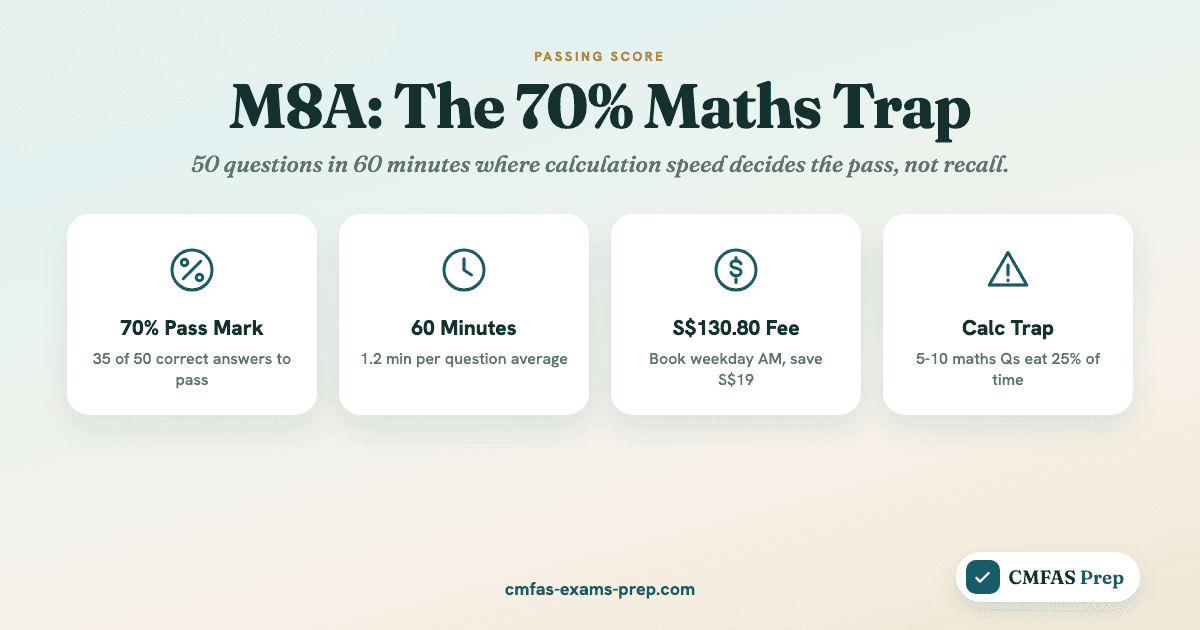
The M8A exam consists of 50 multiple-choice questions, and the passing score is 70% (35 correct answers).
Yes, we have a "Practice by Chapter" mode. You can focus on specific chapters and drill on your weak spots.
The M8A exam is 1 hour long. You will be given 50 multiple-choice questions to answer.