CMFAS M8A practice papers in 2026: what's worth paying for
CMFAS M8A in 2026: compare notes, printed papers and an online bank, and see which one shows the working behind every answer.
The best M8A mock exam is the one that shows you the working behind every derivative payoff and structured product calculation, not just the correct option. For most people sitting M8A in 2026, that points to an online question bank with worked answers rather than a stack of PDF notes or a fixed set of printed papers.
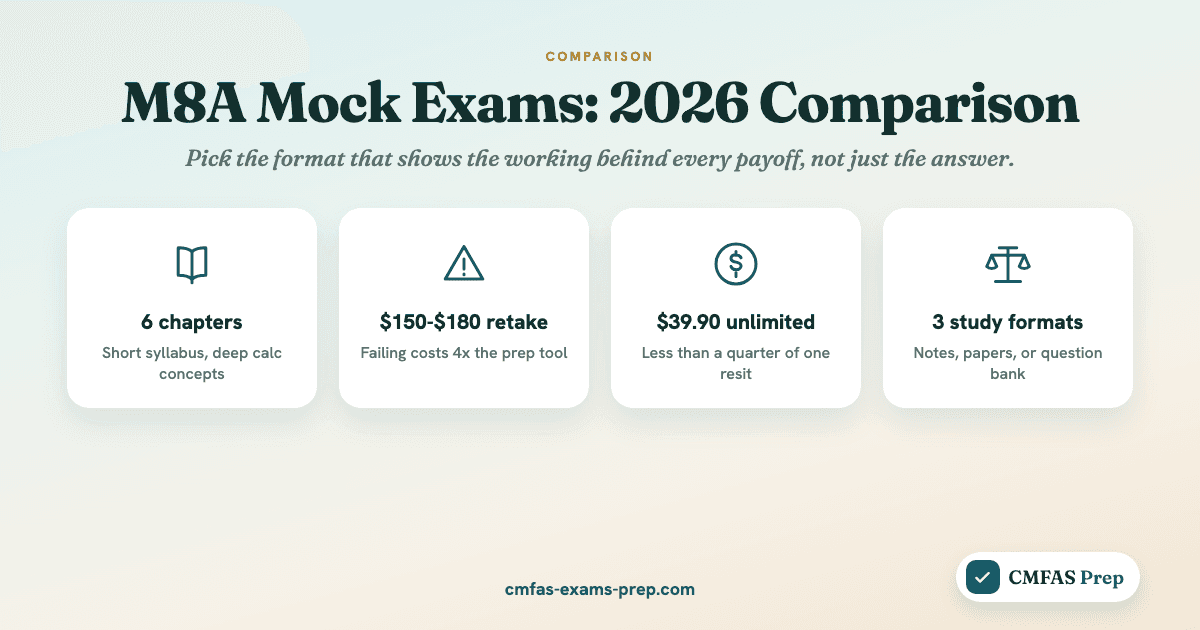
M8A is a short syllabus, six chapters, but the marks come from concepts you have to picture rather than recite. You need to read a structured product term sheet and work out what it pays at each barrier, and you need to combine derivative payoff positions and calculate the result. A document can hand you an answer key. It cannot walk you through how the numbers move.
Search around and you will find three kinds of study material on sale in Singapore. They sit in a similar price range but they teach in very different ways. Here is how they hold up against what M8A actually asks of you.
What M8A tests, and why your practice format matters
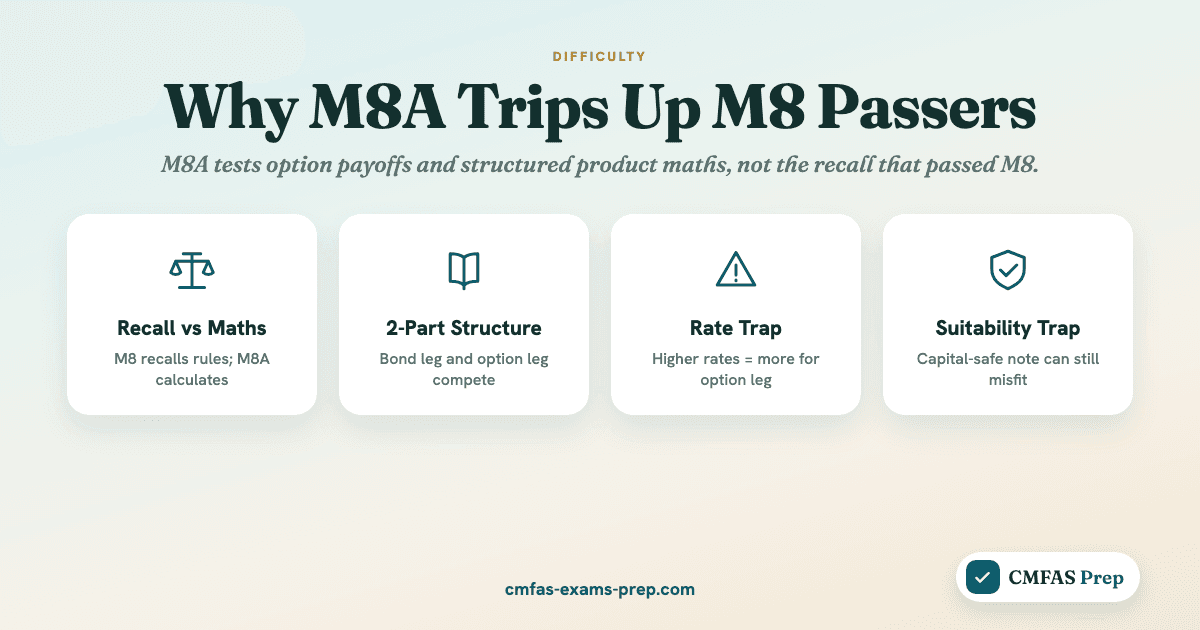
Two chapters carry most of the difficulty. One asks you to value the bond component of a structured note, which means present value math on the fixed-income leg. Another asks you to read combined option positions, say a long call paired with a short put, and state the payoff as the underlying price moves through different levels. A knock-in barrier only activates once the underlying touches a set price, so the same product can pay out two completely different ways depending on a single threshold.
If your material only gives you the final answer, you can get a question wrong and never learn whether the mistake was your present value formula, your barrier logic, or a currency conversion at the end. That is the gap a worked solution closes.
Comparison table
| What you get | Second-hand notes / PDFs | Printed practice papers | CMFAS Prep |
|---|---|---|---|
| Format | PDF or hardcopy | Fixed digital or paper sets | Online question bank |
| Worked solutions | Answer key only | Answer key only | Step-by-step working |
| FX conversion steps shown | No | No | Yes |
| Practice by chapter | No | No | Yes |
| Syllabus currency | Often outdated | Current | Updated |
| Weak-topic tracking | No | No | Yes |
| Progress history | No | No | Yes |
| Typical price | $15 to $20 | About $40 per set | $29.90, unlimited |
Option 1: second-hand notes and PDF packs
You can buy a senior's old M8A notes cheaply, often for $15 to $20. This works if you already have a derivatives background and only want a refresher on how the syllabus is laid out.
The trouble is the math. M8A questions turn on present value calculations and payoff formulas, and most second-hand notes give you the formula and the answer with nothing in between. When your number is off, you are left guessing why. Old material also carries a currency risk: structured product figures and some regulatory details change, and a note written two years ago can quietly teach you a wrong number.
Option 2: printed practice papers
Established providers sell well-checked mock papers, usually around $40 a set, and they are reliable for final timed practice before exam day.
Their limit is the one every static format hits. A paper can tell you the payoff of a combined long call and short put, but it cannot show you how that combined profit and loss line bends as the underlying price changes. Chapters 3 and 4 reward you for drilling many payoff scenarios, and a fixed set of papers runs out fast. Once you have seen a set twice, you are recalling answers instead of working them out, which is the exact skill the exam tests.
Option 3: an online question bank (CMFAS Prep)
CMFAS Prep was built around the two things candidates lose marks on in M8A: the calculation steps and the payoff logic. Every question comes with the full working, not just the letter.
For currency questions, where you convert an FX gain or loss back to SGD, you see each step instead of a single final figure, so you can find the exact point your own answer diverged. You can also run practice by chapter and sit only on the chapters you are weak in, which matters when most of your risk sits in two of the six. The platform records what you keep getting wrong and sends you back to those topics, and it keeps a history so you can see whether your scores are actually moving.
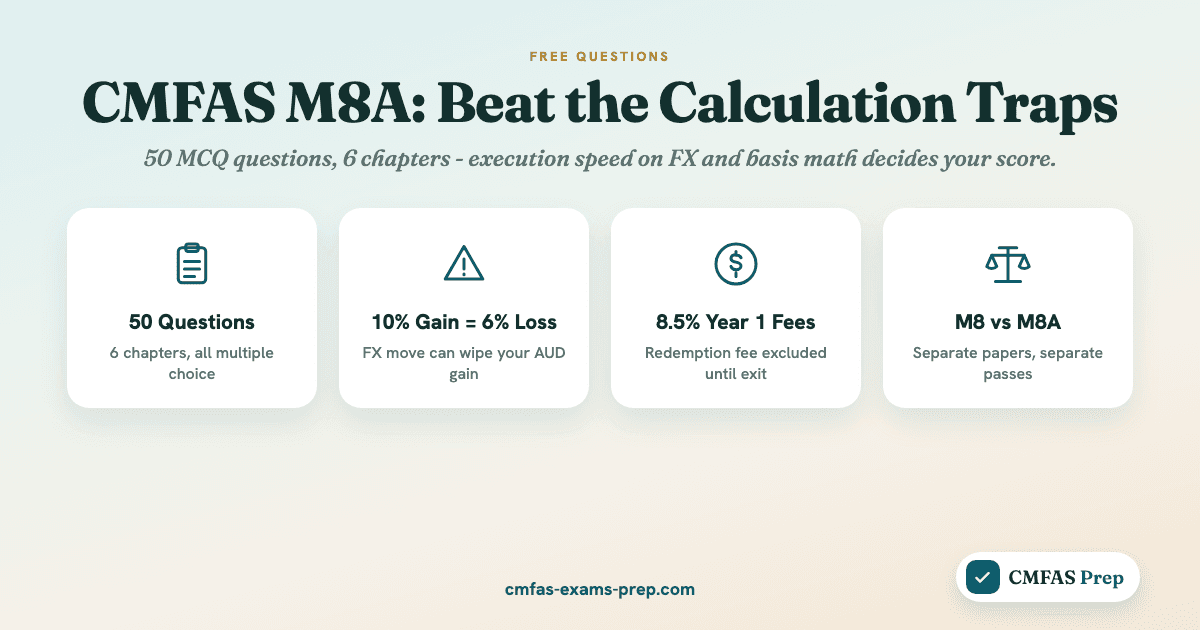
You can try the question style first in our free M8A mock paper, which walks through a full FX conversion the same way the paid bank does.
The cost of a retake
This is where the comparison gets practical. If you fail M8A, the resit fee runs about $150 to $180. Unlimited access to CMFAS Prep is $29.90. The practice tool costs less than a quarter of a single retake, and it exists to keep you from needing one.
How to choose
Pick second-hand notes if you already know derivatives well and accept the resit risk to save money now. Pick printed papers if your gap is timed exam stamina rather than the underlying concepts. Pick an online question bank if your problem is the math and the payoff diagrams, since that is the part a static format cannot teach.
If you are still deciding between this paper and its sibling, the M8 vs M8A breakdown explains which one applies to your licensing, and the M8A passing score and registration guide covers the format and how to sign up.
Practise before you sit
M8A rewards understanding the mechanics, so practise on questions that show their working. Start a free M8A set on CMFAS Prep, work through the payoff and FX examples with every step visible, and keep returning to your weak chapters until the numbers come easily.
Practise M8A now
800+ exam-style M8A questions with instant explanations.
Frequently asked questions
M8A requires you to understand derivatives payoff diagrams. A PDF can only show a static image. A simulator allows you to change variables (strike price, premium) and see the profit/loss curve change dynamically, which is essential for mastering Chapter 3.
No. Derivatives and structured products are prone to regulatory and interest rate changes. Using cheap, potentially outdated notes for complex calculations carries a high risk of failure.
Static papers don't provide enough unique scenarios. You risk memorizing the answer to a question without understanding the core concept, which is disastrous when the exam changes a single variable (e.g., changing a Long Call to a Short Put).
Yes. We are confident in our "Derivative Drill" method. If you complete our full simulated mock exams and still fail the real M8A, we will extend your access for free until you pass.
Absolutely. Our platform is fully mobile-responsive. Unlike PDF notes which require constant zooming, you can easily drill "Derivative Questions" on your phone while commuting.