M8 or M8A first? How the two CM-CIS papers differ
M8 or M8A first? Same SCI fees, same 50 MCQs in an hour, different content. See how the two CM-CIS papers split and which one to sit first.
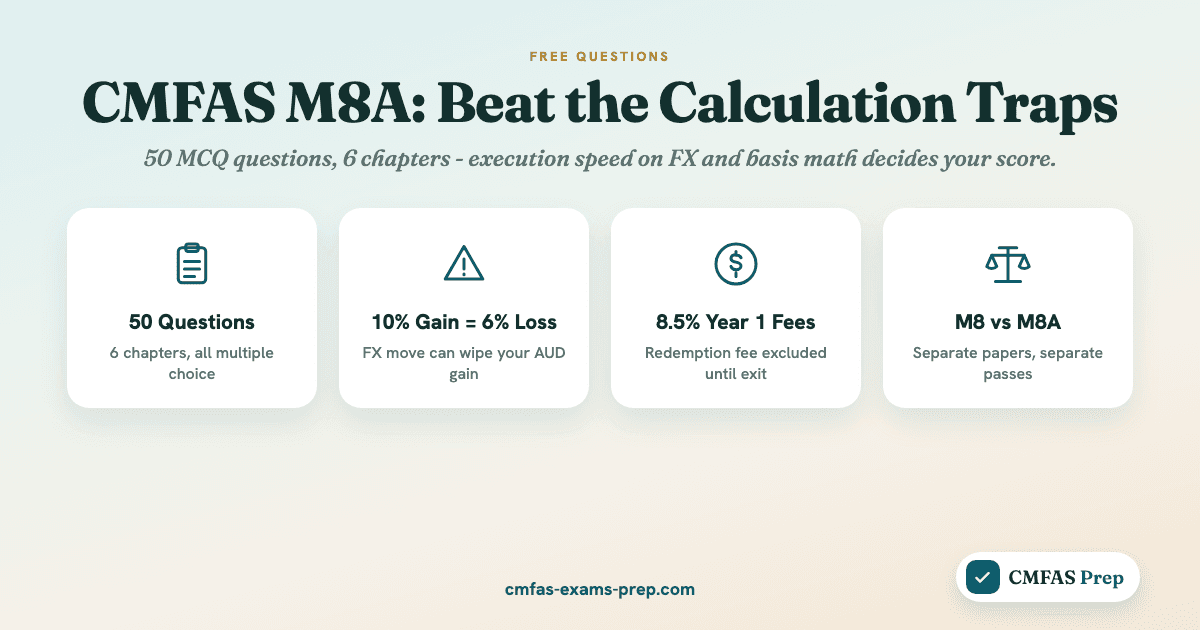
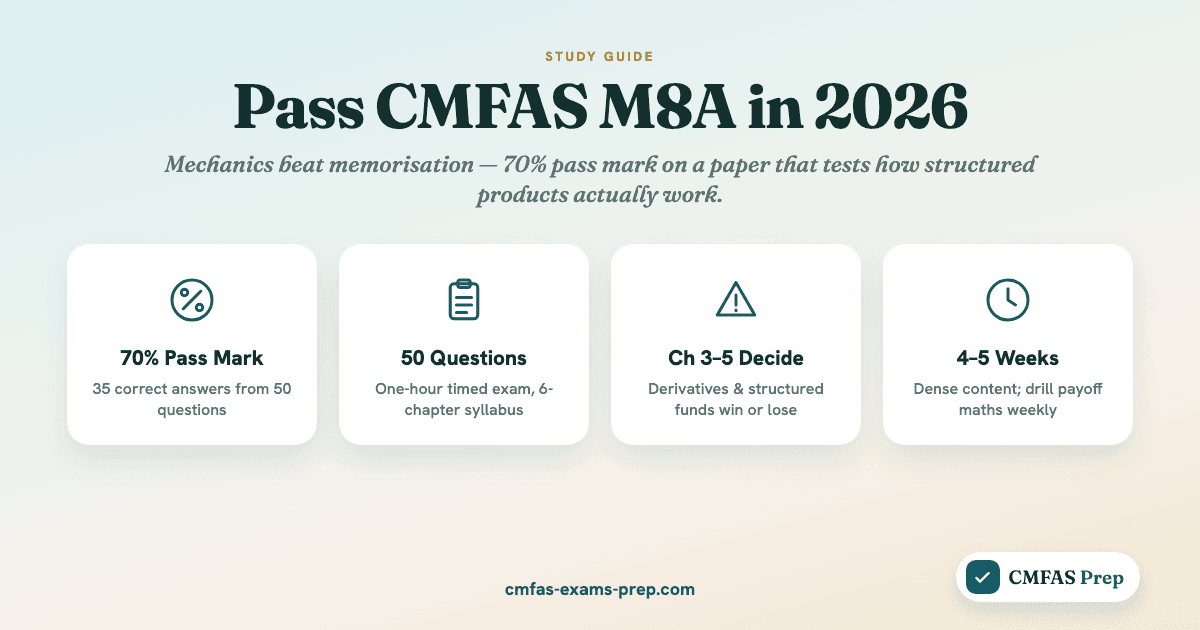
M8 and M8A are two papers in the same Collective Investment Schemes module, both set by the Securities and Compliance Institute (SCI). M8 covers the basics a representative needs before selling any fund: asset classes, how markets work, how risk and return are measured, and the time value of money. M8A takes that foundation and applies it to derivatives and structured products, the more complicated instruments you put in front of a client. Each paper is 50 multiple-choice questions in one hour.
If you are stepping into a wealth management, retail bank, or fund distribution role in Singapore, you will almost certainly sit both. A representative who advises on or distributes the full set of collective investment schemes needs the M8 and the M8A syllabus together, so the question is hardly ever "M8 or M8A." It is about order: which one to take first, and whether to fold them into a single combined sitting.
What sits in each syllabus
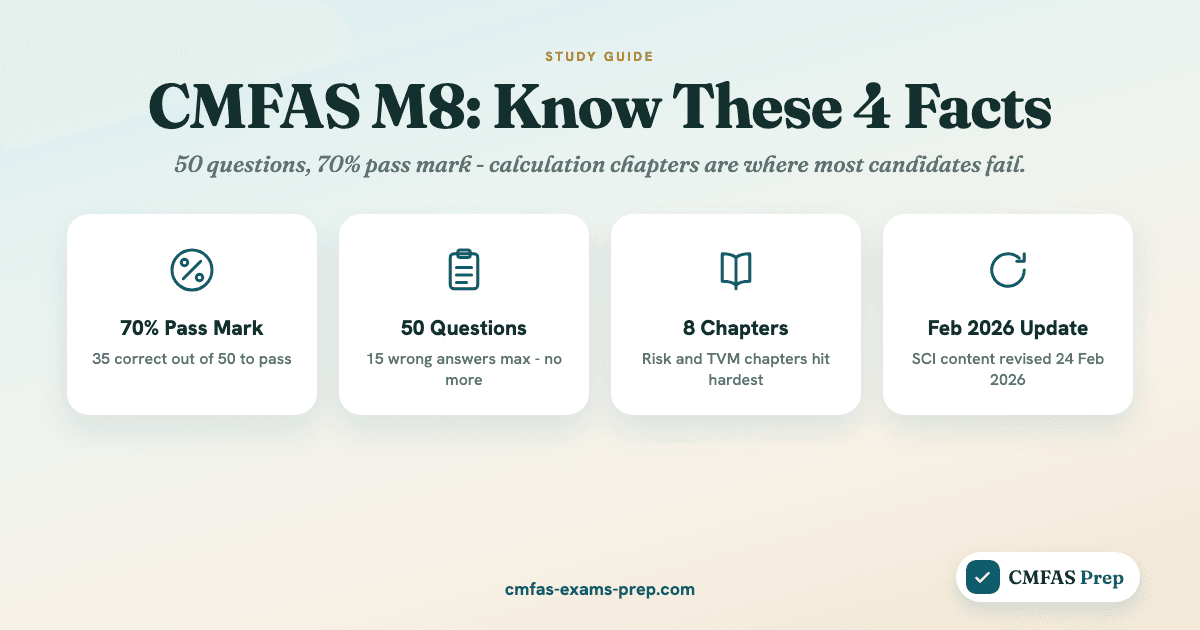
M8, the official name being Collective Investment Schemes Paper I, is the entry paper. It runs through the main asset classes, how financial markets function, risk and portfolio measures such as beta and the Sharpe ratio, the time value of money, and the rules governing unit trusts. Eight chapters in all.
M8A, Collective Investment Schemes Paper II, assumes you already carry that material in your head. It moves into structured products, the derivatives built into them (futures, options, swaps), how those products are put together, and how to decide whether one fits a given client. Six chapters, and the back half leans on case studies rather than plain recall.
A simple way to keep the two apart: M8 asks what a product is and how risky it is, while M8A asks how a product is engineered and who should hold it.
Same exam-day mechanics
On the logistics, the two papers are twins.
| M8 | M8A | |
|---|---|---|
| Questions | 50 MCQs | 50 MCQs |
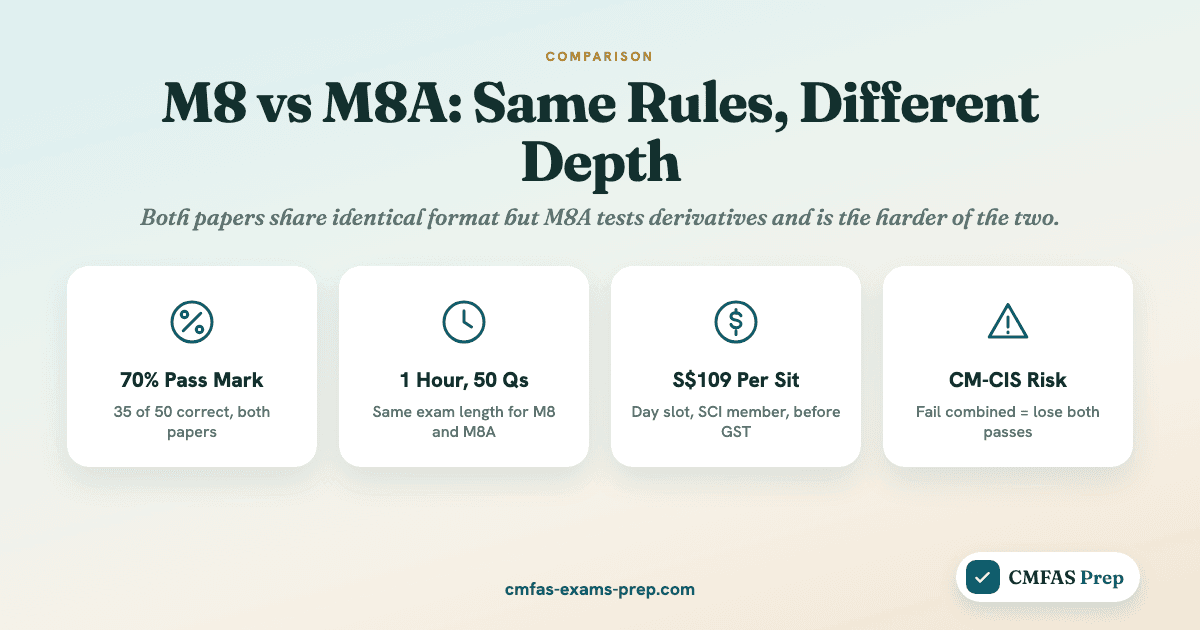
| Time | 1 hour | 1 hour |
| Pass mark | 70% (35 of 50) | 70% (35 of 50) |
| Wrong answers allowed | up to 15 | up to 15 |
| Calculation questions | 7 to 10 | 7 to 10 |
| Chapters | 8 | 6 |
| Set by | SCI | SCI |
Same length, same clock, same bar to clear. The gap is in what the questions demand. M8's sums are formula-driven: drop the numbers into a present-value or Sharpe-ratio equation and work it out. M8A's sums expect you to first understand how a payoff is built before any number means anything, so the same 7 to 10 calculations weigh more.
Fees are identical
SCI charges the same whether you book M8 or M8A. Since 1 April 2024, first attempts and retakes cost the same per sitting.
| Session | SCI/IBF member | Non-member |
|---|---|---|
| Day (9am to 5pm) | $109.00 | $130.80 |
| Evening (after 5pm) | $127.53 | $149.33 |
Figures are before GST. A day slot runs about $18 cheaper than the evening one, so unless your shift forces an after-hours booking, the morning session saves money, and most people think more clearly before a full workday than at the end of one.
Where the content actually splits
This is the real line between the two.
M8's eight chapters start with investment assets and financial markets, then move through risk and return, the time value of money, investment considerations, unit trusts, and fund products. Most candidates find chapters 4 (risk and return), 5 (time value of money), and 7 (unit trusts) the ones that need the most repeating, since that is where the maths and the regulation pile up.
M8A's six chapters open with structured products and their risks, then spend most of the paper on derivatives, structured funds, worked fund examples, and a closing run of case studies. Chapter 3, on derivatives, settles most results. If futures, options, and swaps make sense to you there, the rest of the paper falls into place. If they do not, chapters 4 through 6 only widen the gap.
Some topics live in one paper and never surface in the other.
| Topic | M8 | M8A |
|---|---|---|
| Unit trusts | Core | Not tested |
| Beta, Sharpe ratio, standard deviation | Taught | Assumed |
| Time value of money | Taught (PV/FV) | Assumed |
| Derivatives | Not tested | Core |
| Structured products | Not tested | Core |
| Payoff diagrams | Not tested | Must know |
| Client suitability | Basic | Full case studies |
Read the "assumed" rows closely. M8A does not re-teach beta or present-value maths. It expects you to bring that across from M8, which is the strongest reason to sit M8 first.
Which paper is harder
For most people, M8A is the tougher of the two.
M8 pays back study in a predictable way. The ideas make sense once you have met them, the formulas keep repeating, and questions are mostly either factual or a tidy calculation. Even someone with no finance background can pass after a few weeks of steady practice.
M8A asks more of you. Derivatives baffle people who have never touched them, payoff diagrams need you to see how a position behaves as a price moves, and structured products fold several ideas into one wrapper. The chapter 6 case studies then make you apply all of it to a client scenario and commit to a judgment, which is a different skill from reciting a definition. You can see this for yourself in our M8A derivatives and structured products mock questions, where the suitability items catch more people out than the maths does.
Take M8 first, then M8A
For nearly everyone, the order is M8, then M8A.
Three reasons. M8A treats the M8 material as known, so walking in without it means learning two papers at once. Sitting M8 by itself lets you bank a pass before you face the harder one. And the foundation genuinely carries over: the risk measures and pricing logic from M8 are the language M8A is written in.
The only people who can reasonably compress or flip this are those who already work with derivatives every day, or who hold a finance or banking degree. Even then, doing M8 first costs little. It is the easier paper, and a fresh M8 pass keeps the foundational maths warm for when you sit M8A.
The CM-CIS combined sitting
You can take both papers as one combined exam, CM-CIS: 100 questions in two hours, marked at 70% overall, for one exam fee instead of two.
| Two separate papers | CM-CIS combined | |
|---|---|---|
| Questions | 50 + 50 | 100 |
| Time | 1 hour each | 2 hours |
| Pass mark | 70% per paper | 70% overall |
| If you fall short | keep the paper you passed | lose both |
| Cost | two fees | one fee |
The gain is one saved exam fee. The risk is that a single weak area can pull the combined score under 70% and cost you both passes, including M8 content you knew cold. Someone with a strong finance background who already reads derivatives easily can take the combined paper, pocket the saving, and skip a second trip to the test centre. For everyone else, sitting the papers apart protects the M8 pass and carries less downside. Be honest about your own readiness before you book the combined version.
How to study for each
A workable M8 plan runs two to three weeks. Cover the asset, market, and investment-consideration chapters first, give extra hours to risk, the time value of money, and unit trusts, then close out on full mock papers and grinding through whatever you keep getting wrong.
M8A usually needs three to four weeks, because chapter 3 alone can eat a week. Lay the structured-product basics first, put real hours into derivatives, work the structured-fund examples, then finish on the case studies with timed mocks. If you want to weigh up question banks before you settle on one, our comparison of M8A mock exams lays out what actually matters.
Both papers reward timed practice over re-reading notes. The pass mark leaves you only 15 wrong answers, and the calculation questions quietly chew through your hour, so working under the clock is what tells you whether you are ready.
Start practising
The quickest way to find your weak chapters is to answer questions under exam conditions and read the explanation for every one you miss. The M8A question bank on CMFAS Prep gives you practice by chapter, full mock papers, and an explanation after each question, so you can see where M8A is costing you marks before exam day. Start with M8 to lock in the foundation, then move to M8A once the basics hold up under timed pressure.
Practise M8A now
800+ exam-style M8A questions with instant explanations.
Frequently asked questions
M8 (Collective Investment Schemes I) covers foundational finance—Unit Trusts, Risk & Return, and Time Value of Money. M8A (Collective Investment Schemes II) covers advanced topics—Derivatives, Structured Products, and Client Suitability Case Studies.
Take M8 first. It builds the foundational finance knowledge that M8A requires. M8A assumes you already understand concepts like risk, return, and fund structures from M8.
Yes. M8A covers derivatives and structured products, which are more complex than M8 content. M8A also includes case study questions that require synthesis and judgment, not just memorization.
CM-CIS is the combined M8 + M8A exam (100 MCQs, 2 hours). It saves one exam fee but carries more risk—if you fail, you lose both passes. We recommend taking M8 and M8A separately unless you have a strong finance background.
Yes. Both cost $109 (member, day session) to $149.33 (non-member, evening session), excluding GST. Since April 2024, first-timers and retakers pay the same fee.