M8A derivatives and structured products
M8A sample questions with worked answers: FX conversion, futures basis, unit trust fees, and structured deposit risk. Same traps the real exam sets.
M8A and M8 test different things
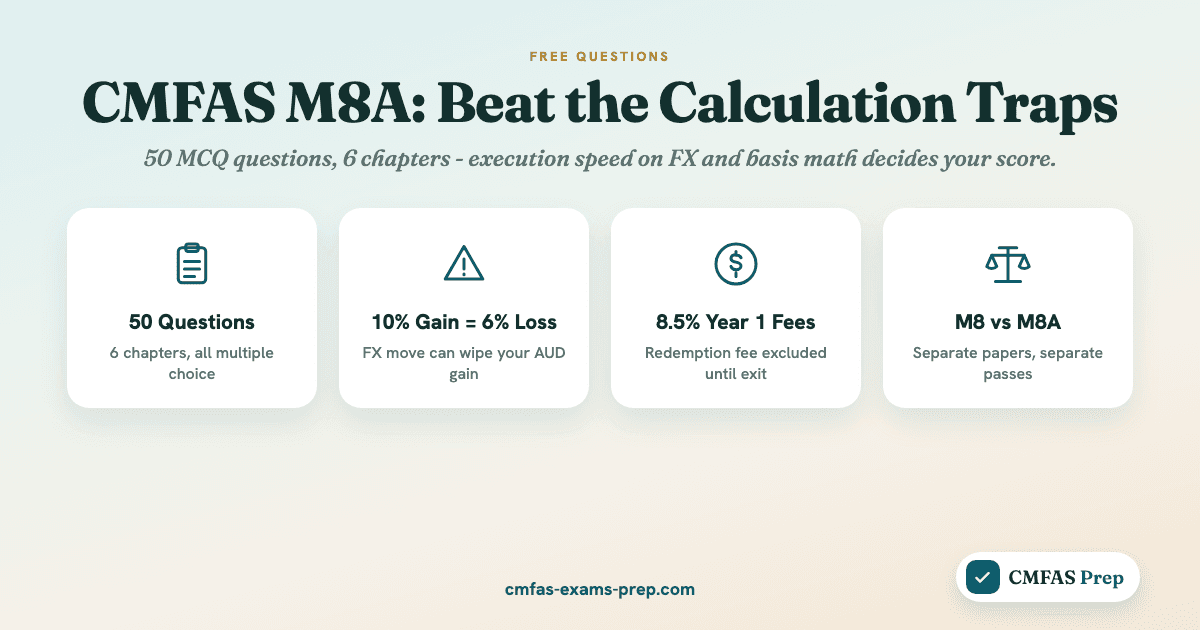
The free mock exam below gives you five M8A questions with worked answers, covering structured deposits, foreign exchange returns, futures basis, unit trust fees, and what counts as a structured fund. Work through them before you book your slot.
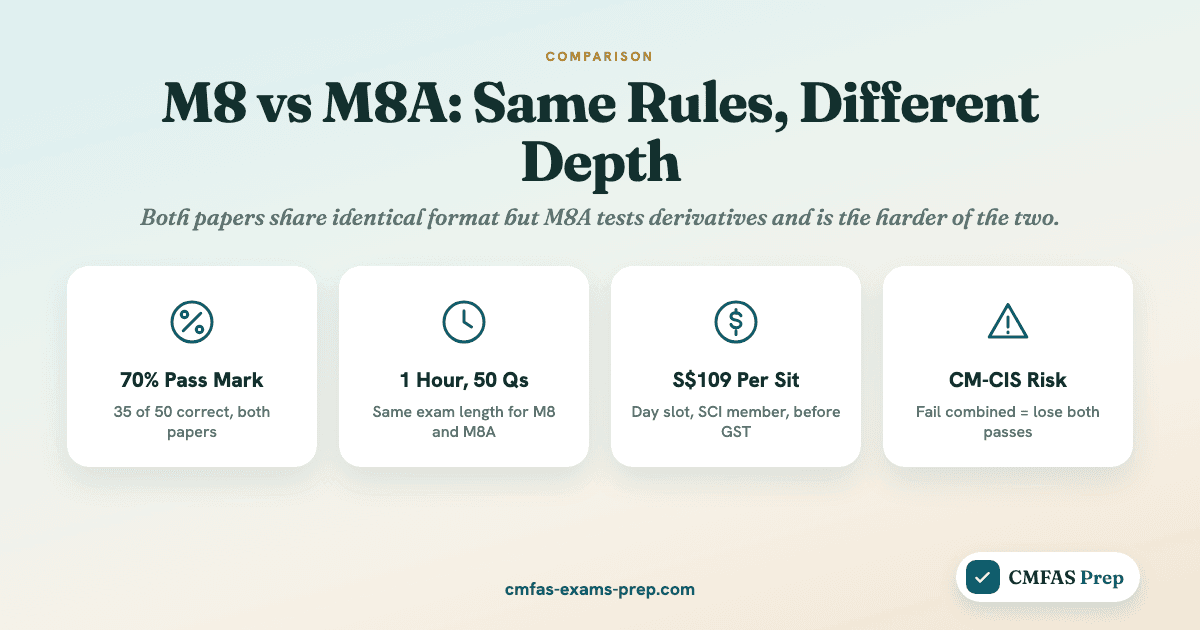
First, clear up a common mix-up. M8 and M8A are both halves of the CM-CIS qualification, but they are separate papers with separate passes. M8 deals with the general side of collective investment schemes and unit trusts. M8A is the second paper, and it goes into derivatives, structured products, and the more complex schemes built on top of them. Passing one does not give you the other. If you are still deciding which paper you actually need, the M8 vs M8A breakdown sorts that out.
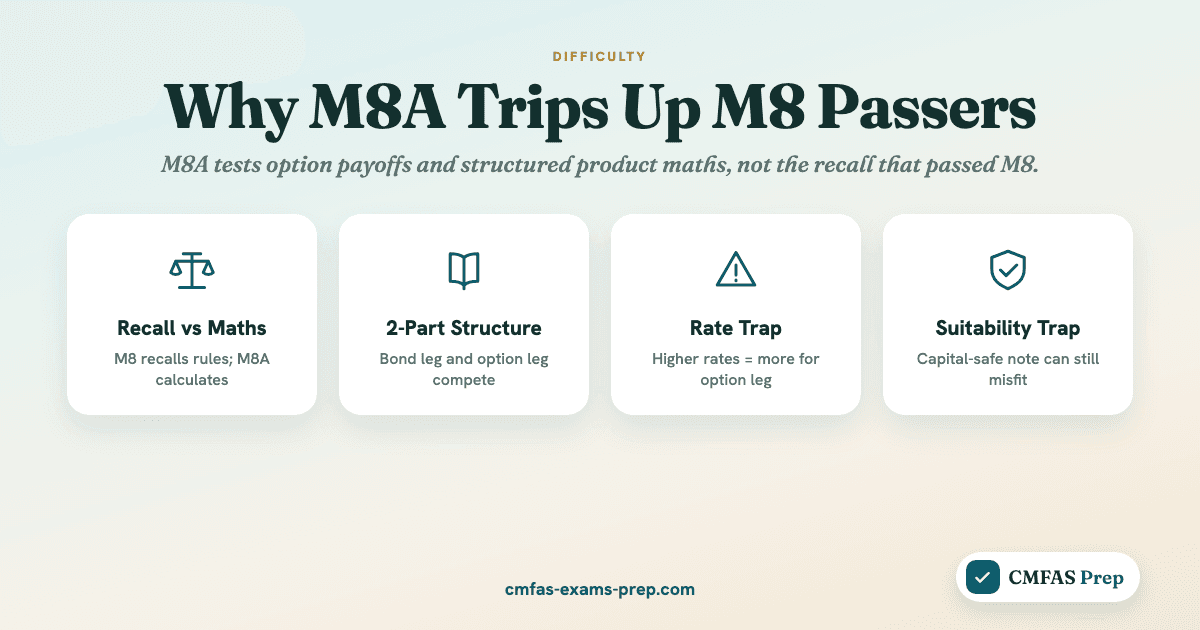
What makes M8A harder is the math. Several questions ask you to run a calculation across two or three steps, and a wrong order or a skipped conversion lands you on a wrong answer that looks plausible. The questions below are built around the exact traps that catch people.
What the five questions cover
- Structured deposit risk: which risk matters least when the issuer is local (Question 1)
- Foreign exchange returns: converting an AUD gain back to SGD (Question 2)
- Unit trust fees: separating one-time charges from annual ones (Question 3)
- Futures basis: cash minus futures, and the over/under wording (Question 4)
- Structured fund definition: what actually qualifies (Question 5)
Question 1: structured deposit risk
Wei Ming places S$80,000 into an SGD-denominated structured deposit from a Singapore bank rated AA. Which risk should concern him least?
- A) The issuing bank defaulting
- B) Being unable to exit before maturity
- C) Movements in the derivative underlying the deposit
- D) Foreign exchange risk
Answer: D.
The deposit is issued locally and held in Singapore dollars, so there is no currency to convert and almost no foreign exchange exposure. That makes FX the weakest concern of the four. The other three still apply. The AA rating still carries default risk, so the issuer's standing matters (A). A structured deposit can be hard to exit early, which is liquidity risk (B). And the payout depends on how the underlying derivative performs (C), so that is always live.
The trap here is reading "AA" and "local bank" as if they cancel out FX risk and issuer risk together. They do not. A strong rating lowers credit risk but never removes it.
Question 2: foreign exchange return
S$120,000 goes into an investment priced in US dollars. At the start, USD 1 buys S$1.35. At maturity the investment has gained 8% in USD terms, and the rate has moved to USD 1 buys S$1.20. What is the return once you convert back to SGD?
- A) Loss 8%
- B) Loss 4%
- C) Gain 8%
- D) Gain 4%
Answer: B.
Run it in order:
- Convert in: S$120,000 ÷ 1.35 = USD 88,888.89
- Apply the gain: USD 88,888.89 × 1.08 = USD 96,000.00
- Convert out: USD 96,000.00 × 1.20 = S$115,200.00
- Compare: (115,200 − 120,000) ÷ 120,000 = −4%
A 4% loss. The 8% investment gain was real, but the US dollar weakened from 1.35 to 1.20, and the currency move was larger than the investment gain. This is the single most common M8A calculation, and the usual mistake is skipping step one. If you forget to convert the starting SGD into AUD first, every number after it is wrong.
Question 3: total unit trust fees in year one
An investor buys a unit trust with these charges: initial sales charge 3%, management fee 1.25% per year, redemption fee 1%, other fees 0.75% per year. Counting the purchase and the first year, what is the total fee incurred?
- A) 6.0%
- B) 5.0%
- C) 4.25%
- D) 3.0%
Answer: B.
Add only what is actually charged in year one while the investor is still holding the fund:
- Initial sales charge: 3.0%
- Management fee: 1.25%
- Other fees: 0.75%
Total: 5.0%.
The redemption fee is left out because the investor has not sold yet, so it is not incurred. The trap is treating every percentage on the page as additive. The initial sales charge is a one-time entry cost; the management fee and other fees are annual. The redemption fee only bites on the way out.
Question 4: futures basis
In September, gold futures trade at $2,410 an ounce while the cash (spot) price is $2,404. What is the basis for September?
- A) $6 over September
- B) $6 above September
- C) $6 under September
- D) $6 below September
Answer: C.
Basis is cash price minus futures price:
$2,404 − $2,410 = −$6
A negative basis means cash is trading below futures, which the market calls "under." So the basis is $6 under September. Two things trip people up. One is reversing the formula to futures minus cash, which flips the sign. The other is the wording: "over" and "under" describe the cash price relative to futures, and they are the answer the exam wants, not "above" or "below."
Want to drill one chapter at a time instead of jumping around? The M8A exam page lets you filter practice by chapter so you can hammer the basis and FX questions until the steps are automatic.
Question 5: what counts as a structured fund
Which of these is a structured fund?
- A) An index tracker mirroring the STI
- B) A fund-of-hedge-funds built with derivative overlays
- C) A long-short hedge fund
- D) A plain fund-of-funds allocating across sub-funds
Answer: B.
A structured fund combines financial instruments, usually including derivatives, to build a specific risk and return shape. The fund-of-hedge-funds in option B does both: it layers funds and uses derivatives, which fits the definition. A long-short hedge fund (C) and a basic fund-of-funds (D) are single strategies. An index tracker (A) just mirrors a benchmark and holds none of the structure that defines the category.
Why M8A trips up prepared candidates
The paper has 50 questions across 6 chapters. Six chapters sounds light, and that is the misread. The questions are denser than M8's, and the calculation ones are unforgiving because there is one correct sequence and several wrong ones that produce answer choices on the page. You do not lose marks for not knowing the topic. You lose them for running the FX conversion in the wrong order or reading "over" as "above."
Static notes do not fix that, because the gap is in execution speed, not recall. You need to do the calculation enough times that the steps stop being a decision. If you are weighing study options or eyeing secondhand notes on a marketplace, the M8A mock exam comparison lays out what each one actually gives you.
Common questions on M8A
Is M8A multiple choice? Yes. All 50 questions are multiple choice, including the calculation ones, so you pick from the given options rather than show working.
Can I sit M8A without M8? The two papers are assessed separately. Check your firm's licensing requirement, since most candidates taking the CM-CIS route need both halves.
How much math do I need? Arithmetic and percentage work, done under time pressure. There is no advanced math, but the FX, basis, and fee questions reward speed and a fixed method.
Practise the calculations
The five questions above are a sample. To pass M8A comfortably you want to run the FX, basis, and fee types dozens of times until the steps are reflex. Practise the full M8A question bank with instant answers and per-chapter filtering on CMFAS Prep, and use the chapter view to spend your time where you keep slipping.
Practise M8A now
800+ exam-style M8A questions with instant explanations.
Frequently asked questions
M8 and M8A are completely different CMFAS certifications. M8 covers general securities, unit trusts, and investment products. M8A (also called CM-CIS) focuses specifically on derivatives (futures, options, swaps), structured products, and complex investment schemes. The calculations and concepts tested are fundamentally different.
The Basis is calculated as the Cash Price (Spot Price) minus the Futures Price. The M8A exam tests whether you know the formula and can interpret the result (positive = over, negative = under).
Structured products often invest in foreign assets. M8A tests your ability to calculate the true return in domestic currency (SGD) after factoring in both the investment gain/loss and the exchange rate fluctuation.
There are 6 chapters in the M8A exam, covering derivatives fundamentals, structured products, futures contracts, options, and regulatory requirements.
The M8A exam is 1 hour long. You will be given 50 multiple-choice questions to answer.
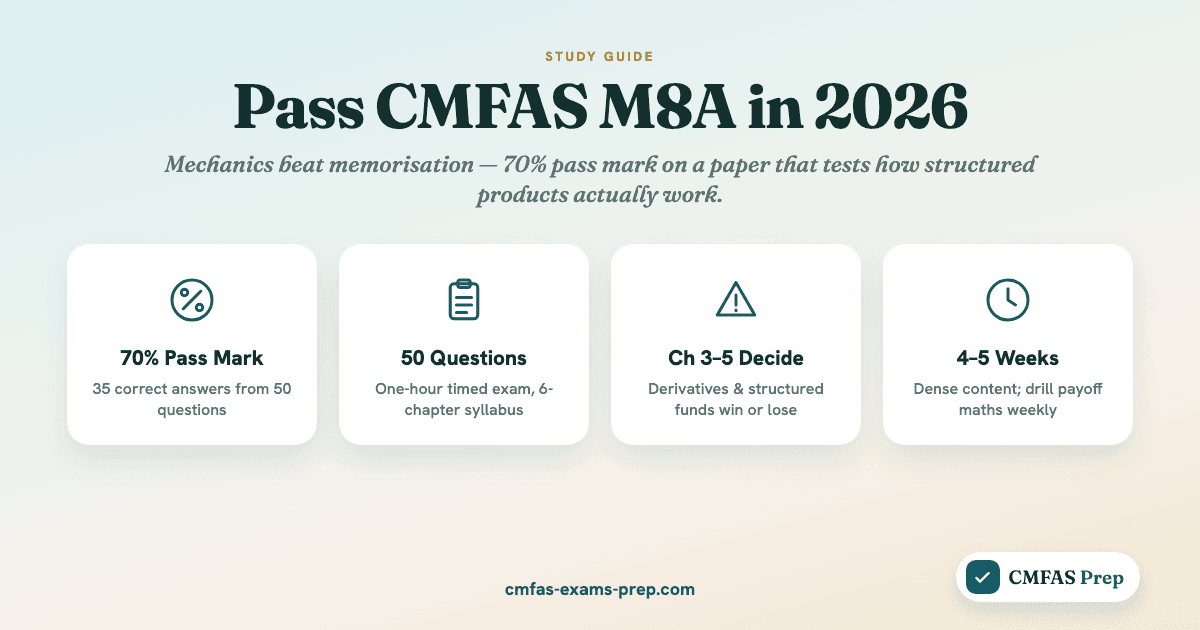
The M8A exam consists of 50 multiple-choice questions, and the passing score is 70% (35 correct answers out of 50 questions).