How hard is CMFAS M8A? Derivatives and structured funds do the damage
CMFAS M8A is harder than M8: derivatives maths and structured product mechanics replace rule recall. See why it trips people up and where to practice.
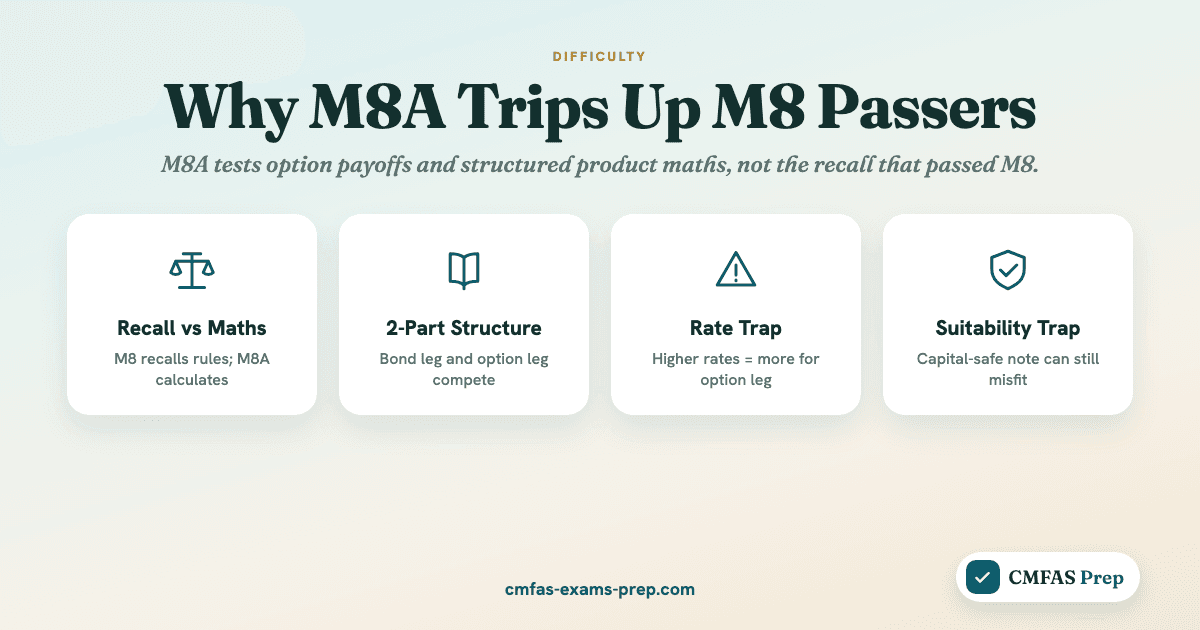
Yes, M8A is one of the harder papers in the CMFAS series, mainly because it moves away from rules-and-governance recall and into derivatives maths and structured product mechanics that you have to work out on the spot. If you passed M8 by memorising notes, that habit is exactly what catches people out here.
M8A covers the more complex end of collective investment schemes: derivatives, structured funds, and the suitability judgement that goes with selling them. The questions reward people who can take a product apart and price the pieces, not people who can quote a definition.
Why M8A trips up people who breezed through M8
M8 sits mostly in governance: the rules for offering unit trusts, the duties of the manager and trustee, disclosure obligations. You can carry a lot of that in your head. M8A keeps some of that regulatory backbone but adds two things that change how you study: contracts whose payoff depends on a moving market price, and products assembled from more than one of those contracts.
The result is a paper where the right answer often needs two or three steps of reasoning. A single fact won't get you there, and that is the gap most repeat-sitters fall into. For a side-by-side on the syllabus split, see the M8 vs M8A comparison.
The derivatives section is where most marks are lost
This part deals with futures, forwards, options and swaps, both exchange-traded and over-the-counter. The exam doesn't just ask what a call option is. It asks what happens to your position when the underlying price moves.
Take a long call. Your maximum loss is the premium you paid. Your breakeven is the strike price plus that premium. Your upside has no fixed ceiling. Now flip it: write a put at the same strike and the picture changes again. Hold a long call and a short put at one strike and you have built a synthetic long position in the underlying, with a payoff that tracks the asset almost one-for-one. If you have never drawn that combined line, you will stare at the option and guess.
The numbers behind these positions are small arithmetic, but you have to produce them under time pressure. Reading about payoff curves is not the same as being able to state max gain, max loss and breakeven for a position you have not seen before. That speed only comes from repetition, which is why working through free M8A derivatives and structured product mock questions does more than re-reading a chapter.
Structured products are two engines bolted together
A capital-protected structured fund is usually built from two parts. One is a zero-coupon bond that matures at the protected amount, so the investor gets their principal back. The other is an option, or a basket of options, that delivers the upside.
Here is the catch the exam likes to test. Those two parts respond to different forces. The bond reacts to interest rates. The option reacts to the volatility of whatever it is linked to. So a single market move can push the two components in opposite directions.
Worked through properly, the interest-rate effect is the opposite of what people assume. When rates are higher, the zero-coupon bond costs less to buy, because it is discounted more steeply. That leaves the issuer more money to spend on the option, which can lift the participation rate. Lower rates do the reverse: the bond eats up more of the budget and there is less left for upside. A question that asks how a rate move changes the fund's potential return is really asking whether you understand that the principal-protection leg and the growth leg compete for the same pot of money.
Once you can split any structured product into its funding leg and its payoff leg, the rest of the chapter gets much easier. Credit-linked notes, equity-linked notes and the like are all variations on the same deconstruction.
Suitability questions punish the obvious answer
The application chapter hands you a client profile and a product and asks whether the fit is right. The trap is that the easy pattern from M8, low-risk client takes low-risk product, no longer holds.
A principal-protected note looks safe. The capital comes back at maturity, so the risk box seems ticked. But if that note is hard to sell before maturity, it is wrong for a client who might need their cash in six months. The exam wants you to spot the secondary risk: the liquidity mismatch, the issuer's credit standing, the volatility exposure buried in the option leg.
Some of these come as calculation questions too, where you read a scenario and have to produce a figure rather than pick the safe-sounding label. The skill being tested is finding the one factor that makes an otherwise reasonable product unsuitable for this specific person.
How M8 and M8A actually differ
| What's tested | M8 | M8A |
|---|---|---|
| Core content | Rules and governance for unit trusts | Derivatives and structured products |
| Main task | Recall obligations and disclosure rules | Calculate payoffs and deconstruct products |
| Maths involved | Minimal | Option payoffs, breakeven, fund mechanics |
| Suitability logic | Match risk level to product | Spot the hidden risk that breaks the match |
| Why people fail | Underestimate the volume of rules | Try to memorise content that needs working out |
How to prepare so the calculations feel routine
Put most of your hours into the derivatives and structured fund material, not the regulatory parts you can revise quickly. The maths is where marks are won and lost, so that is where the time should go.
Practise by drawing or sketching payoffs until you can state max gain, max loss and breakeven for a position without thinking. Then drill structured products until splitting one into its bond leg and option leg is automatic. For suitability, run scenario after scenario and force yourself to name the single biggest reason a product does not fit before you look at the answer.
A question bank with worked explanations is more useful here than any set of notes, because you learn the method by repeating it and seeing where you went wrong. CMFAS Prep gives instant feedback on each question and has a practice-by-chapter mode so you can sit on the derivatives and structured product sections until they stop catching you out. You can drill the same paper conditions on the M8A practice page.
If you are still deciding what study material to trust before buying anything secondhand, the M8A mock exams and study guides comparison is worth a read first.
Common questions about M8A difficulty
Is M8A harder than M8? For most candidates, yes. M8 is heavier on rules you can memorise. M8A asks you to calculate and reason, which is harder to fake on exam day.
Do I need a finance background to pass? No, but you do need to get comfortable with option payoffs and the way structured funds are built. People from non-finance roles pass regularly once they put the practice hours into those sections.
How much maths is in the paper? The arithmetic itself is light. The difficulty is applying it quickly and knowing which calculation a question is actually asking for.
Can I pass by reading the textbook alone? It is the wrong tool for this paper. Notes can describe a payoff curve but cannot make you fast at producing one. Question practice is what builds that speed.
If you want a fuller revision plan, the M8A study strategy guide lays out a week-by-week approach.
When you are ready, open the M8A question bank on CMFAS Prep and start with the derivatives and structured product sets. Work them until the calculations feel routine, and the paper stops feeling difficult.
Practise M8A now
800+ exam-style M8A questions with instant explanations.
Frequently asked questions
Yes, M8A is generally considered harder because it involves complex financial mechanics like derivatives, structured products, and multi-step suitability analysis, which M8 does not cover in depth. M8 is easier to pass via rote learning.
Chapter 3 (Derivatives) is the hardest, specifically visualizing and calculating payoff diagrams for positions like long/short calls and puts, and then applying that knowledge to the components of Structured Funds.
Chapter 3 is dedicated to derivatives, but the concepts are foundational to Chapters 4, 5, and 6. Derivatives concepts likely influence 40-50% of the paper, as structured products are essentially combinations of bonds and derivatives.
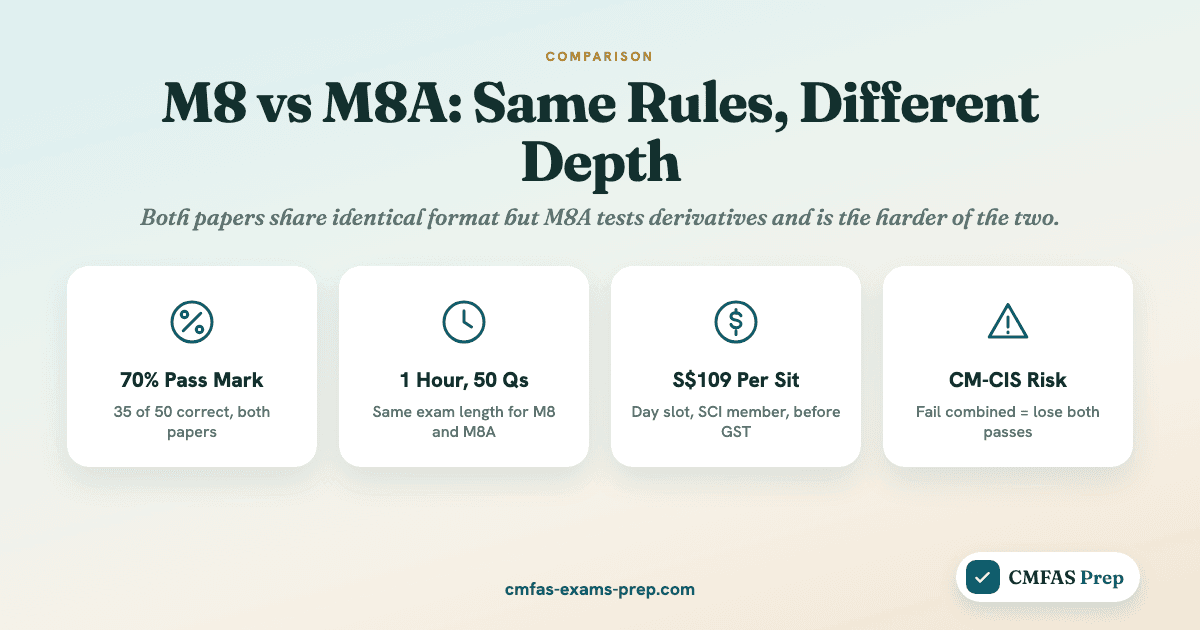
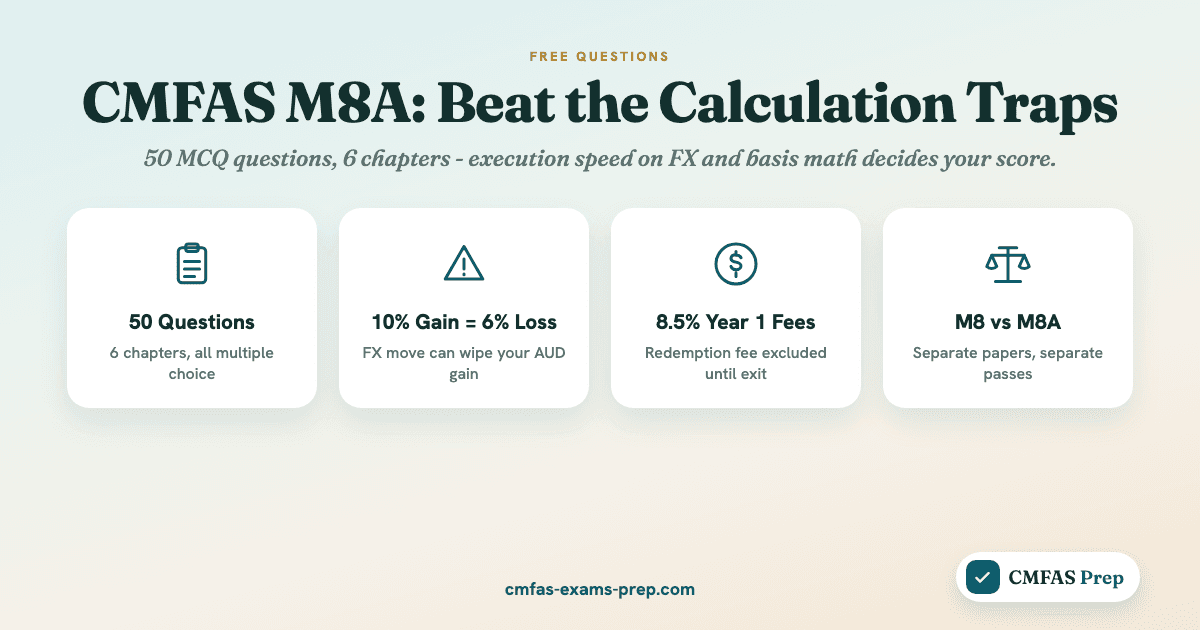
The M8A exam is 1 hour long. You will be given 50 multiple-choice questions to answer.
The M8A exam consists of 50 multiple-choice questions, and the passing score is 70% (35 correct answers).