CMFAS M8A format and pass mark: the technical paper, measured
CMFAS M8A needs 35 of 50 right in 60 minutes. See the real format, the pass mark, and why the derivatives questions eat your clock faster than you think.
CMFAS M8A Passing Score & Exam Format: The "Technical Paper" Trap
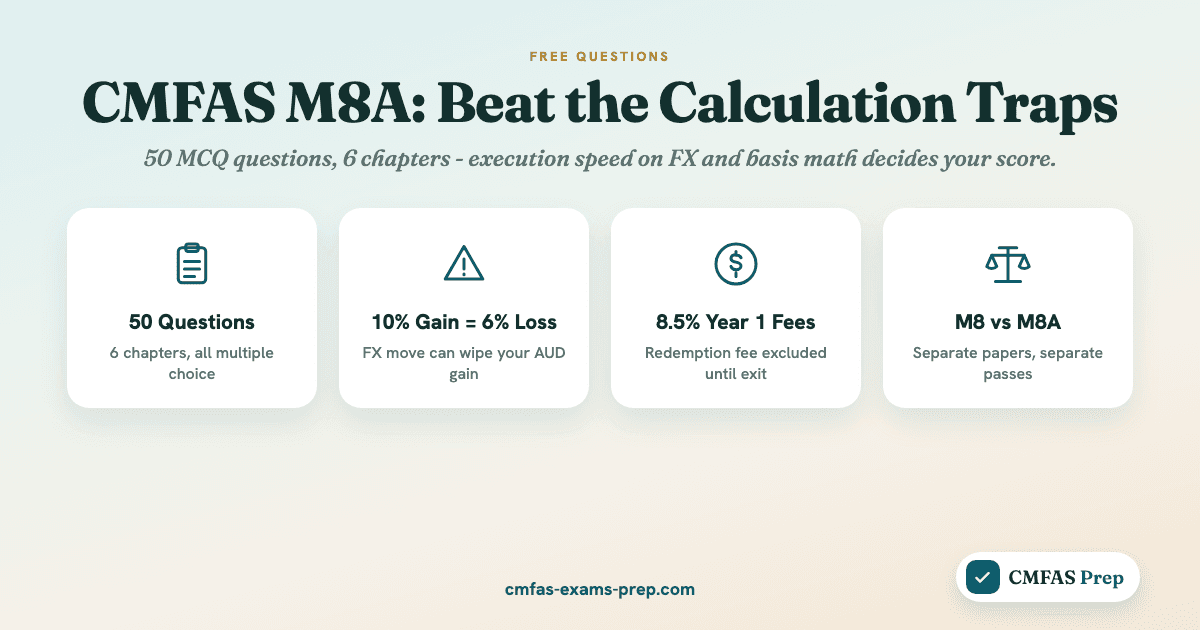
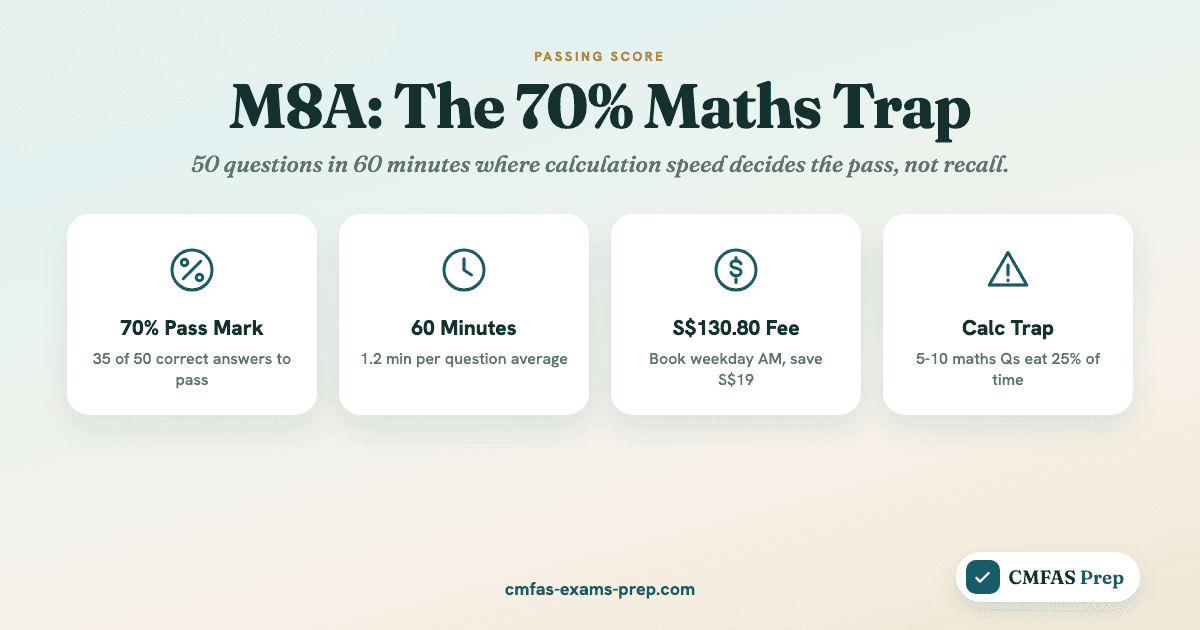
You need 35 out of 50 questions right to pass the CMFAS M8A, a 70% mark, inside a 60-minute window run by the Singapore College of Insurance (SCI). That works out to roughly 1.2 minutes per question, which is where most candidates get caught: M8A (Collective Investment Schemes II) leans on derivatives and structured product maths, not just definitions, so the clock runs faster than the question count suggests.
The rest of this guide covers what those 50 questions actually look like, the SCI fees and how to register, the booking decision that saves you about S$19, and the chapter weighting that tells you where your study hours should go.
M8A at a glance
| Item | Detail |
|---|---|
| Exam body | Singapore College of Insurance (SCI) |
| Format | 50 multiple choice questions |
| Duration | 60 minutes |
| Pass mark | 70%, or 35 correct |
| Pace | About 1.2 minutes per question |
| Module name | CMFAS Module 8A - Collective Investment Schemes II |
Why the time pressure bites harder than M8
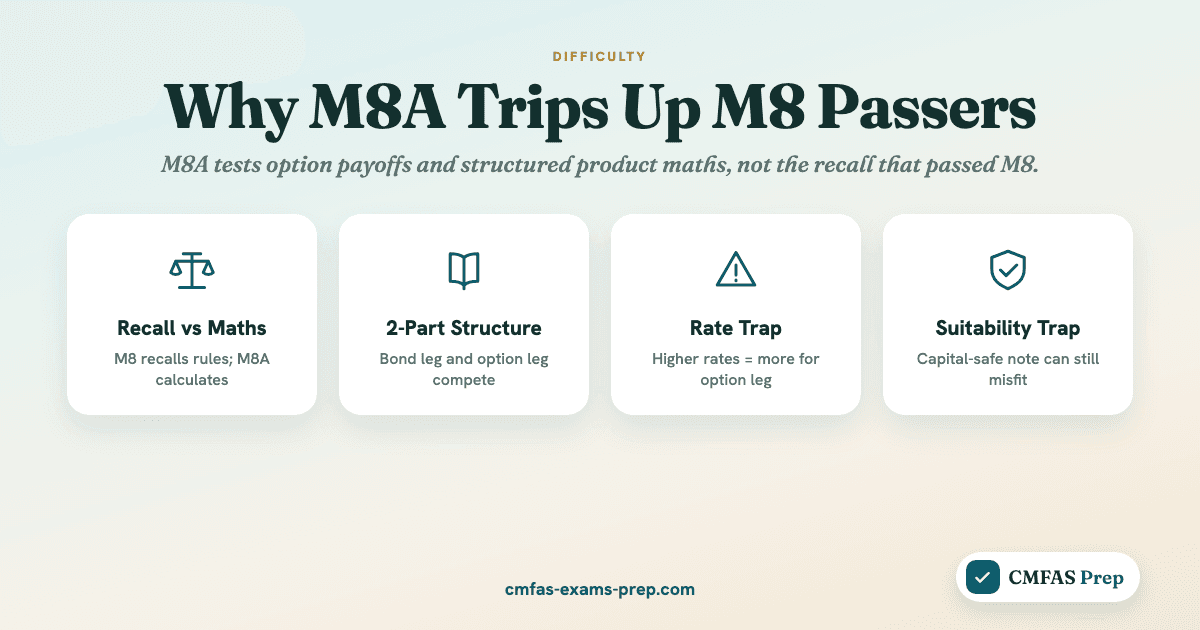
On paper, 50 questions in an hour reads as generous. M8A breaks that assumption because a portion of the paper asks you to work, not recall.
Expect 5 to 10 questions built around derivative payoffs, component valuation, or structured product analysis. A single payoff question can eat three or four minutes if you are reasoning it out from first principles each time. Do that on five questions and you have spent a quarter of the paper on a tenth of the marks, leaving the case studies at the end starved for time.
The fix is mechanical, not clever. Drill the calculation chapters until a long-versus-short payoff or a bond-plus-option breakdown takes you under a minute and you stop re-deriving the method mid-exam. That only happens if every practice paper you sit is timed to the real 60 minutes. Untimed practice teaches you the content but hides the pacing problem until exam day, which is the worst time to find it.
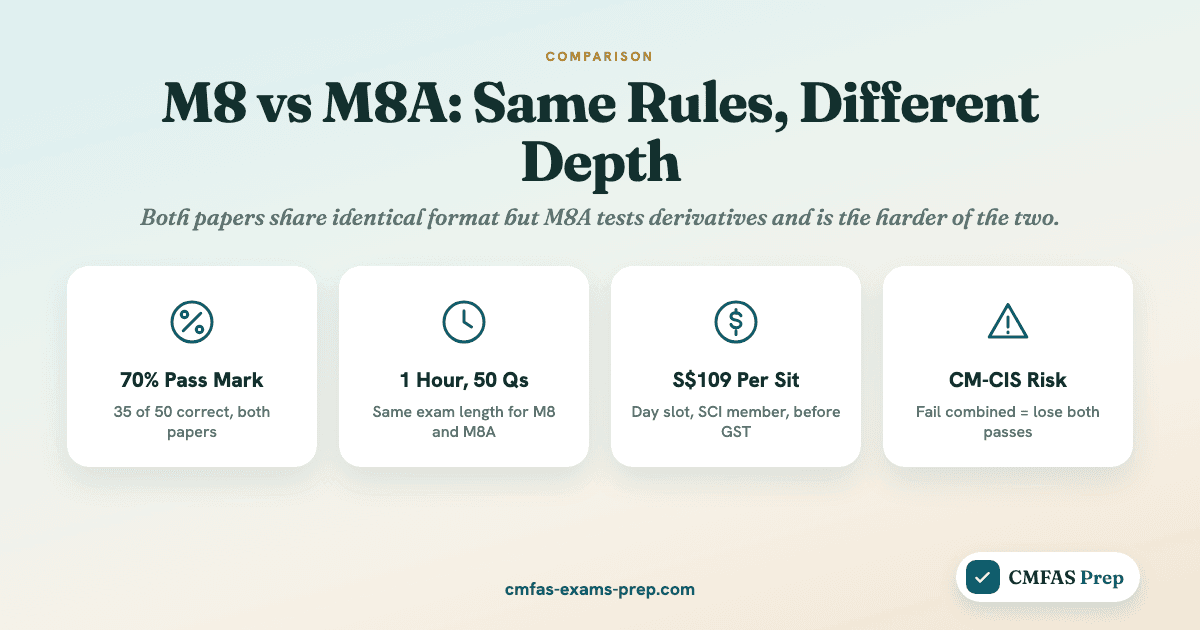
If you are also sitting the plain M8 paper, the difference in question style is worth understanding before you book both. Our M8 vs M8A comparison lays out where the two diverge.
The 70% pass mark, plainly
The pass mark is 70%, the same threshold used across most CMFAS modules. With 50 questions, that is 35 correct answers. There is no separate sectional pass and no penalty for wrong answers, so leave nothing blank. If a payoff question is burning your clock, mark your best guess, flag it, and move on rather than surrendering easy marks later in the paper.
One planning note for anyone targeting both M8 and M8A. Some agencies and recruiters refer to the pair as the "CM-CIS" qualification, which can read as if it were a single combined exam. It is not. You register for M8 and M8A as two separate papers, sit them separately, and pass both to earn the combined credential. Budget your time and fees for two sittings, not one.
Registering with SCI and the fees
M8A is administered by SCI, and you book it through their site. The flow is short:
- Create an SCI account if you are a first-time candidate, or log in to your existing one.
- Select the module: CMFAS Module 8A - Collective Investment Schemes II.
- Pick a date and time slot. Slots typically open two to three months ahead.
- Pay online.
SCI takes only Visa or Mastercard credit cards for online registration, so have one ready before you start. Approved-calculator rules and any policy updates live on the official SCI exam page for M8A, and you should check that page yourself close to your booking date in case of changes.
Day session vs evening and weekend
SCI prices the exam by when you sit it, and the gap is real money:
| Slot | Fee (non-member, approximate) |
|---|---|
| Weekday day session, 9am to 5pm | S$130.80 |
| Evening after 5pm, or weekend | S$149.33 |
A weekday morning slot is the cheaper booking, saving roughly S$19 over the evening or weekend rate. There is a second argument for the morning beyond price: a paper this calculation-heavy is easier to clear when you are fresh, not after a full workday. If your schedule allows it, book early in the day.
After payment: your study text is an eBook
SCI stopped issuing hard-copy books. Once your payment clears, the study text arrives as an eBook access link by email, usually within minutes. Check your spam or junk folder if it has not landed, because the access email is a common one for filters to catch. Without that link you cannot open the official text, so confirm you have it the same day you pay rather than discovering the problem the week before your exam.
The official text covers the syllabus but does not drill you against the clock, which is the actual obstacle on M8A. If you are weighing whether to supplement it with secondhand notes or a question bank, our M8A mock exam comparison walks through what is worth your money.
Where the questions come from
The 50 questions track the syllabus chapters, and the weighting tells you where to spend your hours. This is an approximate distribution, not an official quota, but it reflects how the paper is built:
| Area | Approx. share | What it tests |
|---|---|---|
| Structured products, Ch 1-2 | ~30% (15 questions) | Features, governance, credit and liquidity risk |
| Derivatives, Ch 3 | ~30% (15 questions) | Payoffs, long and short positions, OTC vs exchange-traded, hedging |
| Structured funds, Ch 4-5 | ~30% (15 questions) | Bond and option component valuation, payoff analysis |
| Case studies, Ch 6 | ~10% (5 questions) | Suitability, client mismatch, regulatory application |
The takeaway is that chapters 1 through 5 carry around 90% of the paper. Get those secure and you have cleared the 70% bar with margin to spare on the case studies. The two heaviest calculation blocks, derivatives in chapter 3 and structured fund valuation in chapters 4 and 5, are also the ones that decide your pace, so they earn the largest share of your timed practice.
CMFAS Prep's practice-by-chapter mode lets you isolate those chapters and run them under a timer, so you can see your per-question speed climb on exactly the sections that slow most candidates down.
Common questions
Is M8A harder than M8? Different, mostly. M8 weighs more toward definitions and rules; M8A adds payoff and valuation maths that you have to compute under time pressure. Same 70% pass mark, more calculation.
How many can I get wrong? Up to 15. Thirty-five correct out of 50 is a pass.
Can I retake if I fail? Yes. You register and pay for a fresh sitting through SCI the same way as the first.
Do M8 and M8A have to be taken together? No. They are separate exams with separate fees; you only need both if you are after the combined CM-CIS qualification.
Practise for the M8A
The pass mark is fixed at 35 correct, and the calculation chapters are what stand between most candidates and that number. Drill chapters 3 to 5 against a timer until the payoffs come without hesitation, then sit full 50-question papers at the real 60-minute pace.
Start your timed practice on the M8A exam page or open the CMFAS Prep app to run a chapter set now.
Practise M8A now
800+ exam-style M8A questions with instant explanations.
Frequently asked questions
You need to score 70% or higher to pass the M8A exam. With 50 questions total, you must get at least 35 correct answers.
The M8A exam is 1 hour (60 minutes) long for 50 multiple-choice questions.
The SCI examination fee for M8A is typically between S$150 and S$180, including GST, for both new and retake candidates.
Yes, you are allowed to use a calculator during the M8A exam. However, you must bring your own approved calculator. For a list of approved calculators, refer to the official SCI website.
There are 6 chapters in the M8A exam.