A study plan for BCP: the fastest clock in the SCI suite
A tutor's plan for the BCP exam: how the nine chapters are weighted, the traps in chapters 4 and 7, and a two-week schedule to pass the 45-minute paper.
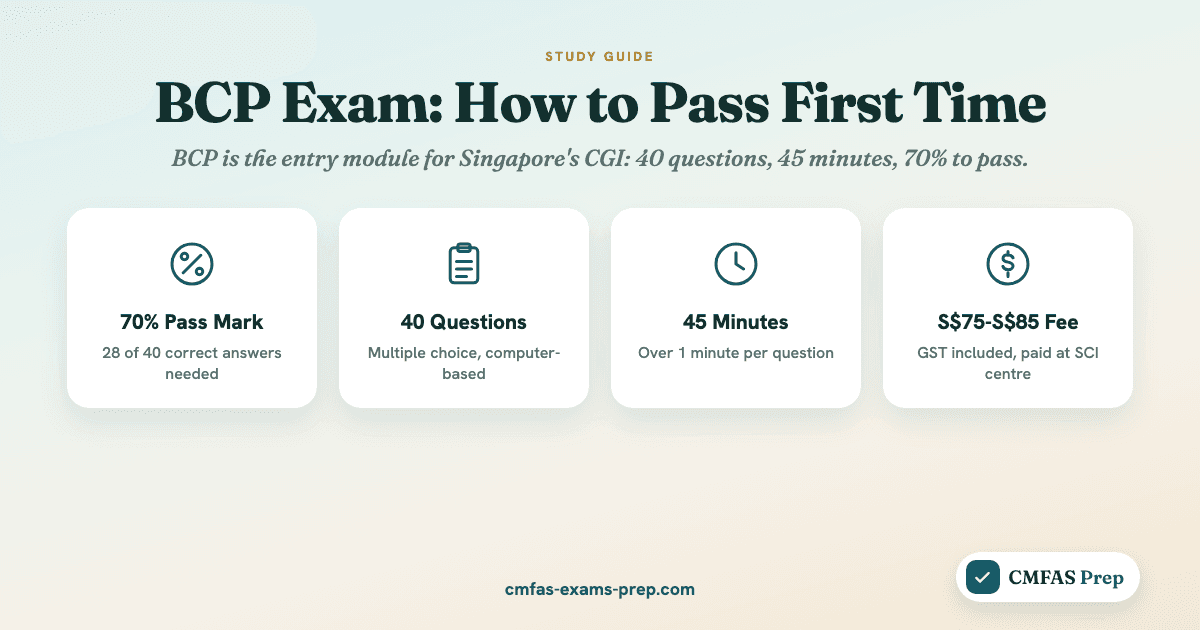
The BCP exam (Basic Insurance Concepts and Principles) is a 40-question, 45-minute paper you need to pass with at least 70% — 28 correct answers — to start the Singapore College of Insurance's Certification in General Insurance (CGI). It is the entry module: you sit it before either of the two specialist papers, so passing it is the gate to everything else in general insurance.
This guide explains what the exam covers, where candidates lose marks, and how to prepare in about two weeks. Every figure here matches the current 7th Edition study text.
What BCP gives you and why it comes first
CGI has two finishing routes. If you sell motor, travel, home, or personal accident cover, you take PGI (Personal General Insurance) after BCP. If you handle commercial risks like fire, marine cargo, or liability, you take ComGI (Commercial General Insurance). Either way, BCP is the shared first step.
The reason for the ordering is practical. PGI and ComGI assume you already know what indemnity means, how an insurance contract forms, and what happens at claim stage. BCP teaches that vocabulary. Sit it first and the product papers read like application; skip ahead and you spend the harder exams relearning basics under time pressure.
You can find the registration details, calculator rules, and centre information on the BCP exam page.
The format at a glance
The whole sitting is built around speed and recall, not long calculations.
| Item | Detail |
|---|---|
| Questions | 40 multiple choice |
| Time | 45 minutes |
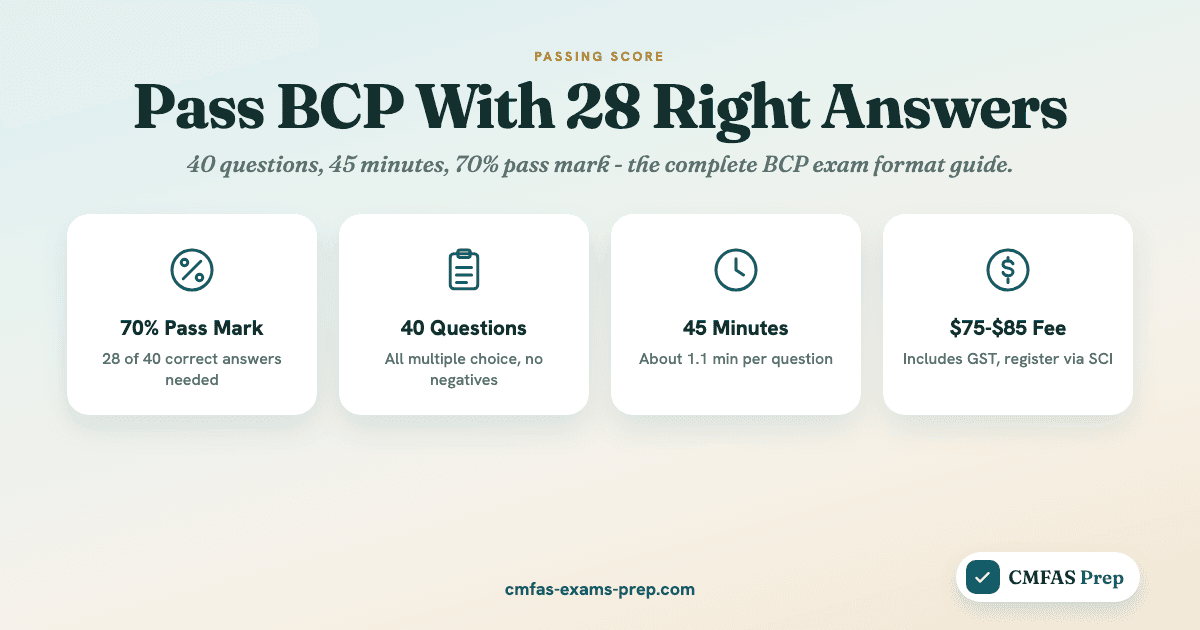
| Pass mark | 70% (28 of 40) |
| Fee | S$75 to S$85, GST included |
| Mode | Computer-based at an SCI centre |
| Edition | 7th |
| Calculator | Allowed (approved models only) |
Forty questions in 45 minutes leaves you a little over a minute each. That pace is the single biggest reason candidates fail a paper they actually knew — they stall on two or three wording-trap questions and run out of clock. A full breakdown of the scoring and timing sits in the BCP passing score and format guide.
The nine chapters, and where the marks sit
The syllabus runs across nine chapters. They are not weighted evenly. Three of them carry most of the questions, and they are the conceptual ones rather than the operational ones.
| Ch | Chapter | Weight |
|---|---|---|
| 1 | The insurance and reinsurance market | Medium |
| 2 | Regulation and industry frameworks | Medium |
| 3 | Risks and insurance | Heavy |
| 4 | Principles of insurance | Heavy |
| 5 | Law of contract and agency | Heavy |
| 6 | Insurance documents | Medium |
| 7 | Claims | Medium |
| 8 | Reinsurance and co-insurance | Medium |
| 9 | Ethics, professionalism, data protection and cyber hygiene | Medium |
Put your study hours where the questions are: chapters 3, 4, and 5.
Chapters 1 and 2: market and regulation
Chapter 1 sets the scene. You learn who the players are — direct insurers, reinsurers, Lloyd's, brokers, agents — and how cover reaches the customer through different distribution channels. Questions here are recognition-level. Know who does what.
Chapter 2 covers the rules that govern the industry in Singapore. The MAS is the regulator, and you should know the licensing and conduct requirements that flow from that, plus the role of bodies like the General Insurance Association. Expect questions that test whether you can match a function to the right authority.
Chapter 3: risks and insurance
This is where the theory starts and the marks pick up. You need the risk classifications cold: pure versus speculative, fundamental versus particular. Only pure, particular risks are generally insurable, and exam questions love to hand you a speculative risk and ask whether cover applies.
Learn the test for an insurable risk — the loss must be measurable, the event fortuitous, the exposure spread across many similar risks, and so on. Group insurance also lives here: one master policy held by an employer or association, with members covered under individual certificates rather than separate policies. Questions often probe that master-versus-certificate distinction.
Chapter 4: the principles of insurance
The heaviest single chapter, and the one most worth over-preparing. Six principles run through everything: indemnity (putting the insured back to their financial position before the loss, no better), insurable interest (a legal stake in the thing insured), utmost good faith (the duty to disclose material facts), subrogation, contribution, and proximate cause.
The trap candidates fall into is treating these as definitions to recite. The exam tests application. A common question gives you a scenario and asks whether the policy is indemnity-based or benefit-based. Property, liability, and pecuniary cover are indemnity contracts, so payouts track the actual loss. Life and personal accident pay a fixed agreed sum, so insurable interest is measured at inception rather than at claim. Get that split clear and a cluster of questions becomes easy.
If chapter 4 is your weak spot, the Practice by Chapter mode on CMFAS Prep lets you drill only these questions until the principles stick, instead of re-reading the whole text.
Chapter 5: law of contract and agency
Insurance is a contract, so this chapter tests the law that makes one valid: offer, acceptance, consideration, and intention to create legal relations. Consideration trips people up — it is simply the price each side gives for the other's promise, and a contract is not binding without it.
You also need the difference between a warranty, a condition, and a representation, because a breach of each has different consequences for the policy. The agency section covers how an agent binds a principal and the limits of that authority. These are precise, technical distinctions, and the wrong answer is usually a near-miss option designed to look right.
Chapters 6 to 9: documents, claims, reinsurance, ethics
Chapter 6 walks through the paperwork: proposal forms, the structure of a policy, endorsements, and renewals. Know what each document does and when it is issued.
Chapter 7 is claims, and it hides one of the exam's favourite distinctions. An excess is the first amount of every claim the insured bears, deducted each time. A franchise is a threshold: below it the insurer pays nothing, but once a loss crosses it, the insurer pays the whole amount. Mix those two up and you lose an easy mark. The chapter also covers claims procedures, the role of loss adjusters, and how settlements are reached.
Chapter 8 is reinsurance and co-insurance — how insurers share risk between themselves. Learn treaty versus facultative, and proportional versus non-proportional. Co-insurance is several insurers each taking an agreed share of one risk.
Chapter 9 covers conduct: the code of practice, PDPA obligations when handling customer data, and basic cyber hygiene. It is recall-based and quick to score if you read it.
A two-week plan that fits the exam
BCP is short enough that most working candidates clear it in two focused weeks.
Week one, build the core. Read chapters 1 and 2 for context, then spend real time on chapters 3, 4, and 5. Don't move on from a principle until you can apply it to a scenario you haven't seen.
Week two, cover the operational chapters 6 to 9, then switch to testing. Sit two or three full mock papers under the 45-minute clock so the pace stops being a surprise. After each one, go back to the chapters where you dropped marks. The performance-by-chapter view on CMFAS Prep flags those for you, and you can pull a fresh set of free BCP practice questions to retest the weak ones.
On the day
Watch the clock from the first question. If a question is fighting you, flag it and move on — a minute spent stuck is a minute stolen from three questions you could have answered. Aim to reach the end with five minutes left for the flagged ones.
Most marks turn on precise terms, so be sure of the pairs the exam likes to confuse: indemnity versus benefit policies, excess versus franchise, warranty versus condition, offer versus acceptance versus consideration. Bring an approved calculator even though the paper leans conceptual; a few questions may need simple arithmetic on claim amounts.
After you pass
You get a result slip rather than a certificate, and the pass earns you 0.75 CPD hours. From there you take PGI or ComGI depending on your line of work. Clear all three papers and you can use the designation Cert SCI (General Insurance).
When you are ready to start, work through timed question sets on CMFAS Prep until you are consistently scoring above 70% on full papers. That is the clearest sign you are ready to book the real thing.
Practise BCP now
800+ exam-style BCP questions with instant explanations.
Frequently asked questions
BCP stands for Basic Insurance Concepts & Principles. It is the foundational module under the SCI Certification in General Insurance (CGI) framework and should be taken before PGI or ComGI.
Yes, SCI recommends taking BCP first as it forms the foundation knowledge for both PGI and ComGI. BCP covers insurance principles, law of contract, and claims processes that the other modules build upon.
The BCP exam has 40 multiple-choice questions to be completed in 45 minutes. The passing score is 70%, meaning you need at least 28 correct answers.
Chapters 3 (Risks & Insurance), 4 (Principles of Insurance), and 5 (Law of Contract and Agency) tend to have slightly more questions as they cover the theoretical core of insurance.
Yes, non-programmable calculators are allowed for the BCP exam. Check the SCI website for the list of approved calculator models.
After passing BCP, you can proceed to PGI (Personal General Insurance) or ComGI (Commercial General Insurance). Passing all three modules (BCP + PGI + ComGI) qualifies you for the Cert SCI (General Insurance) designation.