A study plan for PGI: personal lines without the memory overload
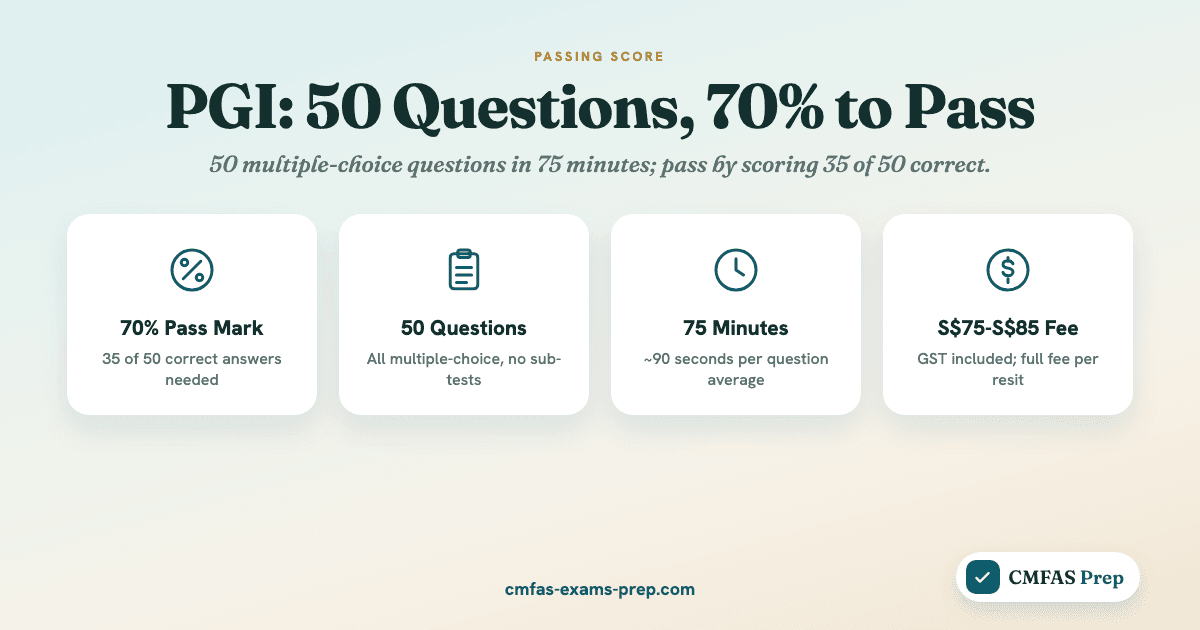
PGI is 50 questions in 75 minutes and you need 35 right. This plan covers all seven chapters in three weeks, motor first, without the memory overload.
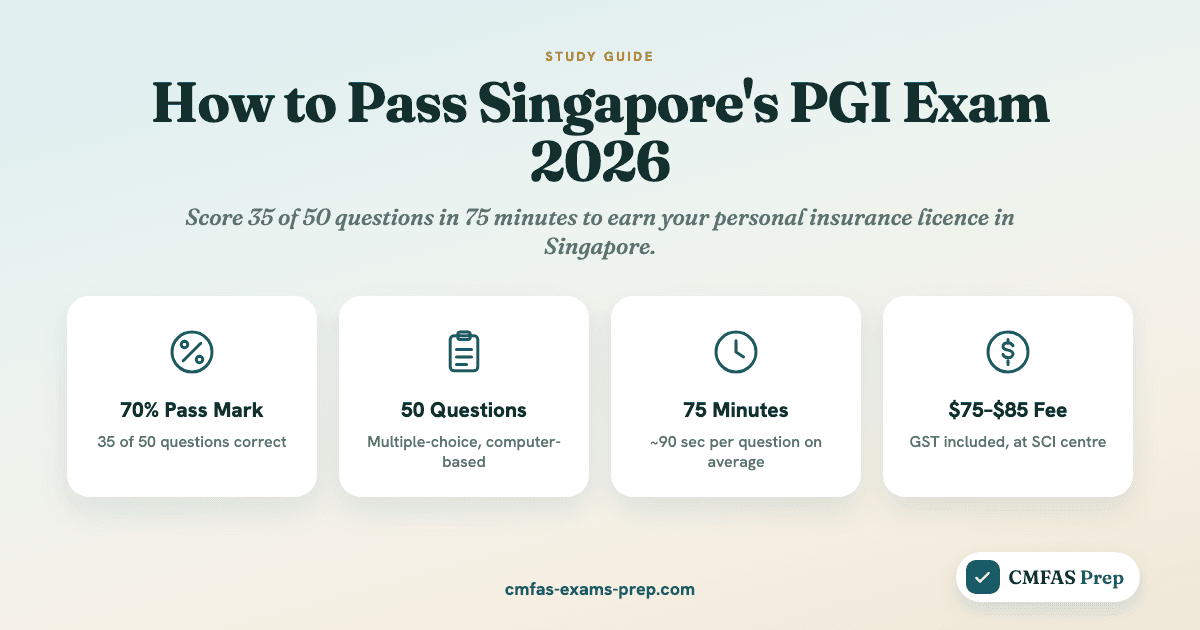
The PGI exam tests whether you can advise on and sell personal general insurance products in Singapore, and you pass it by scoring 70% (35 of 50 questions) within 75 minutes. Personal General Insurance (PGI) is one of three modules inside the Singapore College of Insurance's Certification in General Insurance (CGI). Clear it together with BCP and you hold the Personal General Insurance Certification that the Monetary Authority of Singapore (MAS) requires before you can sell motor, travel, personal accident, and other personal lines products.
This guide walks through the format, the order you should sit the modules in, what each of the seven chapters actually asks, and a study plan that fits around a full-time job.
PGI exam at a glance
| Item | Detail |
|---|---|
| Questions | 50 multiple-choice |
| Duration | 75 minutes |
| Pass mark | 70% (35 correct) |
| Fee | $75 to $85, GST included |
| Format | Computer-based at an SCI centre |
| Administered by | Singapore College of Insurance (SCI) |
| Edition | 7th |
A non-programmable calculator is permitted, and SCI publishes the approved list. The exam is closed-book, so the formulas and definitions have to live in your head before you walk in.
Do you sit BCP before PGI?
Sit Basic Insurance Concepts and Principles (BCP) first. PGI is a products module: it assumes you already understand the machinery underneath every policy. BCP teaches that machinery, including indemnity, subrogation, utmost good faith, the law of contract and agency, how claims are documented and settled, and the regulatory rules that sit over all of it.
Open a PGI textbook without that grounding and the early chapters will keep referring to ideas they never stop to explain. The same BCP foundation also feeds ComGI if you later move into commercial lines, so the time is not wasted.
How the questions are spread across the syllabus
PGI runs across seven chapters, each tied to a category of personal cover. The 50 questions are spread fairly evenly, with one tilt worth planning around: private motor pulls a little more weight than the rest, and the final niche chapter pulls a little less.
| Chapter | Topic | Weighting |
|---|---|---|
| 1 | Private motor car insurance | Heaviest |
| 2 | Personal property insurance | Even |
| 3 | Personal accident insurance | Even |
| 4 | Travel insurance | Even |
| 5 | Personal liability insurance | Even |
| 6 | Health insurance: critical illness and hospital cash | Even |
| 7 | Foreign domestic worker and golfer's insurance | Lightest |
Motor is the heaviest chapter and also the policy you will quote most often on the job, so it earns the most study hours. Chapter 7 is light, but a handful of marks still sit there, and on a 35-mark pass line a handful decides outcomes.
What each chapter expects you to know
Chapter 1, private motor
The examiner leans hard on this one. Know the split between third-party and comprehensive cover, how the no-claim discount (NCD) scale steps up and resets, and what the policy excludes. Get comfortable with excess, the first slice of every claim the insured pays themselves, because questions like to combine it with an NCD scenario and a settlement figure.
Chapter 2, personal property
This covers householder and houseowner policies. The point that trips candidates is that insurers decide which perils to insure, so a named-perils policy only pays for the events it lists, while an all-risks policy covers anything not specifically excluded. Underinsurance and the average clause also show up here.
Chapter 3, personal accident
PA pays fixed benefits for death, permanent disability, and medical expenses rather than indemnifying an actual loss. Learn how the policy defines an accident and which situations fall outside it, such as pre-existing conditions and hazardous pursuits.
Chapter 4, travel
Medical costs overseas, trip cancellation, and curtailment are the headline benefits. The marks, though, sit in the exclusions on baggage: items left unattended, fragile goods, and luggage forwarded separately from the traveller are common reasons a claim is rejected. If you can recite when a baggage claim fails, this chapter pays off.
Chapter 5, personal liability
This is legal liability for injuring someone or damaging their property. The concept the examiner reaches for is subrogation, the insurer's right to step into the insured's shoes and recover from whoever caused the loss, which stops the insured collecting twice for the same event. Know the policy limits and the standard exclusions alongside it.
Chapter 6, health
Critical illness and hospital cash plans. Be precise about how a critical illness is defined, how hospital cash pays a daily benefit regardless of actual cost, and how waiting periods and pre-existing condition clauses limit early claims.
Chapter 7, foreign domestic worker and golfer's
Niche but examinable. For FDW cover, know the security bond MAS requires of employers plus the medical and personal accident protection bundled in. For golfer's policies, the hole-in-one benefit is the detail most likely to surface.
A three-week plan that works around a job
Week 1, the core products
Take chapters 1 to 3. Give motor the most time since it is the heaviest and the most useful at work, then move through personal property and personal accident. These three carry the largest block of marks between them.
Week 2, the everyday consumer lines
Cover chapters 4 to 6: travel, personal liability, and health. You meet these products constantly once you are advising clients, so tie each one back to a real situation as you read. Concrete cases stick better than a list of bullet points.
Week 3, niche topics and full rehearsals
Finish chapter 7, then switch from reading to testing. Sit two or three full timed mock papers, mark them honestly, and spend the rest of the week only on the topics where you dropped marks. This is the week that converts knowing the material into passing the exam.
A pattern runs through every chapter: PGI loves to ask what is not covered. For each product, write out the standard exclusions on a single page. Those are reliable marks once you have them down, and they are exactly what a careless candidate leaves on the table.
Exam-day mechanics
Seventy-five minutes over 50 questions gives you about a minute and a half each, which is generous. Use it to read the full stem rather than rush. Watch for the qualifiers that flip an answer: "not covered," "excluded," "claimable." A question you would answer correctly in conversation is easy to fumble when you skim past one of those words.
Make sure these definitions are automatic before you sit down:
- Excess versus franchise
- Subrogation
- Indemnity
- Named perils versus all risks
What you can sell once you pass
PGI plus BCP certifies you to advise on and transact:
- Private motor insurance
- Personal accident insurance
- Travel insurance
- Personal property insurance, including householder and houseowner
- Personal liability insurance
- Health insurance, including critical illness and hospital cash
- Foreign domestic worker insurance
- Golfer's insurance
Next steps
Get the format straight first with our PGI passing score and exam format breakdown, then check where you actually stand using our free PGI mock exam questions. When you are ready to book, registration is on the SCI website.
The fastest way to find your weak chapters is to answer real questions and see where you slip. CMFAS Prep lets you drill chapter by chapter, shows a worked explanation after every question, and tracks your accuracy per chapter so week three of your plan targets the right topics. Start a practice set on CMFAS Prep and work through the chapters until your mock scores clear 35 with room to spare.
Practise PGI now
800+ exam-style PGI questions with instant explanations.
Frequently asked questions
PGI stands for Personal General Insurance. It is one of three modules under the SCI Certification in General Insurance (CGI) framework, alongside BCP (Basic Insurance Concepts and Principles) and ComGI (Commercial General Insurance).
Yes, SCI recommends taking BCP first as it forms the foundation knowledge for both PGI and ComGI. BCP covers insurance principles, law of contract, and claims processes that PGI builds upon.
The PGI exam has 50 multiple-choice questions to be completed in 75 minutes (1 hour 15 minutes). The passing score is 70%, meaning you need at least 35 correct answers.
Chapter 1 (Private Motor Car Insurance) tends to have slightly more questions as motor insurance is a core personal lines product. Chapter 7 (FDW and Golfer Insurance) has fewer questions. All other chapters are fairly evenly distributed.
Yes, non-programmable calculators are allowed for the PGI exam. Check the SCI website for the list of approved calculator models.
After passing PGI (along with BCP), you will have the Personal General Insurance Certification, allowing you to provide advice and sell personal general insurance products. You can also take ComGI to complete the full CGI certification.