A study plan for the SCI HI paper: limits, riders and claim rules
How to pass the CMFAS HI (Health Insurance) exam. Updated for the April 2025 MediShield Life changes ($1,630 limits). Learn the new calculation formulas and CareShield rules.
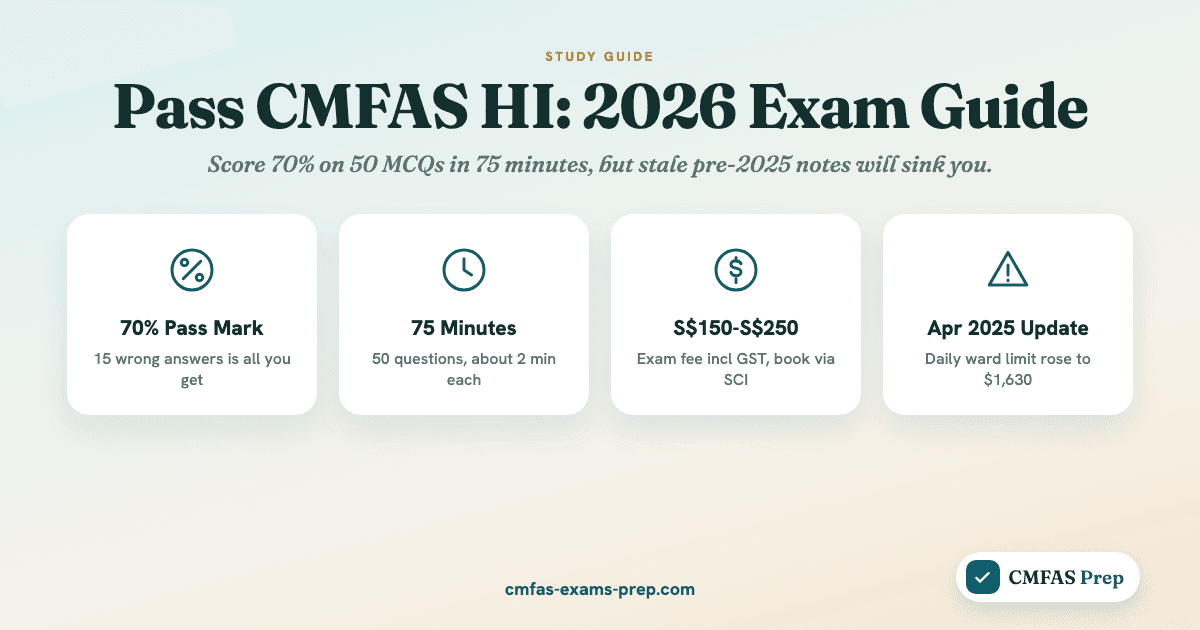
You pass the CMFAS Health Insurance (HI) exam by scoring 70% on 50 multiple-choice questions in 1 hour 15 minutes, which leaves room for 15 wrong answers and no more. What trips people up in 2026 is not the theory. It is arithmetic on figures that changed in April 2025, while most hand-me-down notes still carry the old numbers.
The exam is run by the Singapore College of Insurance (SCI), the fee sits around S$150 to S$250 including GST, and you can book a date on the SCI portal. One sitting, one paper, and a pass either gets you closer to advising clients on hospital and health cover or it does not.
Why 2023 and 2024 notes will fail you
In April 2025 the government revised MediShield Life. The normal ward daily claim limit went from $1,000 to $1,630, deductibles moved, and the Cancer Drug List started showing up in scenario questions. If you borrow a friend's notes from before that change, every worked example with a claim calculation gives you the wrong answer, and the exam is built around those exact calculations.
So the first thing to check is whether your study material uses the post-April-2025 figures. If a practice question still pays out against a $1,000 daily limit, throw it out. The best HI mock exams comparison walks through which materials carry the current numbers.
There is one more date on the calendar. The SCI HI syllabus has a small revision that takes effect 24 February 2026, so anything you study should already reflect that. The question bank on CMFAS Prep is updated to both the April 2025 limits and the February 2026 syllabus.
The calculation questions are where marks disappear
A large share of the paper hands you a hospital bill and asks what the insurer actually pays. A typical version reads: a subsidised patient stays in a private ward, the bill is $50,000, work out the claimable amount.
The method is always the same:
Claimable = (Bill x Pro-ration factor) - Deductible - Co-insurance
Each piece can sink you. The pro-ration factor adjusts a subsidised patient's bill when they stay above their entitled ward class, and you apply it before anything else. The deductible depends on ward type and age, and this is the figure the April 2025 revision touched. The co-insurance is the percentage slice the patient keeps after the deductible. Get the order wrong or use a stale deductible and the whole answer is off, even if your sums are clean.
Two minutes per question is the pace you need. The only way to hit it is repetition until the formula is muscle memory. A free HI mock exam is a fast way to see whether your timing holds under pressure.
The 3Ms, and why candidates mix them up
The other heavy section is healthcare financing, built around MediSave, MediShield Life, and Medifund. People lose marks here because the three sound similar but behave differently, and the exam likes to make you apply two of them in the same question.
| Scheme | What it is | The number that matters |
|---|---|---|
| MediSave | A personal savings account for medical bills | Withdrawal limits, e.g. around $550 a day for inpatient stays |
| MediShield Life | National insurance against large bills | Claim limits, with an annual cap of $200,000 |
| Medifund | A means-tested safety net for the needy | No fixed limit, assessed case by case |
The trap is the difference between a withdrawal limit and a claim limit. MediSave caps how much you can take out of your own account per day. MediShield Life caps how much the scheme pays per claim and per year. A question like "Mr Tan has a $10,000 bill, how much comes from MediShield versus MediSave?" wants you to run both ceilings at once. Memorise the two sets of figures side by side, because the exam deliberately tests whether you can tell them apart.
Shield plans, and the CareShield trigger
Integrated Shield Plans (IPs) sit on top of MediShield Life. They are private cover sold by insurers, and they pay for the gap between what MediShield Life covers and what a private hospital actually charges. Expect at least one question that combines an IP with the pro-ration factor for a subsidised patient who chooses a private ward.
CareShield Life and ElderShield are the long-term care piece, and the common error is the payout trigger. CareShield Life starts paying when a person cannot do at least 3 of 6 Activities of Daily Living. If a question describes someone who fails only 2, the payout is zero. Knowing the exact threshold is the difference between the right answer and a confident wrong one.
For a fuller sense of where the paper gets hard, the breakdown of whether the HI exam is difficult covers the topics that catch people out.
A three-week study approach
You do not need months. You need the right order.
Spend the first week on the financing framework. Write the MediSave withdrawal limits and the MediShield Life claim limits on one page, next to each other, and learn them cold. Almost every scenario question leans on these.
Use the second week on the products: medical expense cover, disability income, and long-term care. This is calculation week. Drill bill-payout questions until you can finish one in under two minutes without checking the formula. If the math is your weak point, isolate it and do nothing else until it clicks.
Give the third week to applied case studies. You get a client profile, say a 45-year-old PR planning a private hospital stay, and you either recommend a suitable plan or work out the cash they pay out of pocket. This is the financing and product knowledge from the first two weeks put together.
If you are not sure where your gaps are, the practice app on CMFAS Prep tracks your accuracy by chapter and points you at the topics you keep missing, so you stop re-reading material you already know.
A quick checklist before you book
- Your materials use the April 2025 MediShield Life limits, including the $1,630 daily ward figure
- You can run the claim formula in order: pro-ration, deductible, co-insurance
- You can state MediSave withdrawal limits and MediShield Life claim limits from memory
- You know CareShield Life pays at 3 of 6 ADLs, not 2
- You have done at least two full timed mock papers
HI rewards accuracy over cleverness. There is no partial credit for knowing roughly how a claim works. You either carry the current numbers in your head or you guess, and 15 wrong answers is the whole margin you get.
Run a few timed papers on CMFAS Prep and check your answers against the 2025 and 2026 figures before you sit the real thing.
Practise HI now
800+ exam-style HI questions with instant explanations.
Frequently asked questions
Yes, significantly. Major changes to **MediShield Life** were implemented in April 2025 (e.g., higher claim limits, new deductibles). The exam now tests these new figures. Old study notes are obsolete.
Most find HI easier conceptually (less math), but harder memorially. You must memorize specific dollar limits ($1,630, $200k) and strict scheme criteria (CareShield vs ElderShield).
Yes. You will get calculation questions where you are given a hospital bill and must calculate the payout. You cannot do this if you don't know the daily ward limits and deductible tiers.
The passing score for HI is 70%. You need to get at least 35 questions correct to pass.
The HI exam is 1 hour 15 minutes. You will be given 50 questions to answer.