How hard is the HI exam? The scheme-name alphabet is the filter
Is the CMFAS Health Insurance (HI) exam difficult? We analyze the "Alphabet Soup" of schemes (MediShield vs CareShield), the memory trap of claim limits, and why general knowledge isnt enough.
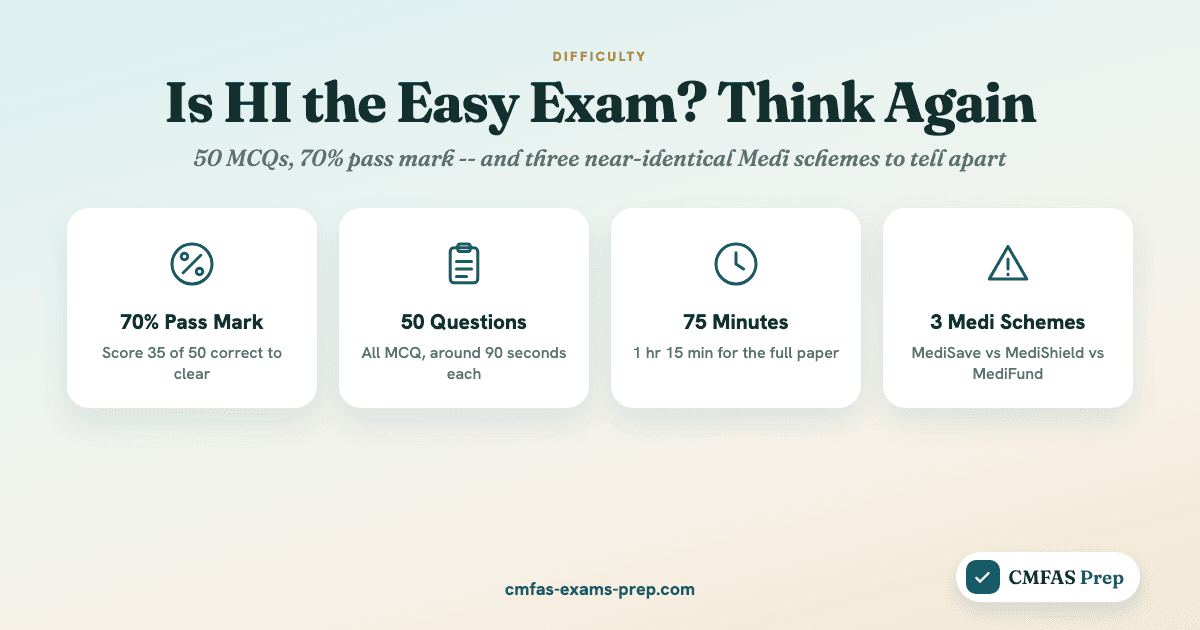
The HI exam facts check out (50 MCQs, 75 minutes, 70% pass mark, SCI). Is the HI exam difficult? Yes, more than its reputation suggests. Health insurance feels familiar because Medisave and hospital bills are part of normal life in Singapore, so candidates assume the HI paper is the soft option among the insurance modules. The pass rate tells a different story. People fail HI because it rewards exact recall of named government schemes and dollar figures, not general familiarity with how healthcare works.
The exam is 50 multiple-choice questions in 1 hour 15 minutes, set by the Singapore College of Insurance, with a pass mark of 70 percent. That gives you about 90 seconds per question, and many of those questions hinge on one number or one scheme name being right.
Why "familiar" is the wrong mindset
Most people walk in thinking they already understand health insurance. They have an Integrated Shield Plan. They have used Medisave. They have heard of ElderShield. That surface knowledge is exactly what trips them up, because the HI syllabus tests the boundaries between schemes that sound almost identical.
The classic failure is mixing up the "Medi" family. These are three different things with three different rules, and the exam writes questions specifically to see whether you know which is which.
| Scheme | What it actually is | What it does | Key limit type |
|---|---|---|---|
| MediSave | A national savings account (your own money) | Pays approved medical bills from your CPF | Withdrawal limits |
| MediShield Life | A basic health insurance scheme (risk pooling) | Pays large hospital bills above a deductible | Claim limits |
| MediFund | A government endowment (a safety net) | Helps lower-income patients who still cannot pay after the first two | Means-tested, no fixed cap |
Read a question like this and the trap becomes obvious:
Mr Tan has a $5,000 hospital bill. How much can he pay using MediSave?
If you reach for a MediShield Life daily claim limit when the question asks about a MediSave withdrawal limit, you get the wrong answer with full confidence. The two limits are different numbers governing different pools of money. You have to read which scheme the question names and apply only that scheme's rule.
If you want to feel this for yourself before paying for anything, our free HI mini mock is built around these exact scheme-matching traps.
The disability schemes are the second trap
The same problem repeats with long-term care. ElderShield is the older scheme. It is opt-out, it pays out on severe disability defined as the inability to perform at least three Activities of Daily Living, and its monthly payouts are fixed at $300 or $400 depending on the plan year a person joined.
CareShield Life is the newer scheme that replaced it for younger cohorts. It is compulsory for Singapore citizens and permanent residents born in 1980 or later, it uses the same three-ADL definition of severe disability, and its payouts start higher and rise over time rather than staying flat.
So when a scenario gives you a birth year, that detail is the answer key. A client born in 1982 is on CareShield Life, not ElderShield, and any payout figure or eligibility rule you quote has to come from the CareShield Life rules. The exam buries this in case wording precisely because rushing candidates skip the birth year and answer from habit.
The calculation questions are data recall, not logic
The other reason HI is hard is the hospital bill maths. Unlike the life insurance papers where a calculation usually follows a single logical formula, an HI claim question often needs you to pull four separate numbers out of memory and apply them in the right order. Forget any one of them and the whole answer falls apart.
A typical Integrated Shield Plan or MediShield Life claim question asks you to work through, in sequence:
- The pro-ration factor that scales a private-hospital bill down to subsidised-ward equivalent (for example, 35 percent for a private hospital stay).
- The deductible you pay before the scheme starts paying (for example, $3,500 for a Class A ward, depending on age band).
- The co-insurance percentage you pay on the amount above the deductible (often 10 percent within claim limits).
- The relevant MediShield Life claim limit for that bill component (for example, a daily ward limit in the region of $1,630 per day).
Miss the pro-ration step and your deductible applies to the wrong figure. Forget the co-insurance and you overstate the payout. The question is not testing whether you can subtract. It is testing whether you memorised the four inputs and know which sequence they go in.
This is where rote reading fails and drilling wins. Working through dozens of bill scenarios on the practice app with instant worked answers does more than re-reading the chapter, because the feedback shows you the exact step where your number was wrong.
The numbers move, so old notes go stale
HI has a moving-target problem the other CMFAS papers mostly avoid. MediShield Life deductibles, claim limits, and the way Integrated Shield Plans are structured get reviewed and adjusted by MAS and the Ministry of Health from time to time. Premium subsidies and payout figures have changed across recent years. A study buddy who passed two years ago may be quoting figures that are no longer examinable.
The practical effect for 2026 candidates: confirm you are studying the current limits, not whatever a forum post or an old PDF says. When you practise, use a question bank that has been updated to the current syllabus rather than recycled material from an earlier cohort.
How to actually prepare for HI
The candidates who clear HI on the first attempt treat the scheme names and the limit tables as things to be memorised cold, then test that memory under time pressure. A workable plan:
- Build a one-page reference of the scheme families (the three "Medi" schemes, ElderShield versus CareShield Life) and the eligibility rules that separate them.
- Memorise the four calculation inputs and practise bill questions until the sequence is automatic.
- Use Practice by Chapter mode to isolate the topics you keep getting wrong, instead of re-reading chapters you already know.
- Sit at least two full-length, timed mock exams so the 90-seconds-per-question pace stops feeling rushed.
If you are deciding which question bank to put your study hours into, our comparison of HI mock exam options lays out what to look for, especially how current the questions are.
Practise before you sit it
HI is passable, but only if you stop relying on what you already know about healthcare and start treating it as a recall exam. Drill the scheme names, lock in the limit figures, and run timed papers until the calculation steps are second nature.
Start practising HI questions on CMFAS Prep and use the chapter analytics to find the schemes you keep confusing.
Practise HI now
800+ exam-style HI questions with instant explanations.
Frequently asked questions
**Chapter 9 (Healthcare Financing)** is widely considered the hardest because it requires you to distinguish the rules of MediSave, MediShield Life, and Medifund simultaneously in complex scenarios.
**Yes.** The exam will not provide a "Reference Table." You must memorize the Daily Ward Limits, Policy Year Limits, and Deductible amounts for A/B1/Private wards.
Most candidates find HI easier than M9A because it requires less complex logic. However, HI requires significantly more **rote memorization** of facts and figures.
Create a comparison table. Put ElderShield next to CareShield Life and list the differences (Payout amount, Trigger criteria, Age limit). Visually separating them helps prevent confusion during the exam.
Yes, primarily in **Chapter 2 (Medical Expense Insurance)**. You will need to calculate claim payouts involving Pro-ration, Deductibles, and Co-insurance.