The HI exam's format and pass mark, and why memory work decides it
What is the passing score for the CMFAS HI exam? We break down the 50-question format, the 70% cut-off, and why "Bill Calculation" questions determine your result.
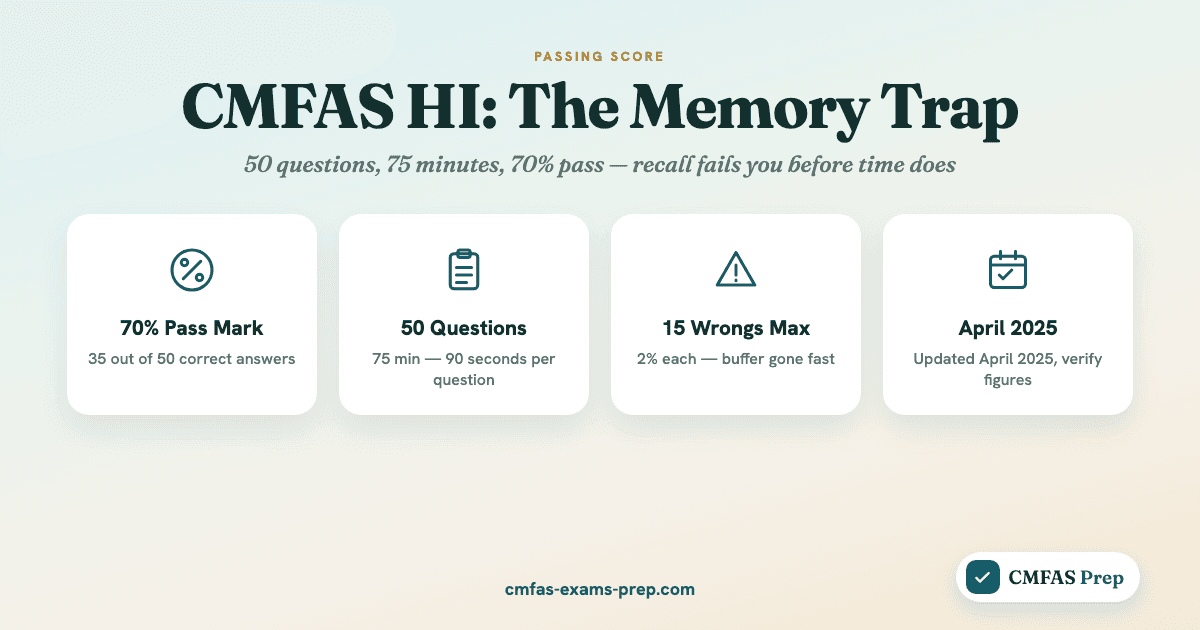
The HI exam is 50 multiple-choice questions in 75 minutes, and you pass at 70 percent, which is 35 correct answers. On paper that gives you 90 seconds per question, which feels roomy next to something like M9A. The catch is that time was never the thing standing between you and a pass. Recall is.
Health Insurance rewards people who memorised the right number and quietly punishes people who understood the concept but blanked on the figure. You either remember that the MediShield Life claim limit for daily ward and treatment charges is built around a fixed cap, or you stare at the screen with 60 seconds to spare and no way to reason your way to it. Extra minutes do not manufacture a number you never learned.
Here is how the format actually works, where candidates lose marks, and how to study so the figures are there when you need them.
The numbers that define the exam
- Questions: 50, all multiple choice
- Duration: 75 minutes (1 hour 15 minutes)
- Pass mark: 70 percent, so 35 out of 50
- Weight per question: 2 percent each
- Margin for error: 15 wrong answers
Full exam details are on the HI exam page. The figure that should change your study plan is the last one. Fifteen mistakes is your entire buffer, and it disappears faster than most people expect.
Why 2 percent per question is a trap, not a cushion
A 50-question paper sounds easier than a 100-question one because there is less to read. The opposite is true for your safety net. Every question is worth a full 2 percent, so a cluster of wrong answers in one weak topic can end your attempt before you reach the back half of the paper.
Picture a candidate who is shaky on medical expense insurance and the claim mechanics that sit under it. If the paper hands them eight calculation questions in that area and they get six wrong, that is 12 percent gone from a 30 percent allowance. They now need to be near-perfect on everything else. The math chapters are not optional, and you cannot treat them as questions to skip and come back to. There aren't enough easy marks elsewhere to carry the gap.
If you want to see where your weak topics actually are before exam day, run a timed set on CMFAS Prep and look at the per-topic breakdown rather than the overall score.
The hospital bill question, step by step
The format that catches the most people is the claims scenario. You get a short case with a patient, a hospital stay, a bill, and a policy, and you compute the payout. Something like:
A Singaporean is warded in a private hospital for five days. The bill is $20,000. His Integrated Shield Plan carries a $3,500 deductible and 10 percent co-insurance. What does he get back?
The trap is not the arithmetic. It is the sequence and the hidden checks. Three things sink answers here.
First, pro-ration. A private hospital bill for a plan benchmarked to a lower ward type gets scaled down before anything else happens. Apply the wrong pro-ration factor and every figure after it is wrong, even if your deductible and co-insurance steps are flawless.
Second, order of operations. The chain runs bill, then pro-ration, then deductible, then co-insurance, then payout. Swap the deductible and co-insurance steps and you land on a clean-looking number that is simply incorrect. The exam writes distractor options that match those common mistakes, so a wrong method often has a matching wrong answer waiting for you.
Third, the MediShield Life limits. Daily and per-treatment claim caps still apply underneath the Integrated Shield Plan, so a high daily charge can be trimmed to the cap before your other deductions even begin. Skip that check and you over-claim.
These questions are pattern work. Once you have drilled the same sequence 30 or 40 times, your hand moves through bill, pro-ration, deductible, co-insurance without conscious effort, and you spend your thinking time on the one detail that varies. The HI calculation drills on CMFAS Prep exist for exactly this, and there is a free mini mock if you want to test yourself on the current syllabus before committing study hours.
Logistics worth knowing before the day
There is no negative marking. A blank and a wrong answer cost you the same, so never leave a question empty. If you are stuck on a claim limit you cannot recall, pick the most reasonable option and move on. A guess on a four-option question is a 25 percent shot at 2 percent you would otherwise forfeit.
The case study material tends to land near the end of the paper. These questions take longer because you are reading a client's existing arrangement, often something like portable medical benefits or group cover from an employer, and deciding what gap a rider or plan should fill. Hold back 15 to 20 minutes for them so you are not rushing the questions that carry the most reading.
How to study for a recall exam
Concept-level understanding is necessary but not sufficient here. The exam tests whether you have the exact figure, and the figures are the part candidates most often get wrong. Two questions decide a lot of marks:
- Is the deductible $3,000 or $3,500 for this ward and plan type?
- Is the co-insurance 10 percent or 5 percent?
Get the layer wrong and a correctly sequenced calculation still produces a wrong payout. This is why your material has to reflect the current rules. The Health Insurance syllabus and the underlying figures were updated in April 2025, so any notes or question banks built before that date can have you memorising numbers that are no longer correct. Studying hard from stale material is worse than not studying that topic at all, because you walk in confident and wrong. Confirm the current figures against the SCI exam page for HI and make sure whatever you practise on matches.
A study sequence that works for this paper:
- Learn the claim mechanics as a fixed procedure, not a set of facts to recombine
- Memorise the current deductible, co-insurance, and MediShield Life cap figures as flashcard-style recall
- Drill bill scenarios under a timer until the sequence is automatic
- Sit a full 50-question mock at exam length so the case studies at the end do not surprise you
For a wider look at where the difficulty really sits and how candidates plan their revision, the HI mock exam comparison walks through what to practise and in what order.
Practise the calculations until the numbers are automatic
The HI exam is won on recall and clean procedure, not reading speed. If you can produce the right deductible, the right pro-ration factor, and the right claim cap without pausing to think, the 75 minutes are more than enough.
Run timed HI drills and a full-length mock on CMFAS Prep to check your figures against the current syllabus, then book your slot once your mock scores are clearing 70 percent with room to spare.
Practise HI now
800+ exam-style HI questions with instant explanations.
Frequently asked questions
The passing score is **70%**. Since there are 50 questions, you must answer at least **35 questions** correctly. Scoring 34/50 (68%) results in a fail.
No. HI is a closed-book exam. You are not allowed to bring any notes, summaries, or cheat sheets into the exam center. You must memorize all claim limits and deductibles.
Yes. A significant portion of the exam involves calculating hospital bill payouts (Pro-ration, Deductibles, Co-insurance). SCI does not provide calculators, so bring an approved model (e.g., Casio FC 100V).
You have **1 hour and 15 minutes** (75 minutes). This gives you approximately 1.5 minutes per question, which is generally sufficient if you have memorized the content well.
No. While there are definition questions (e.g., "What is a Moratorium?"), many are application-based, requiring you to calculate dollar amounts or choose the correct policy for a specific client scenario.