MediShield Life vs Integrated Shield plan: the HI basics
MediShield Life vs Integrated Shield plan for the HI exam: who is covered, MediSave limits by age, minimum deductibles and the April 2026 rider rules.
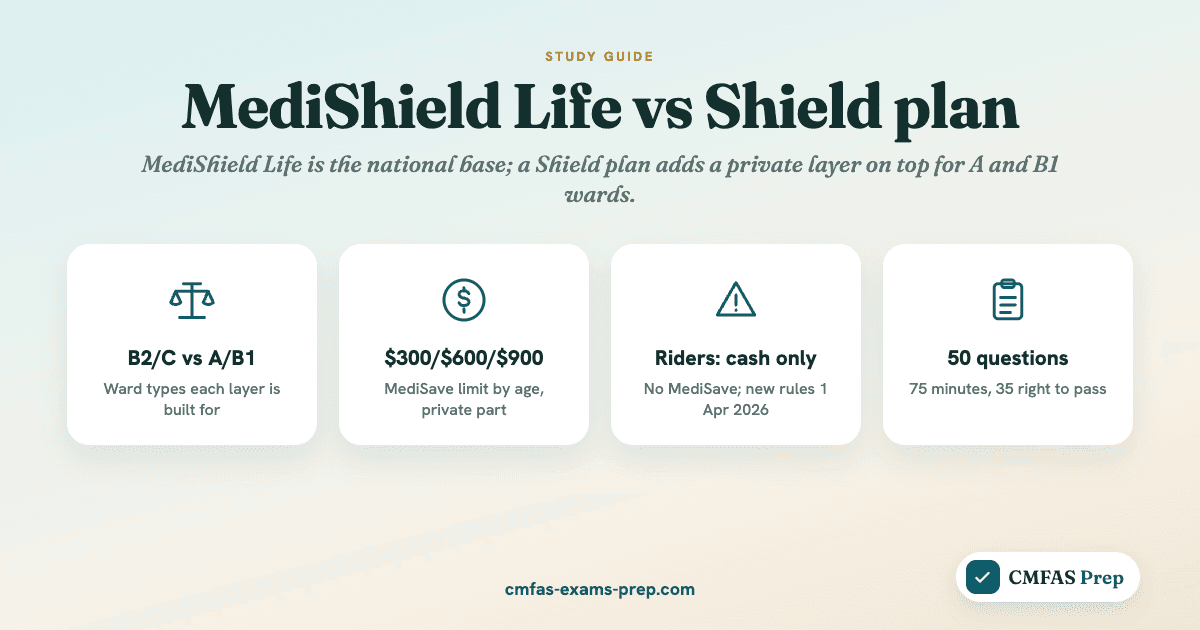
MediShield Life vs an Integrated Shield plan comes down to this: MediShield Life is the basic national cover every Singapore Citizen and PR has for life, sized for B2 and C wards. An Integrated Shield plan keeps that MediShield Life cover and adds a private insurer's layer on top, for A and B1 wards or private hospitals. Riders sit above both, and you pay for them in cash.
The two side by side
| MediShield Life | Integrated Shield plan | |
|---|---|---|
| Who has it | Every Citizen and PR, for life, whatever their age or health | Anyone who chooses to buy one |
| Who provides it | The national scheme | A private insurer, with MediShield Life inside |
| Wards it's built for | B2 and C in public hospitals | A or B1 in public hospitals, or private hospitals |
| Premiums | Fully payable from MediSave | MediShield Life part from MediSave; private part from MediSave up to a limit, then cash |
| How many | One each, automatically | One plan at a time |
| Yearly claim cap | $200,000 a policy year | Set by each insurer |
The HI paper can test any row of this table, often inside a client scenario. Chapter 1 covers the healthcare environment, chapter 2 medical expense insurance and chapter 9 healthcare financing, and Shield plan questions draw on all three.
A Shield plan contains MediShield Life
People who own an Integrated Shield plan sometimes think they've swapped out of MediShield Life. They haven't. CPF describes the plan as two parts: the MediShield Life component and an additional private insurance component. The private insurer handles premiums and claims for both, so the client deals with one company, but the national cover is still underneath.
That's why a question asking "what does the client lose by cancelling the Shield plan?" has a short answer. They lose the private layer and keep MediShield Life, because MediShield Life covers every Citizen and PR regardless of age or pre-existing conditions.
The private layer buys choice. CPF lists access to A and B1 wards and private hospitals, and the freedom to pick your own doctor or see a specialist without a referral. For someone happy in a B2 or C ward, CPF says MediShield Life with subsidies of up to 80% is enough.
Paying for it: MediSave and the Additional Withdrawal Limits
The MediShield Life part of any premium comes fully out of MediSave. The private part can use MediSave only up to an Additional Withdrawal Limit, set by the policyholder's age next birthday.
| Age next birthday | Most MediSave can pay toward the private part each year |
|---|---|
| 40 and below | $300 |
| 41 to 70 | $600 |
| 71 and above | $900 |
Anything above the limit is cash. A worked example of our own: a client who turns 45 at their next birthday has a private component of $1,000 for the year. MediSave pays $600 of it and the client pays $400 in cash. Exam questions like to give a current age and let you forget that the limit runs on age next birthday.
CPF also warns that Shield plan premiums climb with age and can reach five times MediShield Life premiums for people in their 70s and 80s. That's a suitability point as much as an exam one.
Deductibles: the first slice of every bill
A deductible is a fixed amount the patient pays before insurance pays anything, once per policy year. MOH sets a minimum deductible for every Shield plan, and as of November 2025 it runs by ward class:
| Ward class | Minimum Shield plan deductible |
|---|---|
| Class A or private | $3,500 |
| Class B1 | $2,500 |
| Class B2 | $2,000 |
| Class C | $1,500 |
The deductible that applies is the lower of two: the ward the plan is built for, and the ward the patient actually used. MOH's own example is a plan aimed at B1 wards. A patient on that plan who stays in B2 faces a $2,000 deductible, not $2,500. MOH also notes the deductible and co-payment can be paid from MediSave, within the usual withdrawal limits.
Riders, and what changed on 1 April 2026
A rider is an optional add-on to a Shield plan that cuts the cash a patient pays on admission. MOH is blunt about two things: rider premiums must be paid fully in cash, and they rise steeply with age.
The rules for new riders changed on 1 April 2026:
- A new rider can no longer cover the minimum Shield plan deductible. The patient pays that part.
- The patient still co-pays at least 5% of the bill. That rule didn't change.
- The cap on yearly co-payment rose to at least $6,000, up from the $3,000 minimum set in 2018. The cap excludes the deductible and applies to claims such as panel or pre-authorised ones.
Insurers stopped selling riders that break these rules on 1 April 2026. Anyone who bought an old-style rider from 27 November 2025 onward moves to a compliant rider no later than their next renewal after 1 April 2028. For riders bought before that date, each insurer decides its own approach. MOH says all seven Shield plan insurers have launched new riders, and that premiums for the new riders with maximum cover average about 35% to 40% lower than the old ones.
If your HI study text describes riders that pay the whole deductible, it was written before these changes. Answer the exam from the text you were given, and use the current rules with clients. Our note on where the study text is out of date explains how to handle that split.
Where CareShield Life fits
CareShield Life isn't hospital insurance. It's long-term care insurance that pays monthly cash for life once an MOH-accredited assessor finds you can't do 3 of the 6 activities of daily living. People born in 1980 or later are covered automatically, while people born in 1979 or earlier could choose to join. Expect the HI paper to put it next to MediShield Life in a question to see if you'll mix up a hospital bill with a care need. Our HI study plan goes through it with the other schemes.
A practice question in the HI style
This one is ours, written for this guide.
Mr Lim turns 52 at his next birthday. He holds a private hospital Integrated Shield plan and a rider. Which premium must he pay entirely in cash?
- A) The MediShield Life component
- B) The private component, up to $600
- C) The rider
- D) None of them, since MediSave covers all three
The answer is C. MediSave pays the whole MediShield Life component, and up to $600 of the private component at his age band. The rider gets nothing from MediSave. Option D catches people who know MediSave can pay "Shield plan premiums" and stop reading there.
More worked HI questions, including the bill arithmetic, are in our HI sample questions.
Get it right under time pressure
HI gives you 50 questions in 75 minutes and you need 35 right, so a Shield plan scenario can't take five minutes. Learn the comparison table above until you can write it out, then practise on timed questions. The HI paper page has a free sample question from our bank, and when you're ready you can start HI as a single paper.
Sources
- MOH, MediShield Life, read 12 October 2026
- MOH, MediShield Life benefits and claim limits, read 12 October 2026
- CPF Board, Integrated Shield Plan, read 12 October 2026
- MOH, new Integrated Shield Plan riders, read 12 October 2026
- MOH, new requirements for Integrated Shield Plan riders (26 November 2025), read 12 October 2026
- CPF Board, CareShield Life, read 12 October 2026
- SCI, Health Insurance (HI) exam details, read 12 October 2026
Practise HI now
350+ exam-style HI questions with instant explanations.
Frequently asked questions
No. An Integrated Shield plan contains MediShield Life and adds a private insurer's cover for A or B1 wards in public hospitals and for private hospitals.
The MediShield Life part, fully. The private part only up to the Additional Withdrawal Limit for your age next birthday: $300 at 40 and below, $600 from 41 to 70 and $900 from 71. The rest is cash.
No. MOH says rider premiums must be paid fully in cash.
New riders can no longer cover the minimum Shield plan deductible, and the yearly co-payment cap rose to at least $6,000. The minimum 5% co-payment did not change.
No. CPF says you can only be covered by one Integrated Shield plan at a time.