PGI sample questions: motor, travel and home scenarios to try
Four PGI mock questions on motor excess, subrogation, property and travel baggage, with answers and explanations, so you know where you stand.
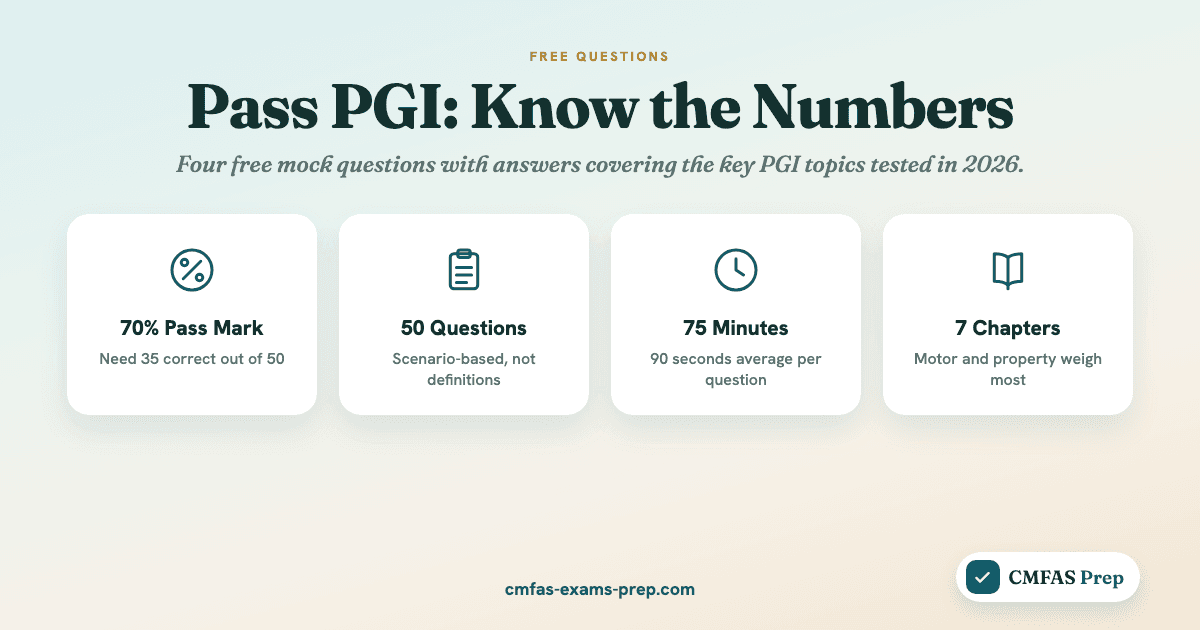
Here are four free PGI mock exam questions for 2026, each with the answer and a short explanation, so you can test where you actually stand before booking the Personal General Insurance paper. They cover the four areas that come up most: property cover, motor excess, subrogation, and travel baggage claims.
Most candidates underestimate PGI because the products feel familiar. You renew car insurance every year. You bought travel cover for your last trip. You may have home contents cover tied to your HDB flat. The exam asks you to explain what those policies pay, what they refuse, and why. That is a different skill from owning the policy, and it is where people lose marks.
PGI sits closer to daily client work than the more theory-heavy papers. The questions tend to describe a situation and ask what the insurer can or cannot do, rather than asking for a textbook definition. If you can talk a confused customer through their own policy, you can pass. The four questions below are built the same way the real ones are.
Question 1: personal property insurance (chapter 2)
A home contents policy must cover every peril that could possibly damage the insured property. True or false?
A) False B) True
Answer: A) False
Property insurance is a contract of indemnity. Within the limits of applicable law, regulation, and policy wording, an insurer designs its own product. It chooses which perils to insure, which to exclude, and what conditions apply. That freedom is why two home policies priced similarly can pay out very differently.
Two structures show up in the syllabus. A named perils policy pays only for events listed in the wording, such as fire, lightning, or explosion. An all-risks policy works the other way: it pays for any loss except the perils the wording specifically excludes. Knowing which structure a client holds tells you, before any claim, whether a given loss has a chance of being paid.
This is also the practical reason a representative compares products instead of quoting one price. When a customer asks why one home policy costs more, the honest answer is usually that it covers perils the cheaper one leaves out.
Question 2: private motor car insurance (chapter 1)
A motorist carries a $500 excess and suffers $2,000 of accident damage. What does that excess represent?
A) The first $500 of each loss, which she bears herself B) The most the insurer will pay on any single claim C) A premium refund she earns by staying claim-free D) An amount the insurer adds on top when settling
Answer: A) The first $500 of each loss, which she bears herself
An excess is the slice of every loss the insured pays first, before the insurer pays anything. That portion is not recoverable under the policy.
Work a number through it. Say your excess is $500 and you claim for $2,000 of damage. You pay the first $500. The insurer pays the remaining $1,500. The excess applies to each claim, not once per policy year.
Excesses exist for plain commercial reasons. They remove tiny claims that cost more to process than to pay, they give the insured a reason to drive carefully, and they hold premiums down. In Singapore, drivers under a set age often carry an additional young or inexperienced driver excess on top of the standard one, because their loss record is statistically worse. Being able to explain that to a 24-year-old buying their first policy is exactly the kind of thing PGI is checking.
One distinction the exam likes: excess is not the same as a franchise. An excess is deducted from every claim. A franchise is a threshold, and once a loss crosses it, the insurer pays the whole amount.
You can drill motor questions like this one, with the answer and reasoning shown straight after each attempt, on CMFAS Prep.
Question 3: subrogation (chapter 5)
An insurer pays its policyholder for damage a careless third party caused. Which principle lets the insurer recover that payout from the third party?
A) Contribution, because more than one party bears the loss B) Disclosure, because circumstances changed after the claim C) Subrogation, because the insurer steps into the insured's position D) Utmost good faith, because the third party acted carelessly
Answer: C) Subrogation, because the insurer steps into the insured's position
Subrogation is the insurer's right, after it has paid the insured for a loss caused by someone else, to step into the insured's position and recover that money from the party at fault.
The sequence runs like this. A third party causes the damage. The insurer pays its policyholder's claim. The insurer then chases the third party, suing in the insured's name if it has to, to get its payout back. The point is to stop the insured collecting twice for one loss, once from the insurer and again from the person who caused it.
The wrong options are real principles wearing the wrong label. Contribution shares a loss between two insurers covering the same risk. Disclosure is a duty the insured owes, and gives no recovery right. Utmost good faith governs how the contract is formed in the first place. The exam mixes these on purpose, because a candidate who has only memorised the word "subrogation" will recognise it without being able to rule out the lookalikes.
In real claims work, subrogation is why the first question after an accident is "was anyone else at fault?" The answer decides whether the insurer has someone to recover from.
You can focus on one chapter at a time using the practice-by-chapter mode in CMFAS Prep, which is the fastest way to clear a topic you keep getting wrong.
Question 4: travel insurance (chapter 4)
A traveller returns home with a suitcase the airline cracked in transit. Which of these losses would her policy's personal baggage benefit normally pay?
A) Repair of the damaged suitcase, up to the policy limit B) A camera stolen after she left it on a cafe table C) A porcelain vase that shattered inside the case D) A bag she shipped home separately before flying
Answer: A) Repair of the damaged suitcase, up to the policy limit
The baggage benefit exists for exactly this case: luggage lost or damaged in transit gets repaired or replaced, capped at the policy limit and subject to the policy's conditions.
The other three are standard exclusions, and they are the reason travel claims get rejected. Fragile or brittle items are excluded because they break too easily to insure cleanly. Unattended baggage is excluded because the insured is expected to take reasonable care of their belongings. Baggage sent in advance is excluded because it sits outside the insured's control during the journey. Items left in unlocked vehicles and valuables not carried in hand luggage usually fall away for the same reasons.
The lesson the syllabus wants here is that "travel insurance" does not mean "everything is covered." A representative who knows the exclusion list can set a customer's expectations before the trip instead of arguing with them after a rejected claim.
The exam you are preparing for
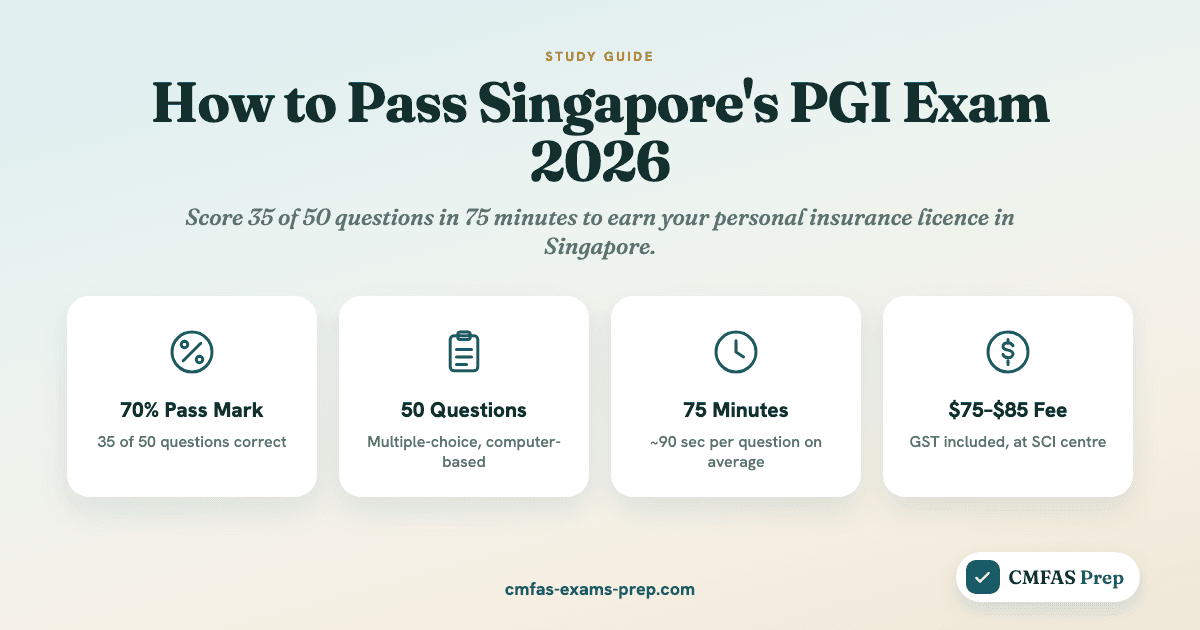
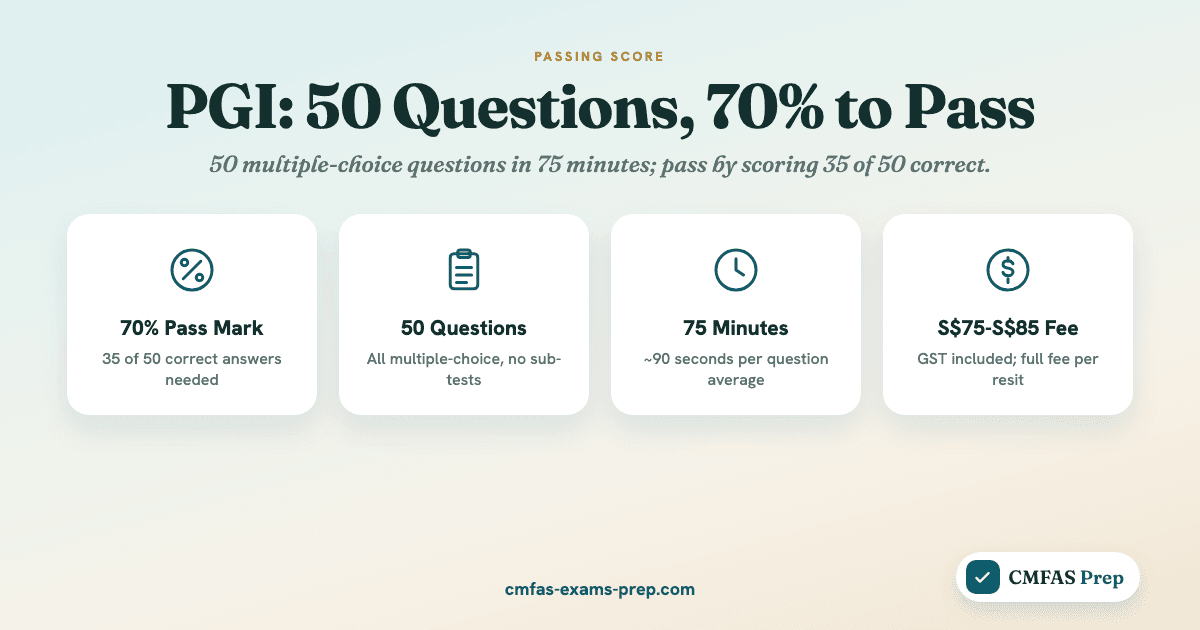
PGI is 50 questions in 75 minutes. That is 90 seconds per question, which is comfortable as long as you do not stall on the scenario wording. The pass mark is 70%, so you need 35 correct and can afford 15 wrong.
The questions lean on application rather than recall. Instead of "define subrogation," you get a fact pattern and a question about what the insurer is entitled to do next. Practising loose definitions is not enough. You need reps reading short scenarios and picking the right action under a clock.
How the chapters map to products
PGI is organised by product, not by abstract concept. Each chapter is something a representative actually sells.
| Chapter | Product | Where you see it |
|---|---|---|
| 1 | Private motor car insurance | Singapore's most common cover |
| 2 | Personal property insurance | HDB and condo home cover |
| 3 | Personal accident insurance | PA riders on life policies |
| 4 | Travel insurance | Bought before each trip |
| 5 | Personal liability insurance | Damage or injury you cause |
| 6 | Health insurance | Critical illness, hospital cash |
| 7 | FDW and golfer's insurance | Niche, still tested |
Motor (chapter 1) is the heaviest because it is the product sold most. If you are short on study time, secure motor and property first, then work outward. Do not skip chapter 7. It is small, but it still appears, and easy marks there cover for a harder question elsewhere.
Where to go next
If you have already cleared BCP, PGI is the natural follow-on. The principles you learned there, indemnity, excess, subrogation, get applied to specific products here. Our guide on how to pass the PGI exam shows how to build on that base, and the PGI passing score and exam format breakdown walks through the 50-question, 75-minute structure in detail.
When you are ready to put in real reps, work through the question bank at app.cmfas-exams-prep.com. Sit a few timed mock papers, read the explanation after every question, and keep practising the chapters where your score is lowest until 70% stops feeling close.
Practise PGI now
800+ exam-style PGI questions with instant explanations.
Frequently asked questions
Yes, these questions are designed to mirror the style and format of actual PGI exam questions. They cover key topics including Motor Insurance, Property Insurance, Travel Insurance, and Liability Insurance—all important areas in the syllabus.
We recommend practicing at least 150-200 unique questions before the exam. Focus on all 7 chapters, with extra attention to Chapter 1 (Motor Insurance) which tends to have slightly more questions.
Excess (deductible) is a fixed amount deducted from every claim payment. Franchise is a threshold—if the loss exceeds it, the full amount is paid; if below, nothing is paid. Both concepts are tested in PGI and BCP.
Chapter 1 (Private Motor Car Insurance) tends to have slightly more questions as it is a core personal lines product. Chapter 7 (FDW and Golfer Insurance) has fewer questions. Other chapters are fairly evenly distributed.
PGI covers Personal General Insurance products (motor, travel, personal accident, property, etc.) while ComGI covers Commercial General Insurance products (business property, liability, marine, construction, etc.). Both have 50 questions in 75 minutes with a 70% passing score.
Yes, our platform is fully mobile-optimized. You can practice PGI questions during your commute or breaks, making it easy to fit study time into your schedule.