ComGI sample questions: commercial cover scenarios to try
Four free ComGI sample questions on fire insurance, business interruption, bonds, and fidelity guarantee, with worked answers to check your reasoning.
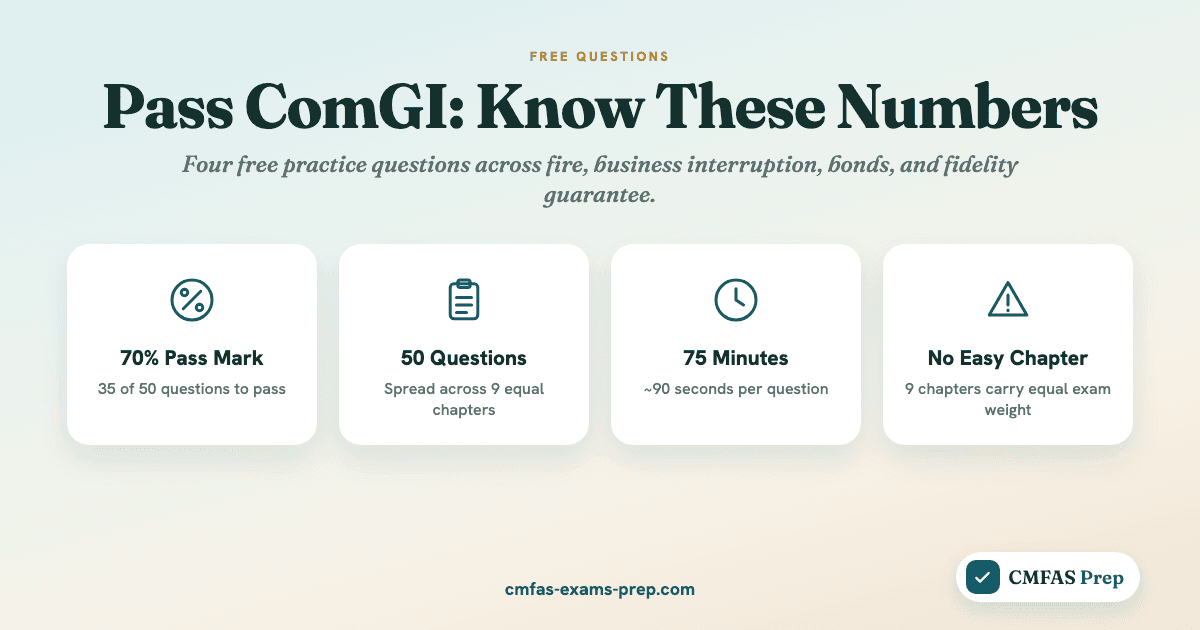
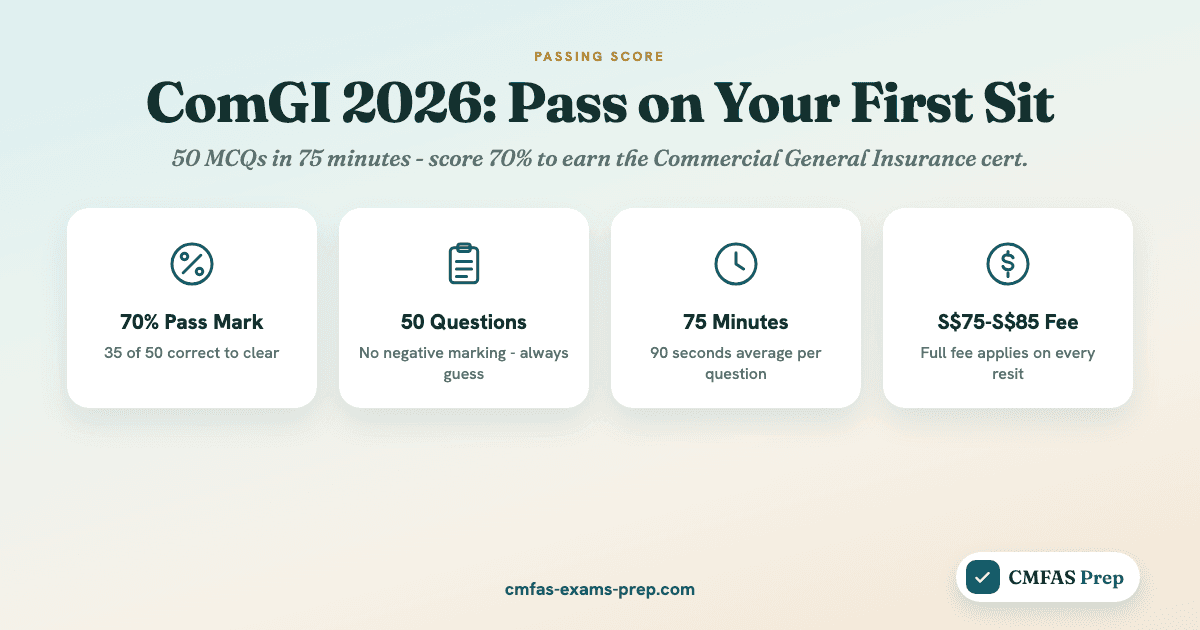
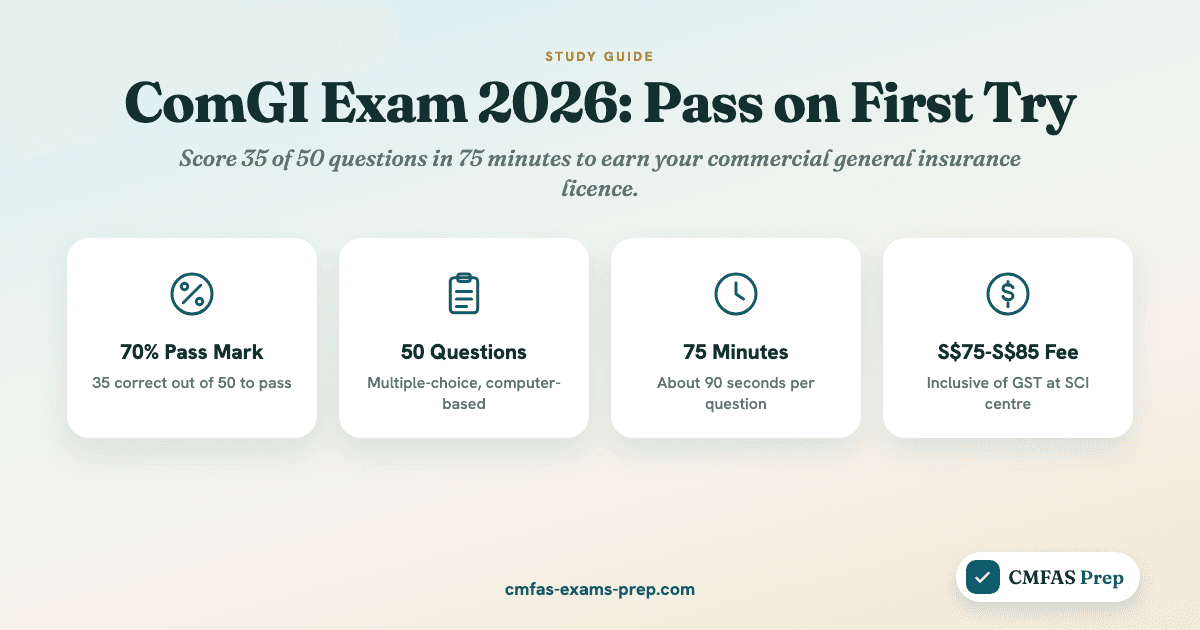
Here are four free ComGI practice questions with worked answers, covering fire insurance, business interruption, bonds, and fidelity guarantee. Work through each one before you read the explanation, then check where your reasoning broke down. The ComGI exam gives you 50 questions in 75 minutes and asks for 70% to pass, so the habit of reading a question carefully and eliminating wrong options is worth more than memorising answers.
ComGI sits under the Commercial General Insurance (CGI) module of the SCI certification, and it expects you to think about cover for businesses rather than individuals. The sums are larger, the parties are more numerous, and a few concepts (bonds, business interruption, fidelity guarantee) have no real equivalent on the personal side. The four questions below each come from a different chapter, so they give you a quick read on which parts of the syllabus you already hold and which need another pass.
Question 1: fire insurance policy period
A standard fire insurance policy runs for what period of insurance?
A) 24 months B) 18 months C) 6 months D) 12 months
Correct answer: D, 12 months.
Fire policies are written annually. The cover, the sum insured, and the premium are all set for one year, and the policy comes up for renewal at the end of that term. That annual cycle is the reason a few other things line up the way they do.
Premiums are quoted as annual rates, so any mid-term change (a new building, higher stock values) is handled by an endorsement and an adjusted premium, not a fresh policy. Sums insured also get reviewed at renewal, which matters because property values and rebuilding costs drift upward. If a business sets a sum insured once and never revisits it, underinsurance creeps in and the average condition can cut the eventual payout.
The trap here is overthinking it. Some candidates assume large commercial risks must run on longer multi-year terms. They usually do not. Long-term agreements exist in specific arrangements, but the default period you are tested on is one year.
Question 2: payroll under business interruption
Under current market practice, what percentage of payroll is usually insured in a business interruption policy?
A) 75% B) 50% C) 25% D) 100%
Correct answer: D, 100%.
Business interruption cover responds when a business cannot trade normally after an insured event, such as a fire that shuts the premises. It pays for the loss of gross profit and the standing costs that keep running while income drops. Payroll is one of those standing costs, and the usual practice now is to insure it at the full 100%.
The logic is practical. If a factory burns down, the firm still wants to keep its trained staff on the books so it can restart quickly once the premises are rebuilt. Letting skilled people go and rehiring later costs more time and money than carrying the wage bill through the shutdown. Insuring the whole payroll covers that decision.
There is an older approach called dual basis payroll, where part of the wage bill is insured for the full indemnity period and the rest only for a shorter initial number of weeks. That structure still exists for businesses that expect to shed some staff quickly in a long shutdown. But unless the policy is specifically arranged that way, treat 100% as the standard answer.
If business interruption is where your reasoning slipped, that is common, and it rewards focused drilling. The Practice by Chapter mode on CMFAS Prep lets you sit only on the business interruption chapter until the gross-profit and standing-cost mechanics feel automatic.
Question 3: who guarantees the insurer on a bond
During a training session, a junior underwriter learns that certain parties promise to reimburse the insurer for any loss it pays out when a bond is called. These parties are:
A) Counter guarantors B) Brokers C) Reinsurers D) Recovery agents
Correct answer: A, counter guarantors.
Bonds work differently from a normal insurance policy, and that difference is the whole point of this question. A bond involves three parties: the principal (often a contractor), the beneficiary (the project owner who is protected), and the insurer who issues the bond. Common examples are performance bonds and bid bonds, which assure the project owner that the contractor will deliver.
When the insurer issues a bond, it wants its own protection in case it has to pay. That protection comes from a counter guarantor, who signs a counter-indemnity. If the bond is called and the insurer pays the beneficiary, the counter guarantor must pay the insurer back. In practice the counter guarantor is usually the principal itself, and sometimes its directors or a parent company stand behind it too.
The wrong options each describe a real role that is not this one. A broker arranges and places the cover but does not promise to reimburse losses. A reinsurer insures the insurer against its own portfolio losses, which is a separate relationship from a bond counter-indemnity. A recovery agent chases money after a loss has been paid rather than guaranteeing it in advance. The skill the exam is testing is keeping these party roles straight.
Question 4: offset under a fidelity guarantee policy
A fidelity guarantee policy covers an employer against loss from a dishonest employee. When a claim is paid, whose money must the employer hold back and set against the loss?
A) Broker B) Defaulting employee C) Loss adjuster D) Insurer
Correct answer: B, the defaulting employee.
Fidelity guarantee insurance pays an employer when an employee commits fraud or theft. The policy carries a condition that the employer must retain any money it still owes the dishonest employee and deduct that amount from the claim. The point is to stop the employer recovering twice for the same loss.
Say an employee embezzles 50,000 dollars. At the time the fraud is discovered, the employer still owes that person 5,000 dollars in unpaid salary, commission, and accrued leave. The employer must hold that 5,000, set it against the loss, and claim the balance from the insurer. The insurer then pays 45,000, less any policy excess. The retained pay is the employer's own first slice of recovery from the wrongdoer.
This is the indemnity principle showing up in a commercial setting. Indemnity puts the insured back in the position they were in before the loss, no better. Because cash moves between several parties in a fidelity claim, the offset rule is how the policy keeps the payout honest. CMFAS Prep shows the explanation right after you answer, so when an offset question like this catches you, you see the reasoning while it still stings.
How to read your four results
If you answered all four without hesitation, you are close to mock-exam ready and should move to full timed papers across all nine chapters. If two or more tripped you up, you have specific chapters to rebuild rather than a vague sense of being underprepared, which is the more useful position to be in.
The four questions map onto four different parts of the syllabus:
- Fire insurance policy period sits in the property chapter and tests standard policy terms.
- The payroll question is business interruption and tests market practice, not a formula.
- Counter guarantors come from the construction and bonds chapter and test party roles.
- The fidelity guarantee offset is pecuniary insurance and tests the indemnity principle.
ComGI spreads its questions fairly evenly across the nine chapters, so you cannot rely on one dominant topic carrying you the way motor insurance can on a personal lines paper. Liability, marine, and engineering are not represented in these four questions, and they carry just as much weight on the day. That even spread is why working chapter by chapter, and tracking which chapters keep losing you marks, beats grinding through random questions. The performance-by-chapter view on CMFAS Prep does that tracking for you, and its recommendation engine then feeds you more questions from your weakest chapters after each mock.
For the full picture of what the day looks like, the ComGI passing score and format guide breaks down the 50 questions, 75-minute limit, and 70% mark. If you want a chapter-by-chapter study plan rather than scattered practice, the guide to passing ComGI lays one out.
When you are ready for volume, open the ComGI question bank and sit a few timed sets. Practising under the clock, then reading the explanation on every question you miss, is the part that moves your score.
Practise ComGI now
800+ exam-style ComGI questions with instant explanations.
Frequently asked questions
Yes, these questions are designed to mirror the style and format of actual ComGI exam questions. They cover key topics from the syllabus including Property Insurance, Business Interruption, Bonds, and Pecuniary Insurance.
We recommend practicing at least 150-200 unique questions before the exam. Focus on all 9 chapters, with extra attention to Chapters 1, 3, and 4 which tend to have slightly higher question volumes.
While questions are fairly evenly distributed, Chapters 1 (Property Insurance), 3 (Liability Insurance), and 4 (Commercial Motor Insurance) tend to have slightly more questions. However, you should study all 9 chapters thoroughly.
ComGI covers Commercial General Insurance products (property, liability, marine, construction, etc.) while PGI covers Personal General Insurance products (motor, travel, personal accident, etc.). Both have 50 questions in 75 minutes with a 70% passing score.
You do not need to memorize exact policy wordings, but you should understand key policy terms, standard conditions, common exclusions, and current market practices for each type of commercial insurance covered.
Yes, our platform is fully mobile-optimized. You can practice ComGI questions during your commute or breaks, making it easy to fit study time into your schedule.