BCP sample questions: principles and claims scenarios to try
Try four BCP questions on group insurance, indemnity and excess vs franchise, with worked answers, then see how the 40-question exam is marked.
Below are four free BCP practice questions with worked answers, written to match the wording and difficulty of the real Basic Insurance Concepts and Principles paper. Try each one before you read the explanation, then use the rest of this guide to see how the exam is marked and which chapters earn the most marks.
Basic Insurance Concepts and Principles, sat as the BCP exam, is the first paper in the Certification in General Insurance (CGI) framework run by the Singapore College of Insurance. You clear it before moving on to either the personal-lines paper (PGI) or the commercial-lines paper (ComGI). The ideas you meet here, including insurable interest, indemnity, subrogation and proximate cause, come back in every paper after it, so the time you spend now pays off twice.
How the BCP paper is built
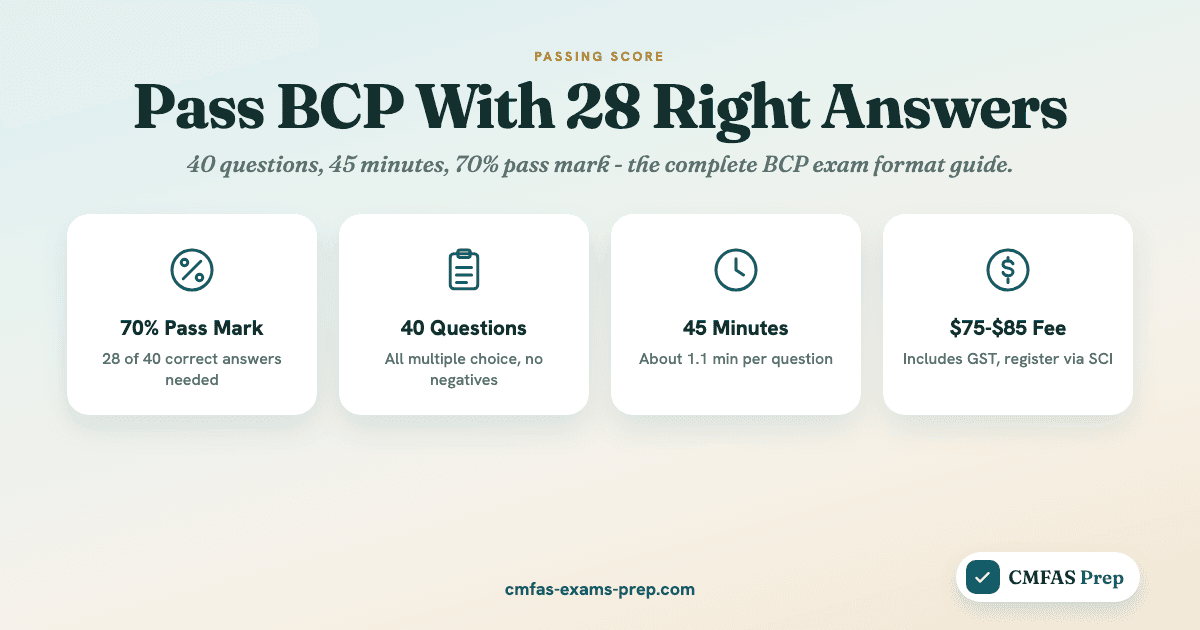
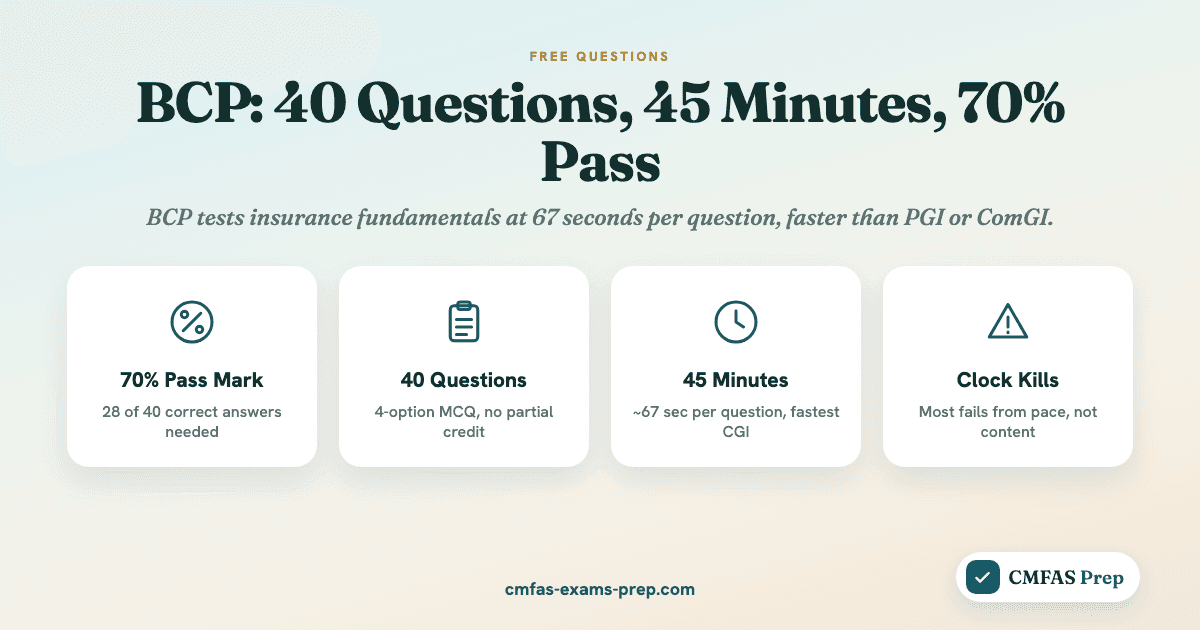
The BCP exam has 40 multiple-choice questions and a 45-minute limit. The pass mark is 70 percent, which means 28 correct answers out of 40. That leaves you about 67 seconds per question, the fastest pace of the three CGI papers.
| Paper | Questions | Time | Seconds per question |
|---|---|---|---|
| BCP | 40 | 45 min | ~67 |
| PGI | 50 | 75 min | ~90 |
| ComGI | 50 | 75 min | ~90 |
The margin sounds generous. You can drop 12 questions and still pass. The trouble is the clock, not the pass mark. Candidates who fail BCP usually knew the material but spent 90 seconds deliberating over questions that needed 30. Speed comes from seeing the same idea phrased a dozen ways until you recognise it on sight. The four questions below are built around the concepts examiners reuse most.
Question 1: group insurance (chapter 3)
An employer buys one group term policy covering its 80 staff. Which statement about this arrangement is FALSE?
A) Cover for a worker ends when he resigns from the company. B) Every worker receives his own full policy document. C) The per-person cost is usually below an equivalent individual policy. D) Workers may be allowed to choose extra cover for dependants.
Answer: B.
Under group insurance, the insurer issues one master policy to the policyholder, normally an employer or an association. Individual members get a certificate of insurance or a benefit schedule, not a full policy contract. So the statement that every member receives a policy document is the false one.
The other three describe how group schemes actually run. Cover is tied to membership, so it ends when someone leaves the employer or the association. Premiums per head come in lower than individual cover because the insurer prices the group as one risk. And many schemes let members pick an option, such as adding cover for a spouse or children.
Question 2: indemnity versus benefit (chapter 4)
Which class of insurance pays a fixed sum assured instead of indemnifying a measured financial loss?
A) Marine B) Pecuniary C) Life D) Liability
Answer: C.
Indemnity means putting the insured back in the financial position they held just before the loss, no better and no worse, up to the policy limit. Marine, liability and pecuniary policies all work this way: they pay the actual loss, measured in money.
Life insurance cannot work that way because a life has no measurable money value to restore. Instead it pays a fixed sum assured on death or maturity. That makes it a benefit policy, the same category as personal accident cover. Knowing which policies indemnify a loss and which pay a set benefit is one of the dividing lines BCP tests again and again, and it carries straight into PGI, where motor cover indemnifies but personal accident pays a benefit.
Question 3: excess versus franchise (chapter 7)
A cargo policy carries a $500 threshold clause: a $600 loss is paid in full, but a $400 loss pays nothing at all. Which policy device produces this result?
A) Reinstatement B) Excess C) Indemnity D) Franchise
Answer: D.
A franchise sets a threshold. Cross it and the insurer pays the whole loss; fall short and you get nothing. With a $500 franchise, a $600 claim pays the full $600, while a $400 claim pays zero.
That behaviour is the opposite of an excess, which is the first slice of every claim that the insured carries themselves. With a $500 excess, a $2,000 claim pays $1,500, and the deduction applies no matter how large the claim. Examiners pair these two on purpose because candidates who memorised the words without the mechanics swap them under time pressure. Read the question for the trigger: "paid in full above the line, nothing below it" is always a franchise.
Question 4: consideration (chapter 5)
When a proposer pays the first premium on a new policy, what does that payment amount to in contract terms?
A) The offer B) The acceptance C) The consideration D) The proposal
Answer: C.
Consideration is the thing of value each side gives in exchange for the other's promise. The premium is what the proposer gives for the insurer's promise to pay valid claims, so it is the consideration.
Every insurance policy is a contract, which is why BCP tests the building blocks. A valid contract needs an offer (the completed proposal form), acceptance (the insurer agreeing to take on the risk), consideration (the premium against the insurer's promise), and an intention to create legal relations. One detail trips people up: consideration has to be sufficient but need not be adequate. The law cares that something of value changed hands, not whether the price was fair, and it does not count past consideration given before the promise was made.
Where the marks sit
These four questions come from chapters 3, 4, 5 and 7, and that is not random. Those chapters define what insurance is, set out the principles that govern claims, and explain the contract law underneath every policy. If you are short on study time, start there.
Chapters 1 and 2 cover the market and the regulatory setup. Chapters 8 and 9 cover reinsurance and ethics. They appear in the paper too, with fewer questions, so read them once you are solid on the core. Skipping them outright is a gamble when your pass margin is only 12 questions.
The fastest way to find your own weak chapters is to answer a block of questions per chapter and see where the wrong answers cluster. The practice-by-chapter mode on CMFAS Prep sorts questions that way, and the app marks each answer with the reasoning so a wrong attempt teaches you something instead of just costing a point.
What to do before exam day
Three pieces fit together. Learn the concepts chapter by chapter using the how to pass BCP guide. Confirm the format and pass mark so nothing on the day surprises you with the BCP passing score and exam format breakdown. Then drill questions under the 45-minute clock until the pace feels normal rather than rushed.
After BCP you choose your route. PGI takes you into personal lines such as motor and home. ComGI takes you into commercial lines such as property, marine and liability. Both build directly on the indemnity, contract and claims ideas you just practised, so a strong BCP makes the next paper read like revision.
Common questions about BCP mock questions
Do free BCP sample questions match the real exam? Good ones mirror the format, the four-option structure and the concept mix, which is what trains your recognition. No public set reproduces the live question bank, so treat samples as practice for the type of thinking, not a leak of the actual paper.
How many questions should I practise? Enough that you stop misreading the question stems. Most candidates need a few hundred mixed questions before the wording stops slowing them down. Track your accuracy by chapter rather than counting questions answered.
Is 70 percent hard to reach? The concepts are not difficult once you have seen them framed several ways. The clock is the real test. Practising at exam pace is what separates a comfortable pass from a near miss.
You have read the worked answers; now put them under time pressure. Open the BCP question bank on CMFAS Prep, set the 45-minute timer, and run a full 40-question round to see where you stand.
Practise BCP now
800+ exam-style BCP questions with instant explanations.
Frequently asked questions
Yes, these questions are designed to mirror the style and format of actual BCP exam questions. They cover key topics including Risks & Insurance, Principles of Insurance, Claims, and Law of Contract—all heavily tested areas.
We recommend practicing at least 100-150 unique questions before the exam. Focus on all 9 chapters, with extra attention to Chapters 3, 4, and 5 which tend to have slightly higher question volumes.
Excess (deductible) is a fixed amount deducted from every claim payment. Franchise is a threshold—if the loss exceeds it, the full amount is paid; if below, nothing is paid. This distinction is commonly tested in BCP.
Life insurance is a benefit policy, not an indemnity policy. There's no measurable financial loss to restore—instead, a pre-agreed sum assured is paid on death or maturity. Indemnity policies (marine, liability, pecuniary) only compensate actual losses.
Chapters 3 (Risks & Insurance), 4 (Principles of Insurance), and 5 (Law of Contract and Agency) tend to have more questions as they cover the theoretical foundations of insurance. However, all 9 chapters should be studied.
BCP is more conceptual while PGI and ComGI are more product-specific. BCP has tighter timing (1 min per question vs. 1.5 min) but questions are generally less calculation-heavy. Difficulty depends on your background.