How hard is the ComGI exam? Know before you book
How hard is the ComGI exam? 50 questions in 1 hour 15 minutes, 35 right to pass. The clock is fair; the breadth of business cover is what makes it hard.
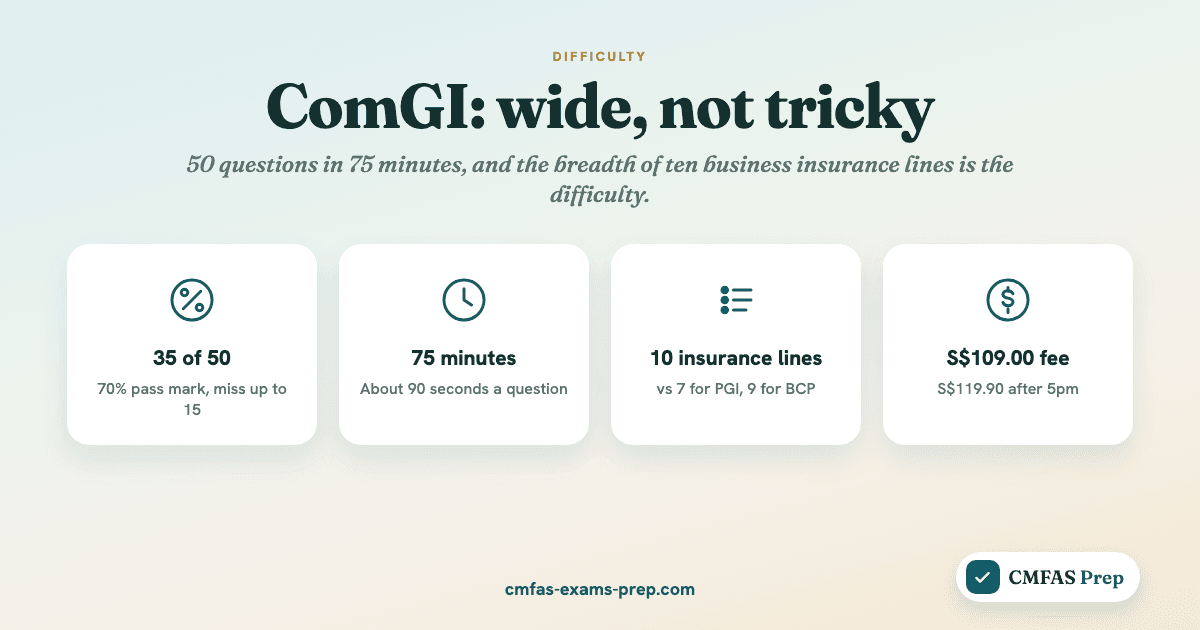
How hard is the ComGI exam? Of SCI's three general insurance papers, it's the widest and the one most recruits find hardest. It has 50 multiple-choice questions in 1 hour 15 minutes, you need 35 right, and the content is business insurance that most people haven't bought: property, liability, marine, construction, bonds and more. The clock is fair. The breadth is the difficulty.
The paper in numbers
| What | ComGI | What it means |
|---|---|---|
| Questions | 50, multiple choice | 15 misses allowed |
| Time | 1 hour 15 minutes | 90 seconds each |
| Pass mark | 70% | 35 correct |
| Wrong or blank answer | Costs no extra mark | Never leave one empty |
| Fee | S$109.00 weekday, S$119.90 after 5pm | A S$10.90 registration fee is inside |
SCI publishes no pass rates, so be wary of any figure you're quoted. The shape of the paper tells you more.
Ten lines of contents
SCI's ComGI contents list property insurance, business interruption, liability and contingency in two parts, commercial motor, marine and aviation, construction, machinery and bond insurance, pecuniary insurance, foreign worker insurance, and group personal accident with corporate travel. That's ten lines, against seven for PGI and nine for BCP.
Each line is a separate product with its own terms. SCI doesn't publish the split of the 50 questions, so assume every line can appear. A candidate who knows eight of ten lines well is leaving questions on the table, and with 15 misses allowed that gap can be the whole margin.
Why unfamiliar cover is harder
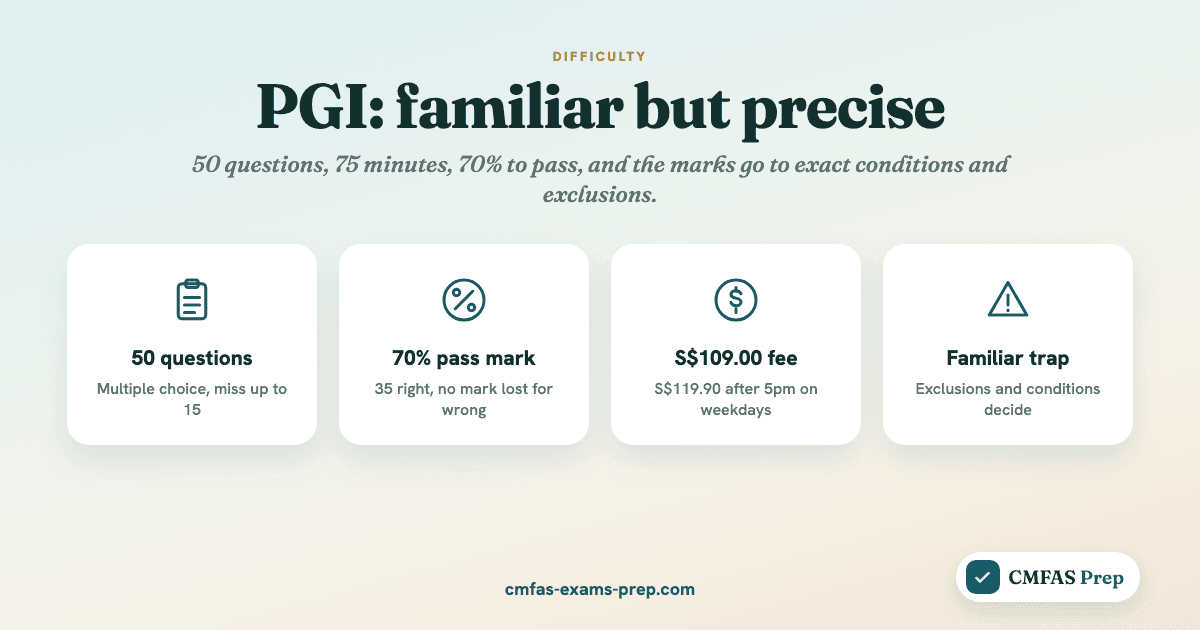
PGI products are ones you've bought. ComGI products are ones a business buys, and unless you've worked in broking, claims or underwriting, you probably haven't touched most of them. Terms like contingency, pecuniary loss and bond insurance sound abstract until you attach a business to them.
A useful trick is to attach one imaginary business to each line. A warehouse for property, a shop that closes after a fire for business interruption, a ship for marine, a building site for construction. When a question describes a loss, you picture the business and ask which cover responds.
Commercial motor deserves its own care because it looks like the personal motor cover you know. SCI treats it as a separate topic, so learn its own terms and don't borrow from personal motor.
Group the ten lines so you can learn them
SCI lists the contents in one run. Grouping them by what they protect makes ten lines feel like five.
| Group | SCI lines | What ties them together |
|---|---|---|
| Premises and profit | Property, business interruption | A business's buildings, stock and lost income |
| Legal exposure | Liability and contingency, parts I and II | What a business owes others |
| Movement | Commercial motor, marine and aviation | Vehicles, ships, aircraft and cargo |
| Projects and money | Construction, machinery and bond; pecuniary | Building works, equipment and financial loss |
| People | Foreign worker; group personal accident and corporate travel | Staff and travellers |
Learn one group a day, and finish with a mixed block of questions so you practise switching between them. Switching is what the real paper asks of you.
Where study time leaks away
Three habits waste hours on a paper this wide. One is rereading the lines you already like, because it feels productive. Another is giving liability and contingency one slot, when SCI splits it into two parts and you should budget for that. The third is saving the people lines, foreign worker and group personal accident with corporate travel, for the last night. They look small beside marine and construction, but SCI lists them with the rest and marks nothing as optional.
A weekly check helps. Every Sunday, list the lines you'd be nervous about if the paper were tomorrow. If the list gets shorter each week, you're on track.
What makes it manageable
- The clock is fair: 90 seconds each, roughly 20 more than BCP allows.
- When you're stuck, guess, because a wrong answer costs only that question.
- Attempts are unlimited and every retake is charged like the first attempt.
- A BCP pass already earned for the personal certification stands for the commercial one too, since SCI treats BCP as common to both.
It also helps that SCI's order puts BCP first. By the time you reach ComGI you should already know indemnity, utmost good faith and the claims process, and ComGI applies them to commercial risks.
Who finds it hardest
Recruits from retail, personal lines or a non-insurance career find it hardest, because every line is new. People who've handled commercial accounts or claims find parts of it easy and still need to cover the lines they haven't touched. If you plan to hold both certifications, we'd sit BCP, then PGI, then ComGI, because PGI is the closer step up. Our general insurance certification guide shows which papers each role needs.
How long to prepare
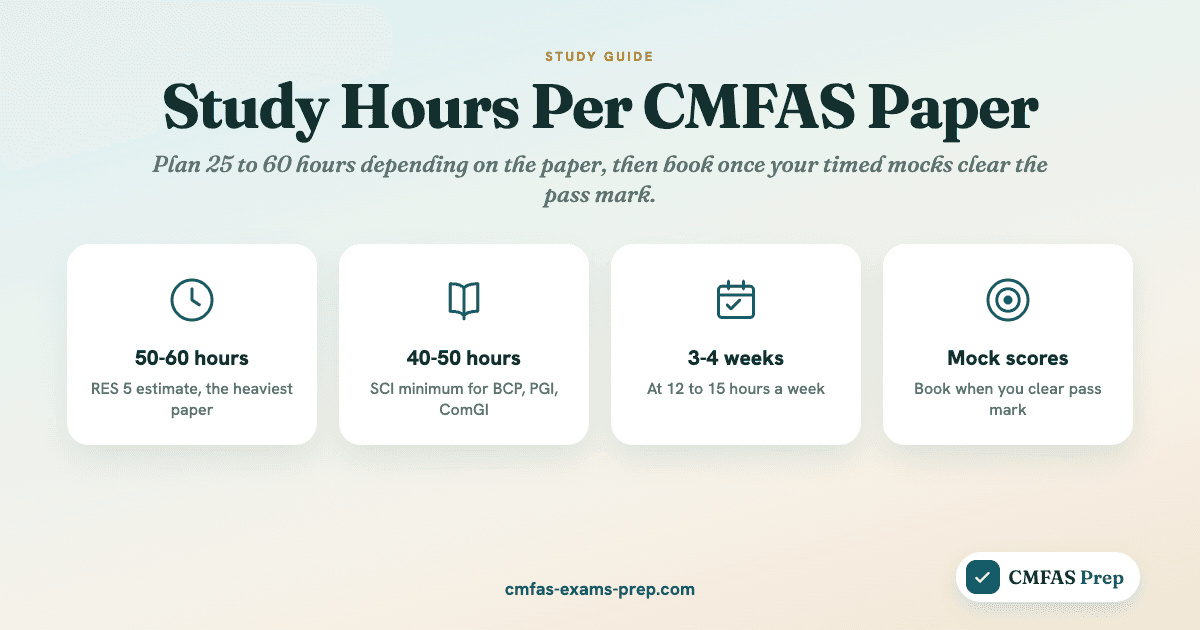
SCI recommends at least 40 to 50 hours per module, and says it depends on you. Over three weeks that's about two to two and a half hours a day. Plan toward the upper end if you're new to commercial cover. The ComGI study plan spreads the work across three weeks.
A sensible first week covers the premises, legal exposure and movement groups, with questions after each. The second takes on projects, money and people. Keep the last week for full timed mocks and for the lines that keep scoring low. Don't start mocks in week one: you'll score badly on lines you haven't read, and the number will mislead you.
How to tell you're ready to book
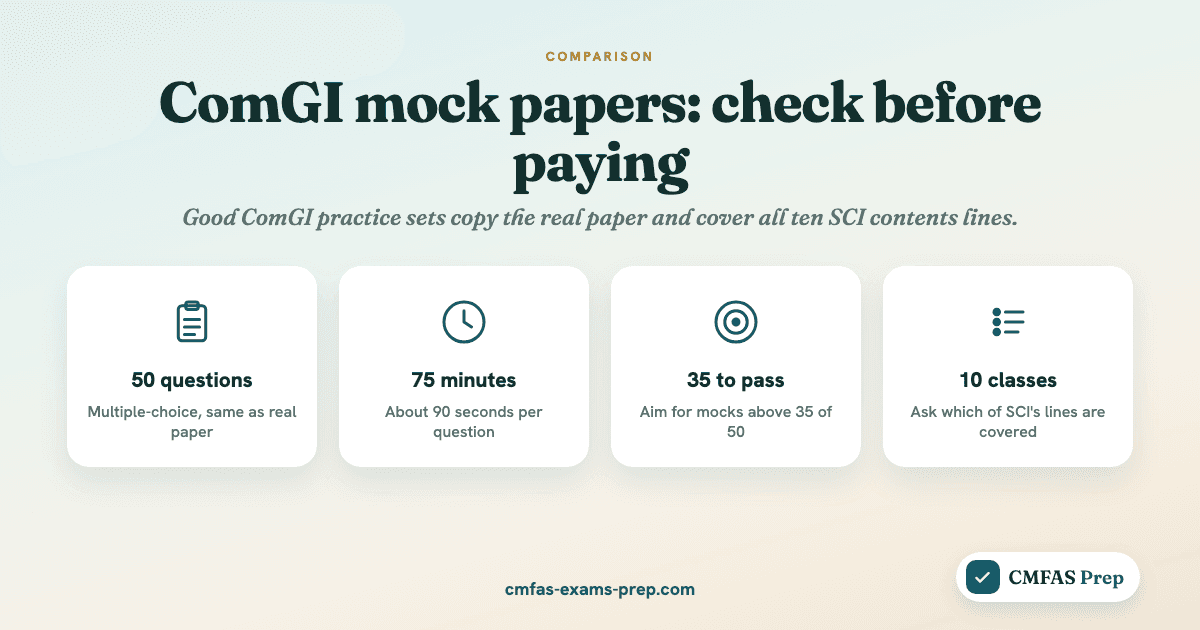
Sit full timed mocks at 50 questions in 75 minutes, and look at the topic scores as well as the total. A pass on the whole paper can hide a line that scored badly. Wait for a run of scores above 35 and no weak line. Then use the ComGI booking guide for SCI's rules on changing a date, and read ComGI practice paper options before you pay for material. The ComGI practice page has timed mocks in this format.
Sources
- SCI, Certification in General Insurance (BCP, PGI and ComGI) exam details and fees, read 2 November 2026
Practise ComGI now
200+ exam-style ComGI questions with instant explanations.
Frequently asked questions
ComGI is the widest of the three general insurance papers and the one most recruits find hardest. The clock is fair at 90 seconds a question, but SCI lists ten lines of business cover, and most are products you may never have handled.
You can miss 15. ComGI has 50 questions and the pass mark is 70%, which is 35 right. A wrong or blank answer loses no extra mark.
SCI lists ten lines: property, business interruption, liability and contingency in two parts, commercial motor, marine and aviation, construction, machinery and bond, pecuniary, foreign worker, and group personal accident with corporate travel.
SCI recommends at least 40 to 50 hours for each general insurance module, and says it depends on you. Over three weeks that is about two to two and a half hours a day, and the upper end suits anyone new to commercial cover.
SCI treats BCP as common to both certifications, so a BCP pass you earned for the personal certification stands for the commercial one too. SCI also puts BCP first in its order.