How hard is the BCP exam? Know before you book
How hard is the BCP exam? 40 questions in 45 minutes, 28 right to pass, a cheap resit and no limit on attempts. Here is where the marks go missing.
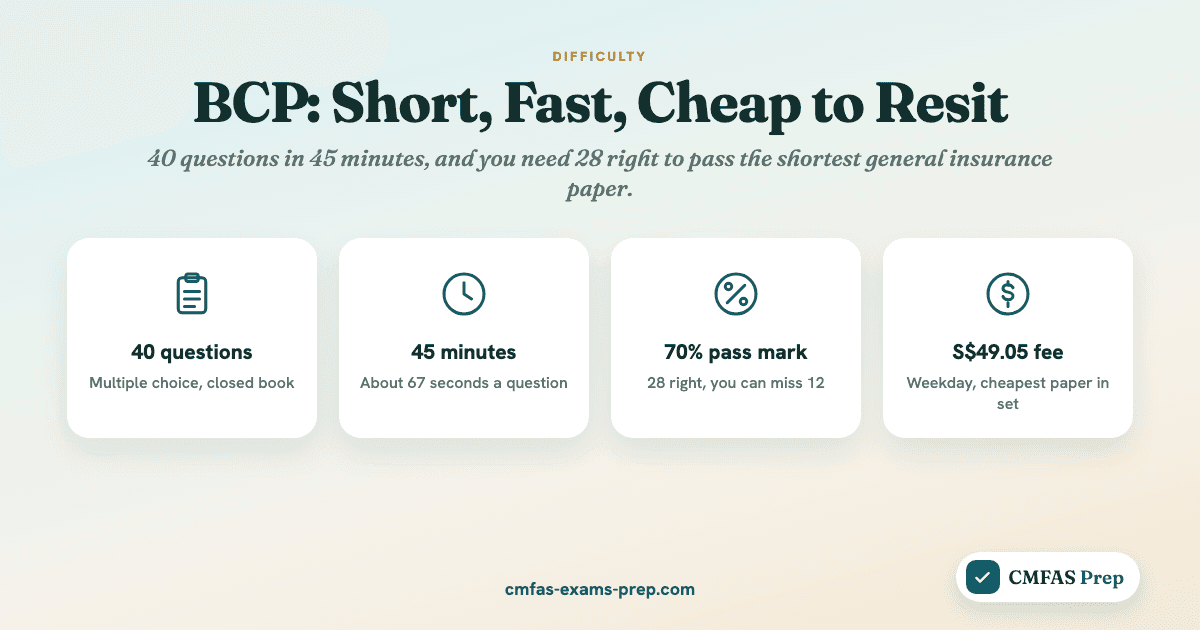
How hard is the BCP exam? It's the shortest of SCI's three general insurance papers and the one with the tightest clock: 40 multiple-choice questions in 45 minutes, and you need 28 right. The difficulty is vocabulary more than volume. If you can tell indemnity from contribution under time pressure, you're most of the way there, and a resit is cheap if you aren't.
The paper in numbers
| What | BCP | What it means |
|---|---|---|
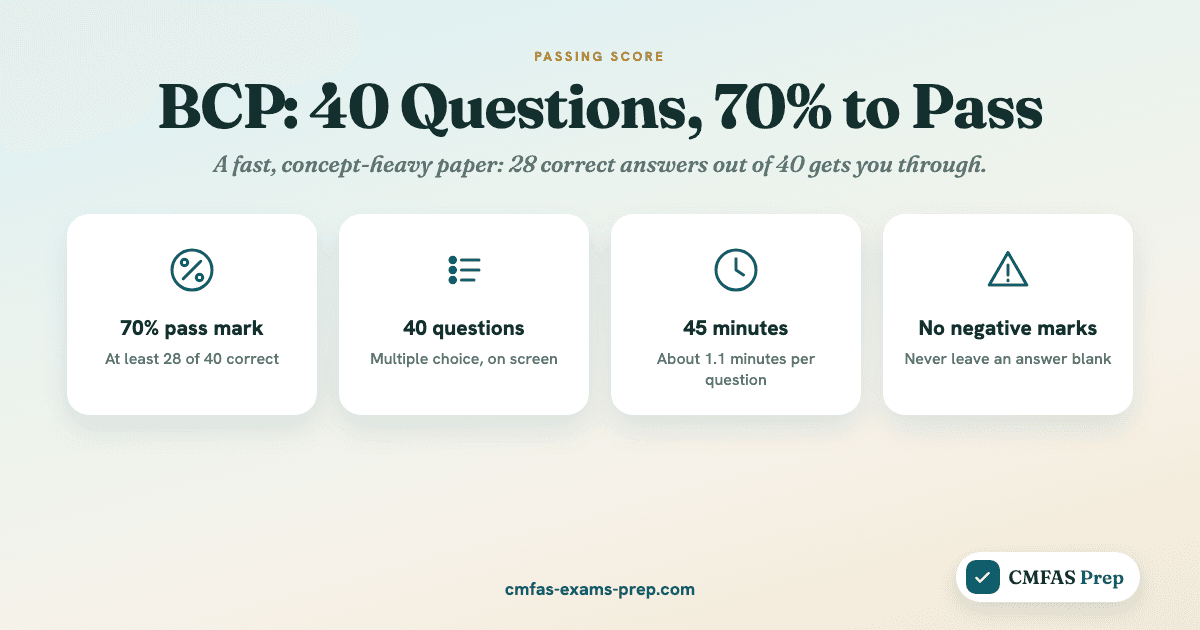
| Questions | 40, multiple choice | You can miss 12 |
| Time | 45 minutes | About 67 seconds a question |
| Pass mark | 70% | 28 right |
| Wrong or blank answer | No mark lost | Answer every question |
| Format | Closed book, on screen | No notes in the room |
| Fee | S$49.05 weekday, S$54.50 after 5pm | The cheapest paper in the set |
SCI doesn't publish pass rates for any paper, so any figure you see for BCP is a guess. What you can judge is the shape of the paper, and the shape is short, fast and unforgiving of weak topics.
Why it feels harder than it looks
Nine topics share 40 questions. SCI lists them as the insurance and reinsurance market, regulation and industry frameworks, risks and insurance, principles of insurance, law of contract and agency, insurance documents, claims, reinsurance and co-insurance, and ethics with data protection and cyber hygiene. SCI doesn't say how the questions divide, so a weak topic costs marks and you can't count on it staying small.
The clock is the second problem. At about 67 seconds a question, a scenario that takes three minutes uses the time of two other questions. Practise reading a scenario once, finding what's being asked, and committing.
The third problem is the study text. SCI's notice puts BCP on the 8th Edition, Version 1.1, for exams from 3 August 2026. Notes from before that date can describe rules that have moved, and the regulation and data protection topics are the likely places. Check the Version Control Record at the back of your eBook, and read where the textbook is out of date before you trust older notes.
Why it's easier than it sounds
A few things work in your favour:
- A wrong answer costs nothing beyond that question, so a guess is always better than a blank.
- A resit costs S$49.05 on a weekday, and BCP has no registration fee inside it, unlike PGI and ComGI.
- SCI sets no limit on attempts, and your result appears when you finish.
- SCI says candidates can self-study for this closed-book paper, with the eBook as the study text.
Put together, BCP is the paper where a fail costs the least. That's a reason to take it seriously and a reason not to panic. It's also the foundation of the set. SCI says BCP forms the base for the other modules and should preferably come first, so what you learn here pays back in PGI or ComGI.
Where the marks go missing
SCI doesn't release question statistics, so this comes from how the topics are built rather than from data. Three habits cost marks on a paper like this.
The first is mixing terms that sound alike. Indemnity, contribution and subrogation all deal with who pays what after a loss, and they get mixed up when you've only memorised definitions. Practise by asking which one applies in a short scenario, then say why the other two don't.
The second is skimming the contract and agency material because it feels like common sense. An insurance contract has to be formed properly before any of the claims rules matter, and a question can turn on whether a person acted as an agent for the insurer or for the customer. The words in the stem decide the answer.
The third is spending time on a hard question at the expense of two easy ones. With 12 misses allowed, you can afford to guess on a question that's eating your clock.
How it compares with PGI and ComGI
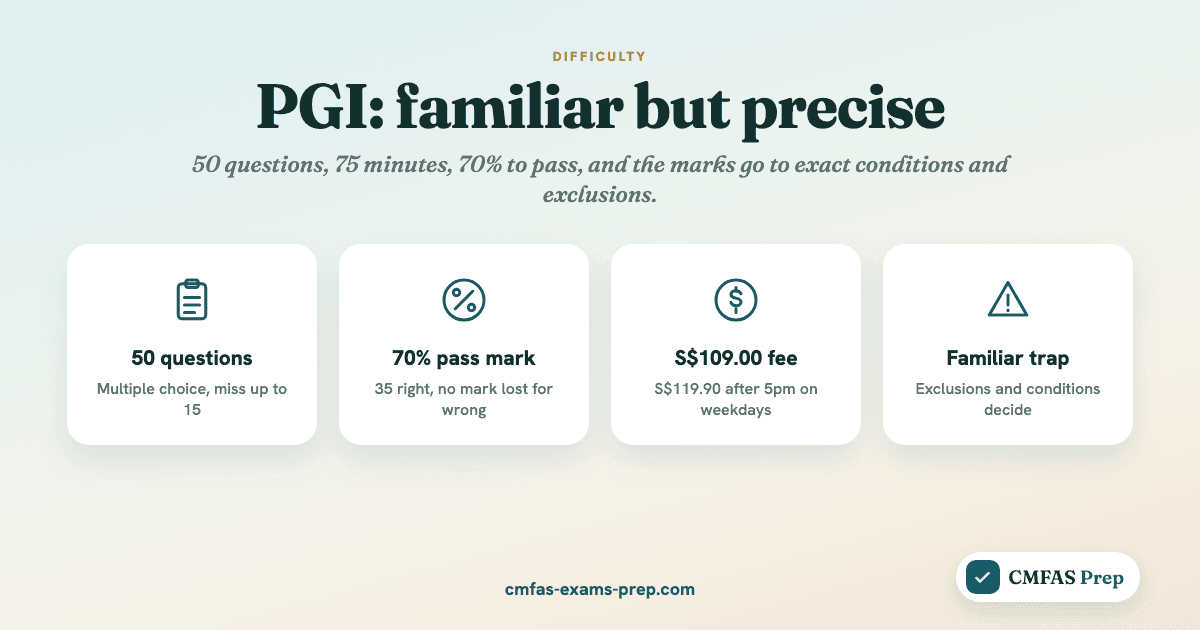
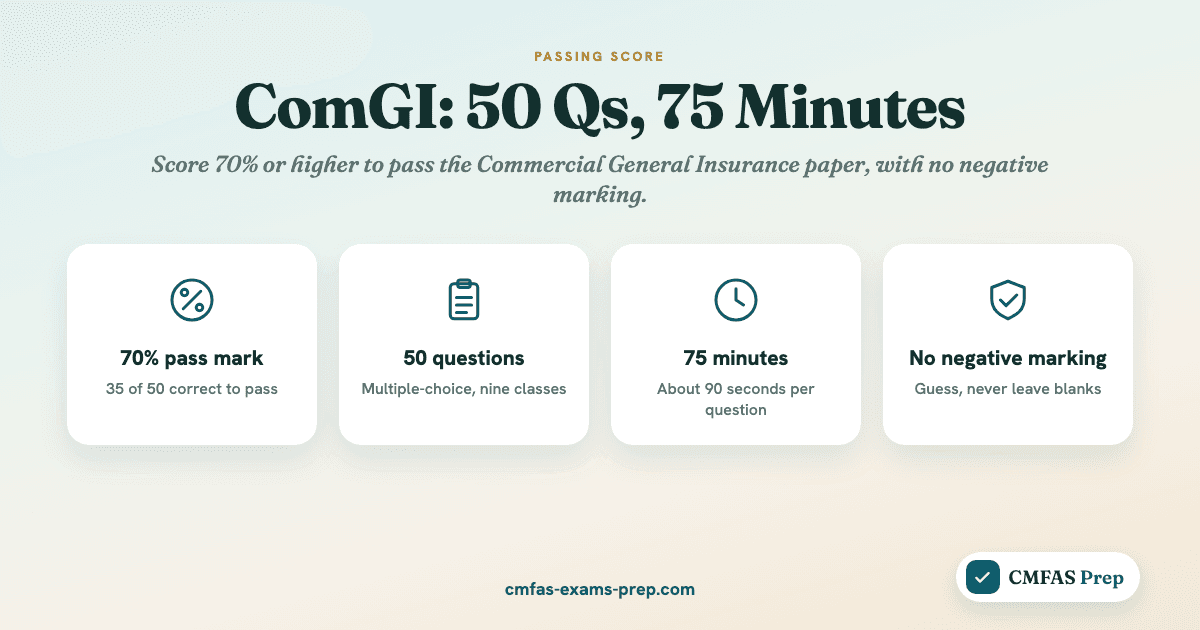
BCP has 40 questions in 45 minutes. PGI and ComGI have 50 each in 1 hour 15 minutes, which is 90 seconds a question. So BCP asks for faster decisions, while the other two ask for more breadth. BCP is abstract: principles, contracts, claims. PGI and ComGI are about products.
For most career switchers, the abstract paper is the unfamiliar one. If you've sold or serviced general insurance before, you already hold half the vocabulary and BCP is mostly about putting precise names to things you do daily.
How long to prepare
SCI recommends at least 40 to 50 hours of study for each module, and says the right amount depends on your experience. Spread over two weeks, that's a little over three hours a day, which is hard around a day job. Three weeks is gentler, at about two hours a day, and it leaves a few evenings free for the mocks that tell you whether the reading has stuck. The BCP study plan shows a two-week version. Read the hours as the floor SCI sets for someone starting fresh, and not as a target to hit.
How to tell you're ready to book
Sit full timed mocks at 40 questions in 45 minutes. One score above 28 proves little. A run of three, comfortably above the line, tells you the content and the clock are both under control. If your misses cluster in one topic, spend your remaining evenings there instead of rereading what you already know.
Then look at your calendar. SCI lets you move the date for free once, until seven working days before the exam, and charges S$32.70 for later changes, so book with a date you can keep. The BCP booking guide covers the rules, and BCP practice paper options helps you choose what to practise on. When you're ready to practise on the real format, see the BCP practice page.
Sources
- SCI, Certification in General Insurance (BCP, PGI and ComGI) exam details, fees and study texts, read 2 November 2026
- SCI, Important notice on new versions of study texts for regulatory examinations, read 2 November 2026
Practise BCP now
250+ exam-style BCP questions with instant explanations.
Frequently asked questions
The difficulty is vocabulary more than volume. BCP is the shortest of the three general insurance papers and has the tightest clock, 40 questions in 45 minutes, and a resit is cheap if it goes wrong.
You can miss 12. BCP has 40 questions and the pass mark is 70%, which is 28 right. A wrong or blank answer loses no extra mark, so answer every question.
SCI recommends at least 40 to 50 hours of study for each general insurance module, and says the right amount depends on your experience. Spread over two weeks that is a little over three hours a day.
You can resit. SCI sets no limit on attempts and charges the same fee as a first attempt, which is S$49.05 on a weekday before 5pm and S$54.50 after 5pm.
BCP has fewer questions, 40 against 50, but less time per question, about 67 seconds against 90. It is abstract rather than product-based, and the cheapest of the three to resit.