CMFAS M8 vs M8A: What is the Difference? (2026 Comparison)
CMFAS M8 vs M8A: What is the difference? Compare Collective Investment Schemes I (Unit Trusts) and II (Derivatives). Learn which is harder, CM-CIS pros/cons, and which to take first.

If you're entering the wealth management or fund distribution industry in Singapore, you've likely come across two similar-sounding exams: M8 and M8A. They're both CMFAS Collective Investment Schemes papers, both administered by SCI, and both have 50 questions.
So what's the difference? And should you take them together as CM-CIS or separately?
TL;DR: M8 vs M8A
- M8: Foundational finance — Unit Trusts, Risk & Return, Time Value of Money
- M8A: Advanced — Derivatives, Structured Products, Case Studies
- Take M8 first (it builds the foundation M8A requires)
- M8A is harder (derivatives are confusing without a finance background)
- CM-CIS: Combined 100 MCQ paper — only recommended if you're confident in both
The Core Difference: Foundations vs. Derivatives
The fundamental distinction is straightforward:
| Exam | Full Name | Focus |
|---|---|---|
| M8 | Collective Investment Schemes I | Financial markets, risk concepts, Unit Trusts |
| M8A | Collective Investment Schemes II | Derivatives, Structured Products, suitability |
M8 teaches you the foundational knowledge of financial markets and products. You'll learn what Unit Trusts are, how to measure risk and return, and the time value of money.
M8A builds on that foundation and moves into complex territory—derivatives (futures, options, swaps), structured products (principal-protected notes, credit-linked notes), and how to assess whether these products are suitable for a specific client.
Exam Format Comparison
| Aspect | M8 | M8A |
|---|---|---|
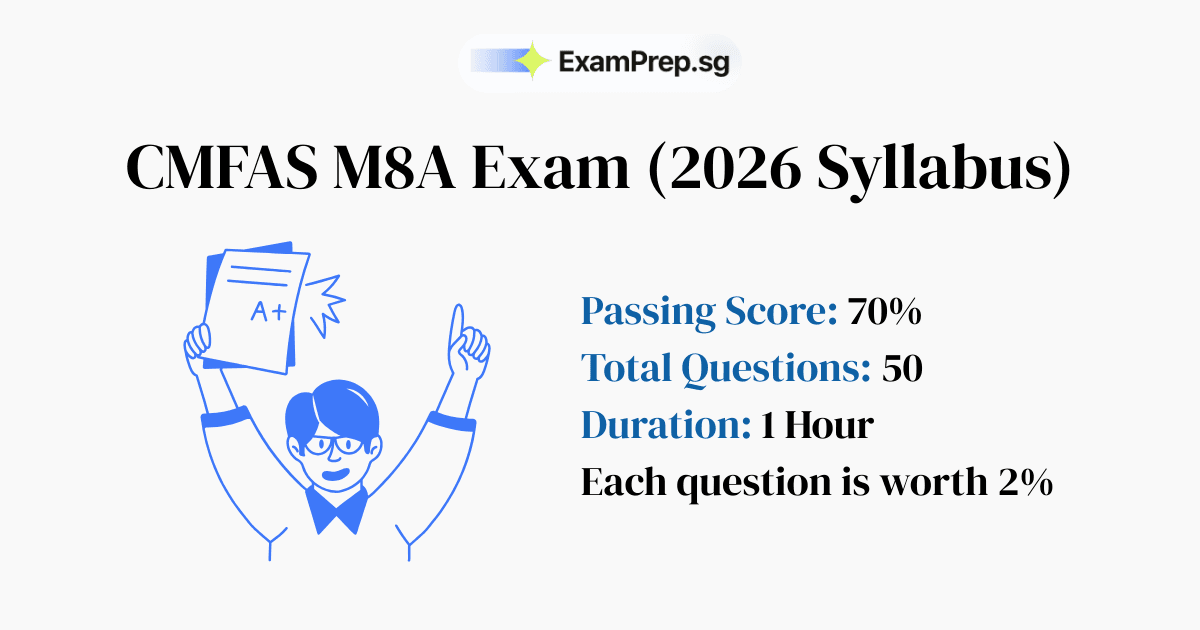
| Questions | 50 MCQs | 50 MCQs |
| Duration | 1 hour | 1 hour |
| Passing Score | 70% (35 correct) | 70% (35 correct) |
| Max Mistakes | 15 | 15 |
| Calculation Questions | 7-10 | 7-10 |
| Chapters | 8 | 6 |
| Exam Body | SCI | SCI |
The format is identical. Same number of questions, same time limit, same pass mark. The difference is entirely in the content and difficulty.
Exam Fees
Both M8 and M8A share the same fee structure:
| Session | SCI/IBF Member | Non-Member |
|---|---|---|
| Day (9am-5pm) | $109.00 | $130.80 |
| Evening (after 5pm) | $127.53 | $149.33 |
Prices exclude GST. Since 1 April 2024, there is no differentiation between first-timer and retaker fees—all candidates pay the same amount per attempt.
Pro Tip: Book a day session and save ~$18. Our data also shows candidates focus better in the morning than after a long day of work.
Syllabus Comparison
M8: 8 Chapters (Foundational)
| Chapter | Topic |
|---|---|
| 1 | Types of Investment Assets - I |
| 2 | Types of Investment Assets - II |
| 3 | Financial Markets |
| 4 | Risk and Return |
| 5 | Time Value of Money |
| 6 | Considerations for Investments |
| 7 | Unit Trusts |
| 8 | Fund Products |
M8 tests your knowledge of CIS features, financial markets, portfolio theory, risk measurement, and Unit Trust regulations. Chapters 4, 5, and 7 are the most challenging.
M8A: 6 Chapters (Advanced)
| Chapter | Topic |
|---|---|
| 1 | Introduction to Structured Products |
| 2 | Risk Considerations of Structured Products |
| 3 | Understanding Derivatives |
| 4 | Introduction to Structured Funds |
| 5 | Examples of Structured Funds |
| 6 | Case Studies |
M8A tests your understanding of derivatives mechanics, structured product construction, and product suitability assessment. Chapters 3-6 are all demanding.
Key Content Differences
| Topic | M8 | M8A |
|---|---|---|
| Unit Trusts | Core topic | Not covered |
| Risk & Return theory | Beta, Sharpe Ratio | Assumed knowledge |
| Time Value of Money | PV/FV calculations | Assumed knowledge |
| Derivatives | Not covered | Core topic |
| Structured Products | Not covered | Core topic |
| Payoff Diagrams | Not covered | Must-know |
| Client Suitability | Basic | Advanced case studies |
Pssst... looking to pass the M8 and M8A exam? CMFAS Prep has you covered with our M8A Mock Exam & Question Bank and M8 Mock Exam & Question Bank.
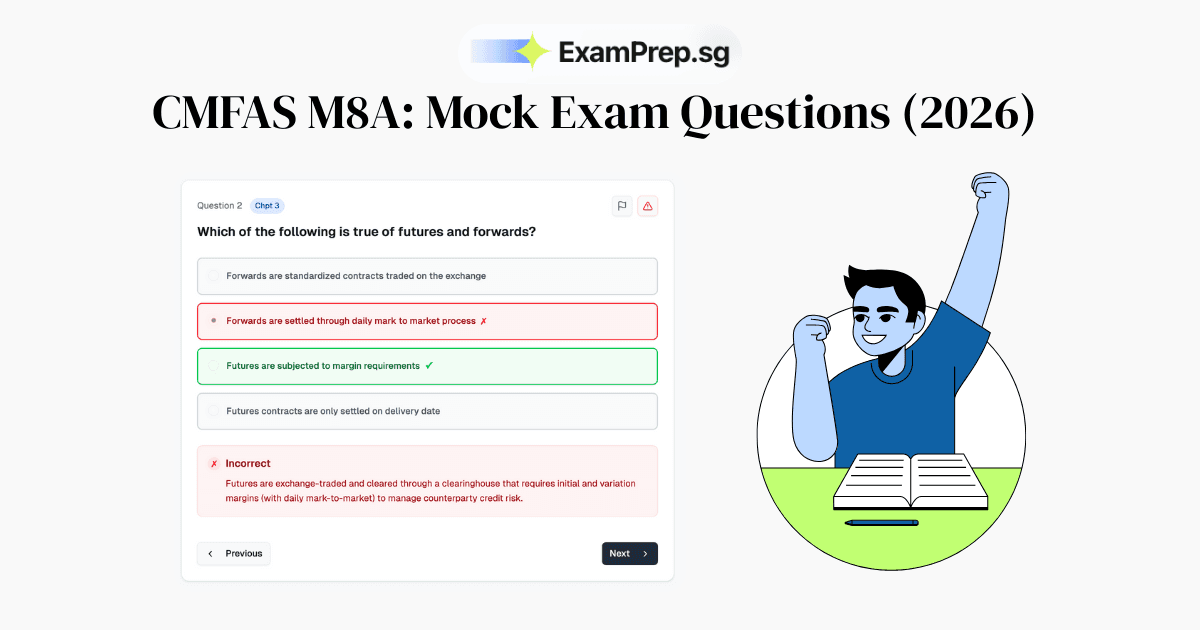
CMFAS Prep provides instant feedback and explanations for every question.
Which Exam Is Harder?
Based on CMFAS Prep's content team sitting for both exams: M8A is harder.
Here's why:
M8 Difficulty
- Math-based but learnable (Beta, Sharpe Ratio, PV/FV are formula-driven)
- Concepts are intuitive if you understand basic finance
- Most questions are factual or calculation-based
- Read our full M8 difficulty breakdown
M8A Difficulty
- Derivatives (futures, options, swaps) can be confusing without a finance background
- Payoff diagrams require visual/spatial reasoning
- Structured products combine multiple concepts at once
- Case studies (Chapter 6) require synthesis and judgment, not just recall
- Read our full M8A difficulty breakdown
Both exams have 7-10 calculation questions. In M8, these are formula-based (plug and solve). In M8A, these require understanding the mechanics of how derivatives and structured products work.
CMFAS Prep provides practice by chapter mode to help you focus on your weak spots.
Should You Take M8 First or M8A First?
Take M8 first. Here's why:
-
M8 builds the foundation. Concepts like risk, return, and fund structures are prerequisites for understanding derivatives and structured products.
-
M8A assumes M8 knowledge. M8A doesn't re-teach beta, standard deviation, or fund pricing—it builds on them.
-
Lock in M8 first. If you fail CM-CIS (combined), you lose your M8 pass too. Taking them separately lets you secure M8 before tackling M8A.
CMFAS Prep provides performance by chapter mode to help you track your progress.
The CM-CIS Option: Combined M8 + M8A
You can take both exams as a single combined paper called CM-CIS (100 MCQs).
| Aspect | Separate | CM-CIS (Combined) |
|---|---|---|
| Questions | 50 + 50 | 100 |
| Duration | 1 hr + 1 hr | 2 hours |
| Pass Mark | 70% each | 70% overall |
| Risk | Fail one, keep the other | Fail = lose both |
| Cost | 2 × exam fee | 1 × exam fee |
When CM-CIS Makes Sense
- You have a strong finance background (degree in finance/banking)
- You're comfortable with derivatives and structured products
- You want to save one exam fee
When to Take Separately (Recommended)
- You don't have a finance background
- Derivatives/structured products are new to you
- You want to secure your M8 pass first
- You prefer lower risk
Our Recommendation: Take Them Separately
Unless you have a strong finance background, take M8 first to lock in the pass, then tackle M8A. The exam fee savings from CM-CIS aren't worth the risk of losing both passes if you fail.
Study Strategy: M8 Then M8A
M8 Study Plan (2-3 Weeks)
| Week | Focus |
|---|---|
| Week 1 | Chapters 1-3, 6 (Investment Assets, Markets) |
| Week 2 | Chapters 4, 5, 7 (Risk, TVM, Unit Trusts) |
| Week 3 | Mock exams + weakness drilling |
Read our full guide: How to Pass CMFAS M8 Exam
M8A Study Plan (3-4 Weeks)
| Week | Focus |
|---|---|
| Week 1 | Chapters 1-2 (Structured Products intro) |
| Week 2 | Chapter 3 (Derivatives — the critical chapter) |
| Week 3 | Chapters 4-5 (Structured Funds) |
| Week 4 | Chapter 6 (Case Studies) + mock exams |
Read our full guide: How to Pass CMFAS M8A Exam
Summary
| Aspect | M8 | M8A |
|---|---|---|
| Full Name | Collective Investment Schemes I | Collective Investment Schemes II |
| Focus | Unit Trusts, Risk & Return, TVM | Derivatives, Structured Products |
| Questions | 50 MCQs | 50 MCQs |
| Duration | 1 hour | 1 hour |
| Pass Mark | 70% | 70% |
| Difficulty | Moderate | Harder |
| Take First? | Yes | After M8 |
| Killer Chapters | Risk (Ch 4), TVM (Ch 5) | Derivatives (Ch 3), Case Studies (Ch 6) |
Not sure where to start? Take M8 first. It builds the foundation you'll need for M8A, and you can secure the pass before moving on to the harder paper.
Want to test yourself? Try our free sample questions for M8 or M8A.
M8 vs M8A FAQs
Ready to Put This Strategy Into Action?
Start with M8 practice, then progress to M8A.
By The CMFAS Prep Team
Singapore's leading CMFAS and SCI exam preparation platform, helping thousands of candidates pass their regulatory exams on the first try.
Practise M8A now
800+ exam-style M8A questions with instant explanations.