Is the CMFAS M8 Exam Difficult? (The "Risk" Chapter Trap)
Is the CMFAS M8 exam difficult? We analyze the "Risk & Return" trap (Chapter 4), the calculation requirements, and why the short syllabus is misleading.
A common mistake candidates make is looking at the M8 textbook and thinking: "It is only 8 chapters. I can study this in one night."
This mindset leads to failure.
While M8 (Collective Investment Schemes) is shorter than M9, it is significantly more technical. It introduces financial concepts—Standard Deviation, Beta, Time Value of Money—that require calculation, not just memorization.
If you don't understand the math behind the definitions, you will fail the application questions (Read our full 2026 M8 study guide here). Not sure how M8 compares to M8A? Read our M8 vs M8A comparison.
Here is a breakdown of the difficulty and the specific chapters that trip everyone up.
TL;DR: Why M8 is "Deceptively" Hard
- The Math: You need to calculate Future Value (FV) and Real Rate of Return.
- The Concepts: "Systematic vs Unsystematic Risk" is the #1 confused topic.
- The Product: You must distinguish between REITs, Business Trusts, and ETFs.
- The Trap: The short book gives you false confidence.
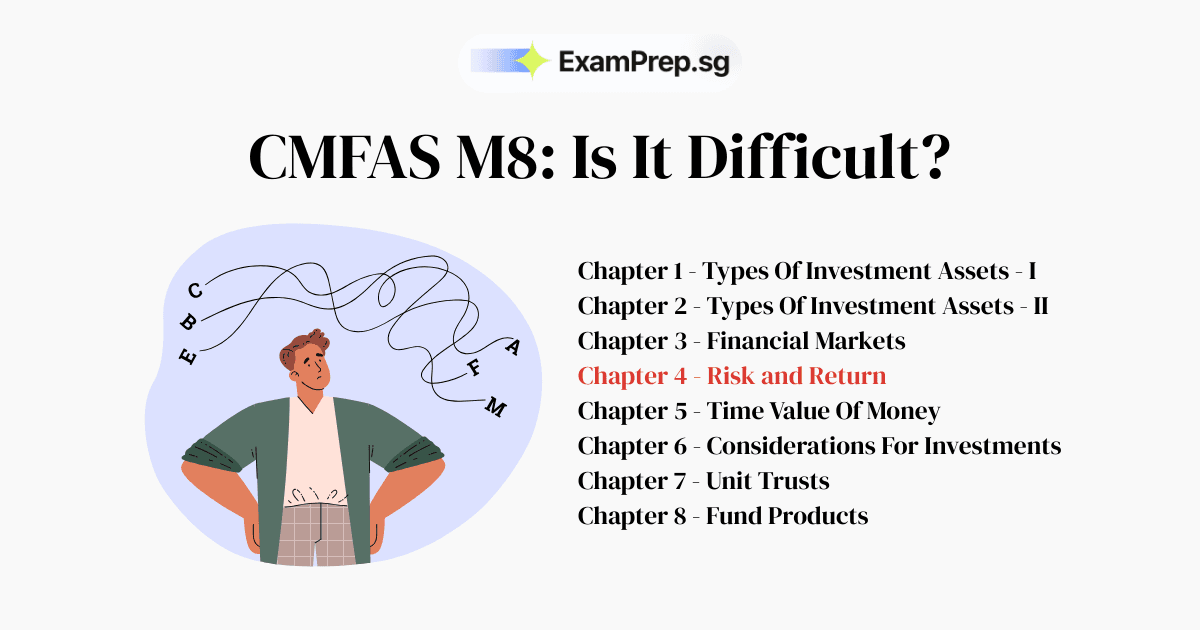
The "Killer" Chapter: Risk & Return (Chapter 4)
This single chapter is responsible for the most lost marks. You are expected to understand:
1. Standard Deviation vs. Beta
-
Standard Deviation measures Total Risk (Volatility).
-
Beta measures Market Risk (Systematic Risk).
-
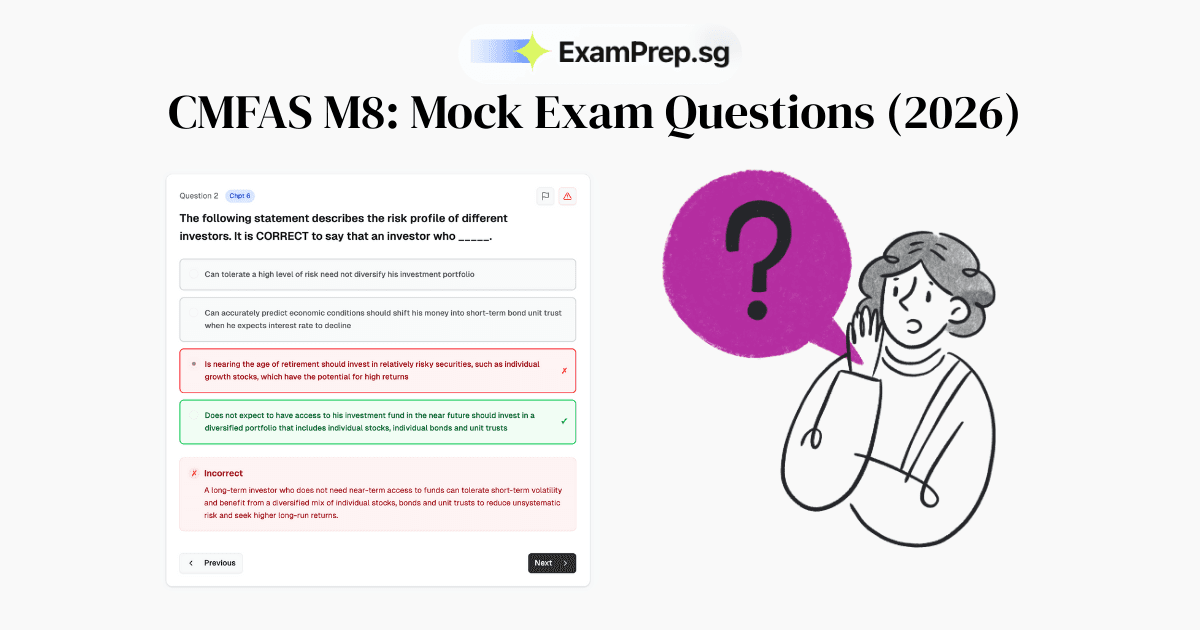
The Exam Trap: A question will give you a portfolio's Beta and Standard Deviation and ask which one indicates it is more volatile than the market index.
2. Systematic vs. Unsystematic Risk
-
Systematic: Market-wide (War, Interest Rates). Cannot be diversified.
-
Unsystematic: Company-specific (Strike, Fraud). Can be diversified.
-
The Exam Trap: "Which of the following risks can be eliminated by diversification?"
We have put together a free mini-mock exam covering the 5 specific question types that trip up most agents.
Confused by Beta and Alpha?
Our platform includes a "Practice by Chapter" mode for you to focus on specific chapters like Chapter 4 (Risk) so you can master these concepts without reading the textbook again.
The "Math" Barrier (Chapter 5)
Chapter 5 (Time Value of Money) is pure calculation.
You will need to solve for Future Value (FV) using the compound interest formula:
> FV = PV x (1 + r)^n
The Trap: The exam often gives you the interest rate per year but asks for the value after 6 months. If you don't adjust "n" and "r" correctly, you will pick the wrong answer.
Don't guess the math. Our platform shows the step-by-step explanation for questions involving calculations.
Conclusion: Don't Rush It
Is M8 difficult? Yes, if you hate math.
It bridges the gap between "Sales" and "Finance."
To pass, you need to stop reading and start calculating. You need to do enough TVM questions that you don't freeze when you see "Compounded Quarterly" (See the M8 exam passing score and format here).
Use CMFAS Prep's "Practice by Chapter" mode to focus on specific chapters.
Don't let the short textbook fool you.
Before you start, read our guide on the best M8 mock exams and study guides here.
Start practicing with our focused M8 study tools today.
Common Questions on M8 Difficulty
Ready to Put This Strategy Into Action?
Master the Risk & Return calculations with our M8 Exam Platform. Start practicing now.
By The CMFAS Prep Team
Singapore's leading CMFAS and SCI exam preparation platform, helping thousands of candidates pass their financial adviser exams on the first try.
Practise M8 now
800+ exam-style M8 questions with instant explanations.